
Enter weeks to find the exact number of calendar days, or switch directions to turn days into weeks.
This includes weekdays and weekends. It does not remove holidays or calculate a date.
This planning estimate does not account for holidays.
This is the full duration divided by 7. A repeating decimal is shown as an approximation.
Only complete 7-day weeks are counted.
This may include part of a day when the entered duration has a decimal.
Table of contents
How to use our Weeks to Days Converter
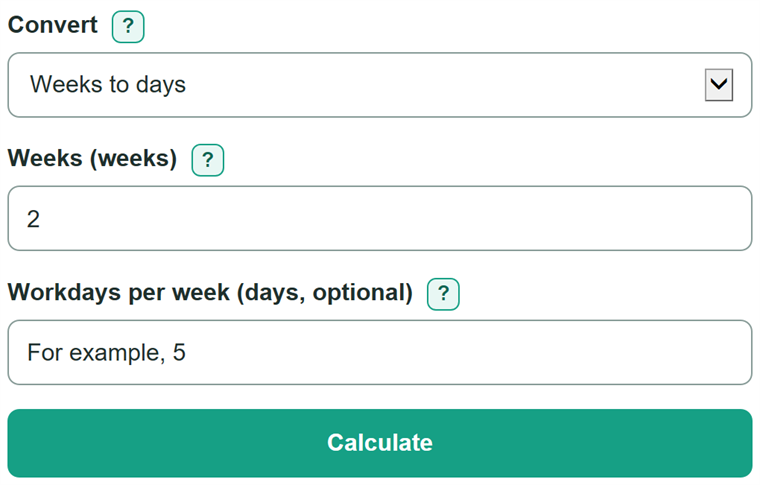
- Choose whether you have a duration in weeks or in days.
- Enter the duration exactly as it appears on your schedule, assignment, trip plan, or worksheet. Decimals are allowed.
- If you want a planning estimate, enter the number of days you work or study in a typical week.
- Click Calculate. Check that the main answer is labeled Calendar days, since it includes weekends.
Definitions
Calendar day: Any day in a seven-day week, including weekends.
Decimal week: A week amount written with a decimal, such as 1.5 weeks.
Complete weeks: Full groups of 7 days in the entered duration.
Days left after complete weeks: The days remaining after full 7-day weeks are removed.
Workdays per week: The number of days you plan to work or study each week. It is used only for the optional estimate.
Common mistakes and quick fixes
Mistake: Treating calendar days as workdays.
Fix: Use Calendar days as the exact conversion. Add Workdays per week only to estimate planned work or study days.
Mistake: Rounding a decimal number of weeks before converting.
Fix: Enter the decimal as written. For example, 2.5 weeks equals 17.5 calendar days.
Mistake: Using a comma as a decimal mark or typing 1,01.
Fix: Use a decimal point for decimals, such as 1.5. Use commas only in thousands groups, such as 1,000.
Mistake: Assuming 4 weeks is one calendar month.
Fix: Four weeks is exactly 28 calendar days. Calendar months have different lengths.
Mistake: Entering more than 7 workdays per week.
Fix: Enter a number from 0 through 7 because a calendar week has seven days.
Limitations & Key Assumptions / Boundary Conditions
- The converter uses the exact relationship that 1 week equals 7 calendar days.
- This converts a duration only. It does not calculate an end date from a start date.
- It does not remove weekends or holidays, and it does not use time zones or clock changes.
- The optional workday estimate uses the weekly number you enter. It is not a business-day count or a deadline.
- Four weeks equals 28 days, but calendar months have different lengths.
- Durations must be 0 or greater; negative durations are outside this converter's purpose.
Methodology
Calculation method
Each week contains exactly 7 calendar days. The calculator keeps decimal durations instead of rounding them to whole weeks or days.
calendar days = weeks x 7
decimal weeks = days / 7
For a days-to-weeks conversion, it counts full 7-day groups and then finds the remaining days.
complete weeks = floor(decimal weeks)
days left = days - (complete weeks x 7)
If Workdays per week is entered, the calculator makes a separate planning estimate. It does not change the calendar-day conversion.
estimated workdays = weeks x workdays per week
For example, 2.5 weeks x 7 = 17.5 calendar days. If you plan 5 workdays each week, 2.5 x 5 = 12.5 estimated workdays. In reverse, 30 days / 7 is about 4.285714 weeks, which is 4 complete weeks and 2 days left.