
Use this calculator to find how much dry water-soluble fertilizer to add for a direct mix or an injector stock tank.
Advanced options
How to use our Water Soluble Fertilizer Calculator
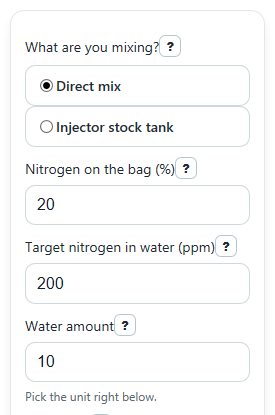
- Choose What are you mixing? and enter Nitrogen on the bag (%) from the first number on the fertilizer grade, such as 20 for a 20-10-20 product.
- Enter Target nitrogen in water (ppm), then enter Water amount and the matching Water unit.
- If you picked injector stock, select the correct Injector ratio; if you want extra nutrient outputs, open Advanced options and add Phosphate on the bag (%) and Potash on the bag (%).
- Click Calculate, then read Dry fertilizer to add first and use What this makes to confirm you solved the right job before weighing fertilizer.
- Sanity-check the result with Quick check: ppm N from 1 oz in 100 gal; if your answer seems far off from a bag table, injector setting, or your own calibration notes, recheck the mode, ratio, and water unit.
Definitions
Nitrogen on the bag (%): The first number in the fertilizer grade. It is the percent nitrogen in the dry product by weight.
Target nitrogen in water (ppm): The nitrogen level you want in the final watered solution. In this calculator, ppm works like milligrams per liter of water.
Water amount: The volume you are mixing. In Direct mix, it is the final solution volume. In Injector stock tank, it is the stock tank size.
Injector ratio: How much the stock solution is diluted. A 1:100 ratio means 1 part stock solution goes into 100 parts final water.
Dry fertilizer to add: The weight of dry fertilizer product to measure out for the mode and volume you selected.
Phosphate on the bag (%): The middle number in the fertilizer grade, reported on US labels as P2O5.
Potash on the bag (%): The third number in the fertilizer grade, reported on US labels as K2O.
Quick reference: 1 ounce of product in 100 US gallons supplies approximately 0.749 times the bag nitrogen percentage in ppm nitrogen: 10% gives 7.49 ppm; 20% gives 14.98 ppm.
Common mistakes and quick fixes
Mistake: Entering the whole bag grade, like 20-10-20, into Nitrogen on the bag (%) .
Fix: Enter only the first number from the grade in Nitrogen on the bag (%) , so 20-10-20 becomes 20.
Mistake: Using Direct mix when you are really filling a stock tank for an injector.
Fix: In What are you mixing? , choose Injector stock tank any time the concentrate will be diluted later by an injector.
Mistake: Forgetting to match Water amount to the selected Water unit .
Fix: If your tank or bucket size is in gallons, pick gallons in Water unit ; if it is in liters, pick liters before you calculate.
Mistake: Reading Injector ratio backward, such as treating 1:100 like 100 parts stock into 1 part water.
Fix: Use the listed ratio exactly as your injector is set. A 1:100 injector means 1 part stock is mixed into 100 parts final water.
Mistake: Expecting Optional phosphate in the final water or Optional potash in the final water to appear when the bag numbers were left blank.
Fix: Enter Phosphate on the bag (%) and Potash on the bag (%) only if you want those companion ppm outputs shown.
Mistake: Treating Dry fertilizer to add as the amount for final water when you are in stock mode.
Fix: In injector stock mode, Dry fertilizer to add is the amount to put into the stock tank size you entered, not directly into the final irrigation water.
Limitations & Key Assumptions / Boundary Conditions
- This calculator uses the fertilizer label percentages exactly as entered, so the answer is only as good as the bag analysis and your input values.
- It targets nitrogen concentration in the final water. It does not adjust for injector calibration errors, uneven draw rate, or line pressure changes.
- Optional phosphate and potash outputs follow the bag-grade ratio and are reported as P2O5 and K2O, not elemental P or K.
- Very large stock-tank amounts may be hard to dissolve fully. Real solubility can vary by product, water temperature, and mixing conditions.
- The quick check output is a shortcut reference for 1 ounce in 100 gallons. It is useful for sanity-checking, but it does not replace the full mode-specific calculation.
- Results assume US liquid gallons when gallons are selected and standard gram-ounce-pound conversions for display.
Methodology
Core idea
The calculator solves for how much dry fertilizer is needed to hit a target nitrogen concentration in the final water. It uses the bag's nitrogen percentage and your water volume. In stock-tank mode, it also multiplies by the injector ratio because the stock is diluted before plants receive it.
Formulas used
mass_g = (target_ppm_n * volume_L) / (10 * n_percent)
mass_g = (target_ppm_n * ratio * stock_volume_L) / (10 * n_percent)
ppm_per_oz_per_100gal = (28.349523125 * 1000 / (100 * 3.785411784) / 100) * n_percent
ppm_p2o5 = target_ppm_n * (p_percent / n_percent)
ppm_k2o = target_ppm_n * (k_percent / n_percent)
volume_L = gallons * 3.785411784
oz = g / 28.349523125
lb = g / 453.59237
Why the direct-mix formula works
In water, 1 ppm is treated as 1 mg/L. A fertilizer labeled 20% nitrogen contains 20 grams of nitrogen per 100 grams of product, which simplifies to 10 times the percent value in mg of nitrogen per gram of fertilizer. That is why the grams needed simplify to target ppm times liters divided by ten times the bag percent.
Worked mini-example
Example: Direct mix, 20% nitrogen fertilizer, target 200 ppm nitrogen, and 10 gallons of final water.
volume_L = 10 * 3.785411784 = 37.85411784 L
mass_g = (200 * 37.85411784) / (10 * 20) = 37.85411784 g
oz = 37.85411784 / 28.349523125 = 1.34 oz
So you would weigh about 37.85 g, or about 1.34 oz, of dry fertilizer. If the bag grade were 20-10-20, the optional companion outputs would be 100 ppm P2O5 and 200 ppm K2O.
How to interpret the quick check
The quick check shows how many ppm nitrogen 1 ounce of that fertilizer would give in 100 gallons of water. For a 20% nitrogen fertilizer, the shortcut is 0.749 x 20 = about 15 ppm N. This is not your final answer unless your actual mix is exactly 1 ounce in 100 gallons. It is there to help you compare your result with common tables and calibration notes.
Assumptions and limits
This method assumes the fertilizer dissolves fully and the injector ratio is the true delivered ratio. Real systems can differ because of injector calibration, settling in stock tanks, and product-specific solubility, so field checks and calibration still matter [2].