
Enter your pressure and solute values to calculate total water potential and, if needed, see which system water tends to move toward.
Advanced options
Table of contents
How to use our Water Potential Calculator
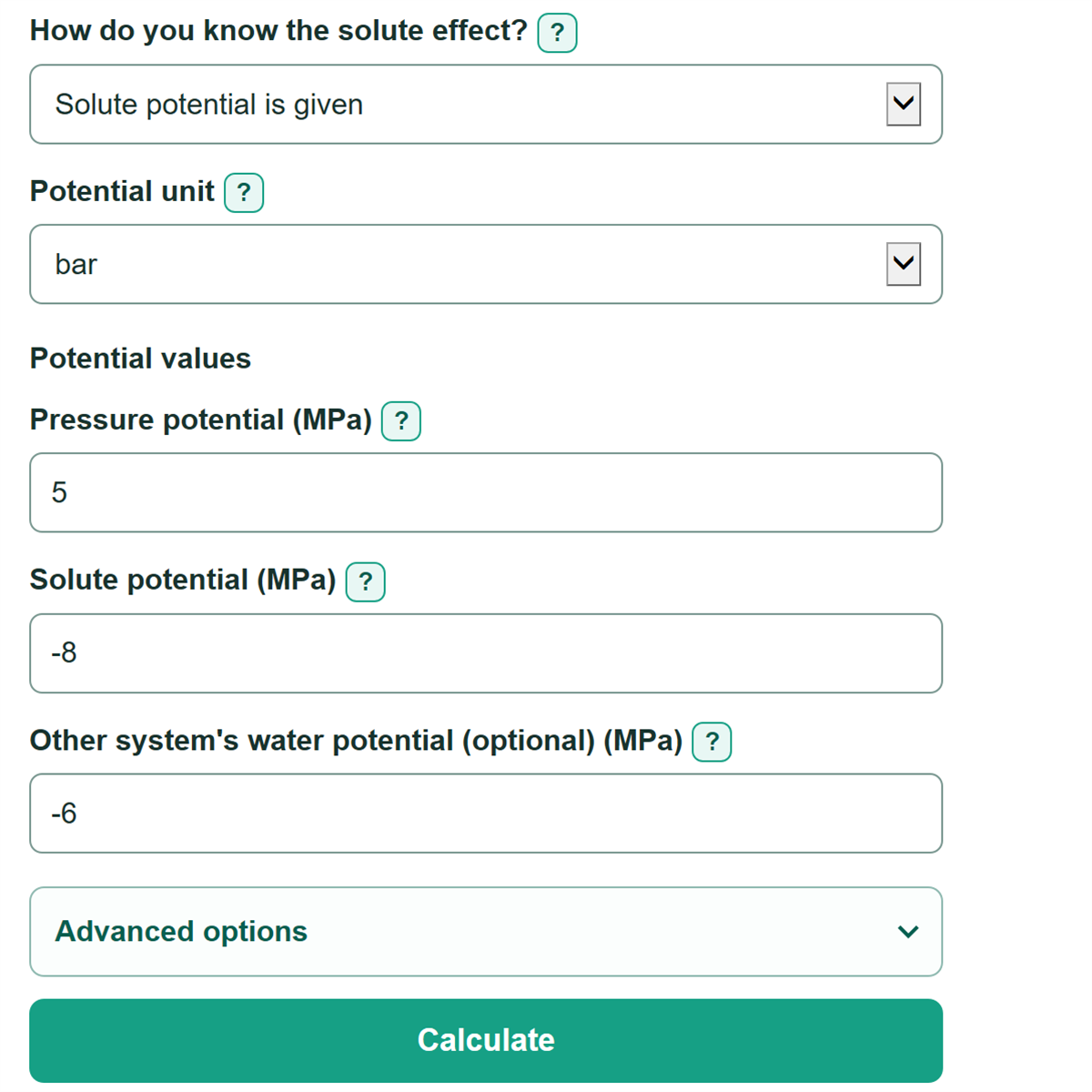
- Choose whether your problem gives solute potential directly or gives concentration, ionization factor, and temperature.
- Select MPa, bar, or kPa to match your worksheet, then enter the signed pressure potential.
- Enter the solute value requested by your chosen method. For concentration, enter mol/L, the ionization factor, and temperature with its stated unit.
- Leave matric and gravitational potential blank unless the problem specifically gives either term, then select Calculate.
- Check that every potential has the intended sign and unit. If you entered another system's total water potential, confirm that water is shown moving from the higher value to the lower value.
Definitions
Water potential (Ψ): A value used to predict the direction water tends to move. A higher value may be less negative, so -0.2 MPa is higher than -0.8 MPa.
Pressure potential (Ψp): The signed effect of physical pressure on water potential. Positive pressure increases the total.
Solute potential (Ψs): The signed effect of dissolved particles on water potential. It is usually zero or negative.
Matric potential (Ψm): A potential caused by water binding to surfaces, such as soil particles or cell walls.
Gravitational potential (Ψg): A height-related potential term used in some plant and environmental problems.
Ionization factor (i): The number of dissolved particles counted per formula unit in the simplified solute calculation.
Molarity (C): Solute concentration measured in moles per liter, written mol/L or M.
Kelvin (K): Absolute temperature. The concentration calculation uses Kelvin rather than Celsius. [1]
Common mistakes and quick fixes
Mistake: Treating -0.8 MPa as higher than -0.2 MPa.
Fix: -0.2 is higher on the number line. In this model, water tends to move from -0.2 toward -0.8.
Mistake: Leaving off the negative sign for solute potential.
Fix: Copy the sign printed in the problem. Solute potential is usually zero or negative.
Mistake: Using 25 as though it were Kelvin in the concentration equation.
Fix: Choose Celsius when the problem says 25 degrees C. The calculator converts it to 298.15 K.
Mistake: Combining values in bar, MPa, and kPa without conversion.
Fix: Select the worksheet's potential unit. A bare number uses that selected unit, while a pasted value with MPa, bar, or kPa is converted.
Mistake: Adding matric or gravitational potential when the problem does not give either term.
Fix: Leave those fields blank. A blank optional term contributes zero.
Mistake: Entering a negative concentration or an ionization factor of zero.
Fix: Enter concentration of 0 or more and an ionization factor greater than 0.
Limitations & Key Assumptions / Boundary Conditions
- The calculator adds only the pressure, solute, matric, and gravitational terms supplied by the problem. It does not derive missing terms from other measurements.
- The concentration method uses the ideal-solution classroom equation. Measured values for concentrated or non-ideal solutions can differ because activity effects are not included.
- The movement statement uses only the entered water potentials. It does not calculate membrane permeability, transport proteins, movement speed, or the amount of water moved.
- A blank matric or gravitational field is treated as zero. Include either term only when the problem explicitly gives it.
- MPa, bar, and kPa are converted before addition, but the two compared systems must still describe compatible conditions from the same problem.
Methodology
Calculation method
Total water potential is the signed sum of the active terms. Most introductory osmosis problems use only pressure potential and solute potential.
Ψ = Ψp + Ψs + Ψm + Ψg
The calculator converts entered potential values to MPa before adding them, then converts the unrounded total to the selected display unit. It keeps positive and negative signs unchanged.
Solute potential from concentration
For the concentration method, Celsius is converted to Kelvin first. The calculator then uses the classroom ideal-solution equation with R = 0.0831 L bar mol^-1 K^-1 and converts the result from bar to the selected potential unit. [1]
T(K) = T(degrees C) + 273.15
Ψs = -iCRT
In this equation, i is the ionization factor, C is concentration in mol/L, R is the gas constant, and T is temperature in K. A concentration of 0 produces a solute potential of exactly zero.
Worked example
Suppose pressure potential is 0.5 MPa and solute potential is -0.8 MPa, with no matric or gravitational term.
Ψ = 0.5 + (-0.8) + 0 + 0 = -0.3 MPa
If the other system is also -0.3 MPa, the gap is zero and the simplified comparison predicts equilibrium. If this system is -0.2 MPa and the other is -0.8 MPa, this system has higher water potential, so water tends to move toward the other system. [1]