
Estimate tankless heater input, storage first hour rating, flow need, and cold-water sensitivity from your busiest shower setup.
Advanced options
Table of contents
How to use our Water Heater Size Calculator
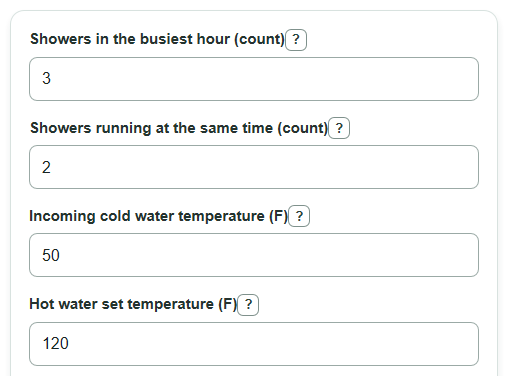
- Enter Showers in the busiest hour and Showers running at the same time using the busiest realistic hour for your home.
- Enter Incoming cold water temperature and Hot water set temperature in F; the set temperature must be higher than the incoming temperature.
- Open Advanced options if you want to change shower gallons, other busy-hour gallons, shower flow, other simultaneous flow, or Tankless heater efficiency.
- Click Calculate and read Tankless heat input needed first, then compare Storage heater first hour rating to shop for and Tankless hot water flow needed.
- Sanity-check the results: a colder Incoming cold water temperature should raise Temperature rise the heater must make and Tankless heat input needed, while more simultaneous flow should raise Tankless hot water flow needed.
Definitions
Storage heater first hour rating to shop for: The hot water, in gallons, a storage tank water heater should be able to supply during one busy hour.
Rough tank-capacity starting point (not a sizing requirement): A rough tank-gallon shopping bucket that is rounded up from the first hour need; it is not the same as the listed first hour rating.
Tankless hot water flow needed: The hot-water flow, in gallons per minute, that may run at the same time.
Temperature rise the heater must make: The number of F the heater must add, found from Hot water set temperature minus Incoming cold water temperature.
Tankless heat input needed: The estimated heater input needed to heat the entered flow by the calculated temperature rise after allowing for Tankless heater efficiency.
Extra tankless heat if incoming water is 10 F colder: The added heater input needed for the same flow if the cold water entering the heater drops by 10 F.
Btu per hour: A heat input rate often used on gas water heaters.
kW: Kilowatts, a power unit often used on electric tankless water heaters; 1 kW is 3412.142 Btu per hour [1].
Common mistakes and quick fixes
Mistake: Using total daily showers for Showers in the busiest hour.
Fix: Count only the showers that may happen in one busy hour, then compare Storage heater first hour rating to shop for.
Mistake: Entering the number of bathrooms in Showers running at the same time.
Fix: Enter only the showers that may actually run together, then check Tankless hot water flow needed.
Mistake: Making Hot water set temperature lower than Incoming cold water temperature.
Fix: Enter a Hot water set temperature above the Incoming cold water temperature so Temperature rise the heater must make is positive.
Mistake: Leaving Tankless heater efficiency blank or entering 0 percent.
Fix: Enter a percent above 0 and no more than 100, because Tankless heat input needed divides by efficiency.
Mistake: Using total mixed shower flow for Hot water flow per shower when you know the hot-water-only flow.
Fix: Use the hot-water portion for Hot water flow per shower, or keep the default only as a planning value.
Mistake: Ignoring Other hot water running at the same time during a dishwasher, sink, or laundry overlap.
Fix: Add that flow so Extra tankless heat if incoming water is 10 F colder reflects the same busy moment.
Limitations & Key Assumptions / Boundary Conditions
- This is a planning estimate for simple residential sizing, not a product selection guarantee.
- Storage tank gallons and first hour rating are different. Confirm the model's listed first hour rating before buying.
- The common storage tank bucket uses 30, 40, 50, 66, 80, and 100 gal planning steps. A first-hour need above 100 gal does not itself require a tank above 100 gal or multiple heaters. Compare each product's first-hour rating with the demand.
- Tankless performance can differ from this estimate because products have flow limits, minimum activation flow, venting or electrical limits, and manufacturer temperature-rise tables.
- Incoming cold water temperature can change by season and location. The 10 F colder output is a simple sensitivity check, not a ZIP-code climate lookup.
- Shower flow and hot-water share can vary by showerhead, mixing temperature, and user behavior. The default flow is only a starting value.
- This calculator does not check plumbing code, scald protection, recirculation losses, altitude derating, hard-water effects, or installation constraints.
Methodology
How the storage estimate is calculated
DOE Water Heating fact sheet distinguishes first-hour delivery from tank capacity. Recovery rate matters: compare the required first-hour rating with the model's listed rating, rather than treating demand gallons as required tank gallons.
The calculator estimates the busy-hour storage need from showers plus other hot water used in that same hour.
storage_first_hour_rating_needed_gal = showers_busiest_hour * gallons_per_shower_peak + other_hot_water_peak_hour_gal
The Rough tank-capacity starting point (not a sizing requirement) is the first bucket in 30, 40, 50, 66, 80, and 100 gal that is at least as large as the storage first hour rating target. If the target is above 100 gal, the actual target is still shown and the note tells you to compare product first-hour ratings. The bucket is only a rough comparison aid and cannot determine required tank capacity.
How the tankless estimate is calculated
The calculator first adds the hot-water flow that may run at the same time.
tankless_flow_needed_gpm = showers_at_same_time * shower_flow_gpm + other_simultaneous_flow_gpm
It then finds the temperature rise from the set temperature and incoming water temperature.
temperature_rise_f = hot_water_temp_f - incoming_water_temp_f
Tankless heat input uses the common water-heating shortcut factor of 500 Btu per hour per gal per minute per F, divided by efficiency to estimate input instead of heat delivered to the water.
tankless_heat_needed_btu_per_hr = tankless_flow_needed_gpm * temperature_rise_f * 500 / (heater_efficiency_percent / 100)
The colder-water check repeats the same heat-input logic for 10 extra F of temperature rise.
cold_water_10f_extra_btu_per_hr = tankless_flow_needed_gpm * 10 * 500 / (heater_efficiency_percent / 100)
The electric comparison converts Btu per hour to kW using 3412.142 Btu per hour per kW [1].
tankless_heat_needed_kw = tankless_heat_needed_btu_per_hr / 3412.142
Mini-example
With 3 Showers in the busiest hour, 2 Showers running at the same time, 50 F incoming water, 120 F set temperature, 10 gal per shower, 10 gal of other busy-hour use, 2.0 gal per minute per shower, 0 other simultaneous flow, and 84 percent efficiency, the storage first hour rating target is 3 * 10 + 10 = 40 gal. The tankless flow is 2 * 2.0 + 0 = 4 gal per minute. The temperature rise is 120 - 50 = 70 F. The tankless heat input is 4 * 70 * 500 / 0.84 = 166,667 Btu per hour, or about 48.84 kW. If incoming water is 10 F colder, the extra input needed is 4 * 10 * 500 / 0.84 = 23,810 Btu per hour.
The default Hot water flow per shower is editable. A 2.0 gal per minute value is a simple planning value that matches common showerhead flow context [2].