
Estimate how many lights and lumens your stairwell needs based on tread area, landings, fixture output, and light losses.
Advanced options
Table of contents
How to use our Stairwell Lighting Calculator
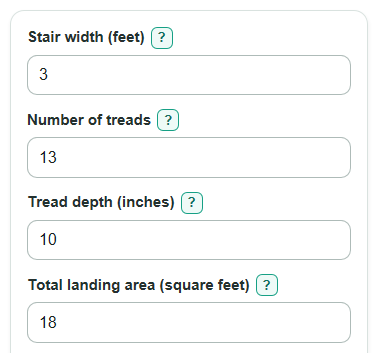
- Enter Stair width (feet), Number of treads, and Tread depth (inches) for the steps that need light.
- Enter Total landing area (square feet) for any top, bottom, or middle landings covered by the same lights.
- Enter Light output per fixture (lumens) from the bulb or fixture label, then adjust Advanced options if you know your target light level, light loss, fixture placement, or energy inputs.
- Click Calculate and read Recommended number of lights first, then check Estimated light on the steps to see whether the rounded fixture count meets your target.
- Sanity-check the result: if Treads plus landings covered looks wrong, fix the area inputs before trusting the light count.
Definitions
Lumens: The amount of light a bulb or fixture makes before losses from dirt, age, or placement.
Foot-candles: Light level on a surface. One foot-candle means one lumen spread over one square foot.
Tread: The flat part of a step where your foot lands.
Total landing area: The combined square feet of the landings that the same stairwell lights need to cover.
Light kept after dirt and age: The percent of fixture light expected to remain after lenses get dirty and light output drops over time.
Light that reaches the steps: The percent of fixture light that lands on the treads and landings instead of walls, ceilings, or open space.
kWh: Kilowatt-hour, a unit your electric bill uses for energy. A 10 watt light running 100 hours uses 1 kWh.
Common mistakes and quick fixes
Mistake: Using wall-to-wall width for Stair width (feet) when rails or trim reduce the walking space.
Fix: Measure the clear step width where people actually walk and enter that value in Stair width (feet).
Mistake: Counting landings in Number of treads.
Fix: Count only the flat step surfaces in Number of treads, then put landings in Total landing area (square feet).
Mistake: Entering tread depth in feet for Tread depth (inches).
Fix: Measure one tread from front edge to back edge in inches, such as 10 or 11, and enter it in Tread depth (inches).
Mistake: Using watts instead of lumens for Light output per fixture (lumens).
Fix: Look for the lumen rating on the package or fixture label, then enter that number in Light output per fixture (lumens).
Mistake: Leaving Light kept after dirt and age (percent) or Light that reaches the steps (percent) at 100 when fixtures are enclosed, dusty, high, or poorly aimed.
Fix: Use lower percents so Total starting lumens to buy includes real-world losses.
Mistake: Treating Estimated electricity cost as a utility quote.
Fix: Enter your real Electricity price ($ per kWh), Power per fixture (watts), and Hours on per day, then use Estimated electricity cost as an approximate yearly cost.
Limitations & Key Assumptions / Boundary Conditions
- This is a lumen method for a simple estimate. It does not replace a photometric lighting layout, code review, or emergency lighting design.
- The calculator treats all treads as the same size. Winder stairs, curved stairs, split stairs, and uneven treads may need a custom layout.
- Fixture placement matters. A light near a wall, behind trim, in a high ceiling, or pointed away from the stairs may deliver less light than estimated.
- Light kept after dirt and age (percent) and Light that reaches the steps (percent) are estimates. If they are too high, the fixture count may be too low.
- Local residential, workplace, rental, and building-code rules can require different light levels, switch locations, emergency lighting, or measured illuminance.
- Estimated electricity use and Estimated electricity cost assume the same fixture count runs at the entered Power per fixture (watts) and Hours on per day all year.
- Very large stairwells, commercial stairs, outdoor stairs, smokeproof enclosures, and code-critical exits should be checked by a qualified lighting or building professional.
Methodology
How the lighting estimate is calculated
The calculator first builds the walking surface area from the treads and the landings. Tread depth is divided by 12 to convert inches to feet.
tread_area_sqft = stair_width_ft * tread_count * (tread_depth_in / 12)
area_sqft = tread_area_sqft + landing_area_sqft
It then finds the maintained light needed on that walking surface. The target is in foot-candles, which are lumens per square foot.
maintained_lumens = target_fc * area_sqft
The starting lumens to buy are higher because not all fixture light remains clean, new, and aimed at the steps.
initial_lumens = maintained_lumens / ((light_loss_percent / 100) * (fixture_use_percent / 100))
The fixture count is rounded up because you can install only a whole number of lights.
fixture_count = ceil(initial_lumens / fixture_lumens)
After rounding up, the calculator estimates the light actually delivered by the recommended fixture count.
delivered_fc = fixture_count * fixture_lumens * (light_loss_percent / 100) * (fixture_use_percent / 100) / area_sqft
Energy estimate
If Power per fixture (watts), Hours on per day, and Electricity price ($ per kWh) are valid, the calculator estimates yearly energy and cost.
annual_kwh = fixture_count * watts_per_fixture * hours_per_day * 365 / 1000
annual_cost = annual_kwh * electricity_price
Worked example
For a 3 foot wide stair with 13 treads, 10 inch tread depth, 18 square feet of landings, 800 lumens per fixture, a 5 foot-candle target, 80 percent light kept after dirt and age, and 60 percent light reaching the steps, the area is 50.5 square feet. The maintained lumens needed are 252.5 lumens, and the starting lumens to buy are about 526.1 lumens. Dividing by 800 lumens per fixture gives 0.66, so the recommendation rounds up to 1 light. With one 800 lumen light, the estimated light on the steps is about 7.6 foot-candles.