
Estimate how many stadium fixtures you need and what brightness, power, energy use, and event cost to expect.
Table of contents
How to use our Stadium Lighting Calculator
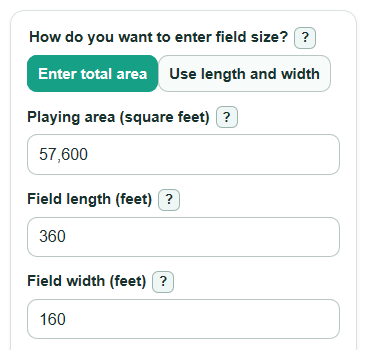
- Choose How do you want to enter field size?, then enter either Playing area (square feet) or Field length (feet) and Field width (feet).
- Enter Target brightness and choose Target brightness unit, using foot-candles for many US field checks or lux when your guide gives lux.
- Enter Light from one fixture (lumens) and Power for one fixture (watts) from the fixture spec sheet, not from a replacement-watt claim.
- Open Advanced options if you have better values for Light that reaches the field (decimal), Light kept over time (decimal), Hours used per event, or Electricity price ($ per kWh).
- After calculating, sanity-check Expected field brightness and Extra brightness after rounding. If the extra brightness is very high, compare a lower-lumen fixture, dimming plan, or a full photometric layout.
Definitions
Lux: Light landing on one square meter of field surface. It is a metric unit of illuminance.
Foot-candle: Light landing on one square foot of surface. It is commonly used in US field-lighting checks and equals one lumen per square foot [4].
Lumens: The amount of visible light a fixture makes. Light from one fixture (lumens) should come from the fixture spec sheet.
Light that reaches the field (decimal): The coefficient of utilization, or the share of fixture lumens that lands usefully on the playing area.
Light kept over time (decimal): The light loss factor, or the share of light expected to remain after dirt, aging, and other losses.
Installed power: The total electrical load of all fixtures, shown in kilowatts.
kWh: Kilowatt-hour, the energy used by running 1 kilowatt of power for 1 hour.
Common mistakes and quick fixes
Mistake: Using total site size in Playing area (square feet), including bleachers, parking, or walkways.
Fix: Enter only the lit playing surface in Playing area (square feet), or use Field length (feet) and Field width (feet) for that surface.
Mistake: Mixing up Target brightness unit, such as entering a foot-candle target while Target brightness unit is set to lux.
Fix: Match Target brightness to Target brightness unit before calculating.
Mistake: Typing fixture watts into Light from one fixture (lumens).
Fix: Use rated lumen output for Light from one fixture (lumens) and input watts for Power for one fixture (watts).
Mistake: Setting Light that reaches the field (decimal) or Light kept over time (decimal) above 1 or at 0.
Fix: Use decimals greater than 0 and up to 1, such as 0.60 and 0.80, unless your lighting plan gives better values.
Mistake: Treating Fixtures needed as a final lighting design.
Fix: Use Fixtures needed as a screening estimate, then review Expected field brightness, Extra brightness after rounding, and a photometric plan for aiming, glare, and uniformity.
Mistake: Reading Estimated cost per event as the full project cost.
Fix: Estimated cost per event only covers energy from Energy used per event and Electricity price ($ per kWh), not installation, demand charges, controls, or maintenance.
Limitations & Key Assumptions / Boundary Conditions
- This is a lumen-method screening estimate. It does not replace a photometric layout with pole locations, mounting height, aiming angles, fixture optics, glare control, spill light, and uniformity checks.
- The result is an average field-brightness estimate. A field can have the right average and still have dark spots or bright glare.
- Light that reaches the field (decimal) and Light kept over time (decimal) are major assumptions. Replace the defaults with project-specific values when you have them.
- Target brightness is entered by the user. The calculator does not choose a sport, league, broadcast class, or code requirement for you.
- Estimated cost per event assumes all listed fixtures run at full power for the whole Hours used per event. Dimming, warm-up behavior, controls, demand charges, taxes, and utility fees can change the bill.
- Very high targets, broadcast sports, and televised events usually need extra checks for vertical illuminance, flicker, camera needs, glare, and light trespass.
Methodology
Core calculation
The calculator first finds the lit area. If you enter total area, that value is used. If you enter length and width, it multiplies them and ignores the hidden total-area field.
area_sqft = field_length_ft * field_width_ft
area_m2 = area_sqft * 0.09290304
Lux and foot-candles both measure illuminance, which means light landing on a surface. A foot-candle is one lumen spread over one square foot [4].
target_lux = target_value when the target unit is lux
target_lux = target_value * 10.7639104167 when the target unit is foot-candles
The required fixture lumens are found by dividing the target field light by the two loss factors. This is why smaller decimal factors increase the fixture lumens needed.
required_fixture_lumens = target_lux * area_m2 / (coefficient_utilization * light_loss_factor)
Fixtures needed is rounded up to a whole fixture count, then the calculator recomputes the expected field brightness from that rounded count.
fixture_count = ceil(required_fixture_lumens / fixture_lumens)
delivered_lux = fixture_count * fixture_lumens * coefficient_utilization * light_loss_factor / area_m2
delivered_fc = delivered_lux / 10.7639104167
target_overage_percent = (delivered_lux / target_lux - 1) * 100
Power and event cost
Installed power is based on input watts for each fixture. Event energy and cost then use the run time and electricity price you enter.
total_power_kw = fixture_count * fixture_watts / 1000
energy_per_event_kwh = total_power_kw * hours_per_event
cost_per_event = energy_per_event_kwh * energy_price
Worked mini-example
With 57,600 square feet, a 50 foot-candle target, 100,000 lumens per fixture, 800 watts per fixture, 0.60 light that reaches the field, and 0.80 light kept over time, the target is about 538.2 lux. The required fixture light is 6,000,000 lumens, so the rounded count is 60 fixtures. The delivered brightness is 50.0 foot-candles, installed power is 48 kW, energy for a 4-hour event is 192 kWh, and the event energy cost at $0.16 per kWh is $30.72.
Calculation choices
Number display style changes only how numbers are shown. It does not change the math. The design note is triggered when the rounded fixture count is far above the target or when the inputs point to a case that deserves a more detailed lighting review. Sports-lighting standards and guides often separate needs by sport, competition level, and spectators, so this calculator keeps the target as a user-entered value instead of guessing it [1].
Sources
- DIN EN 12193 Sports lighting BEGA - BEGA
- Lighting Requirements of Sports Facilities - Trilux
- Virginia DCJS (PDF) - Footcandle: illuminance on a one-square-foot surface from a uniform light source - Virginia
- Fairfax County (PDF) - Athletic Field Lighting draft: foot-candle defined as one lumen uniformly distributed over one square foot - Fairfaxcounty