
Estimate how much battery, solar, and same-time running power your RV devices need each day.
Advanced options
Table of contents
How to use our RV Power Consumption Calculator
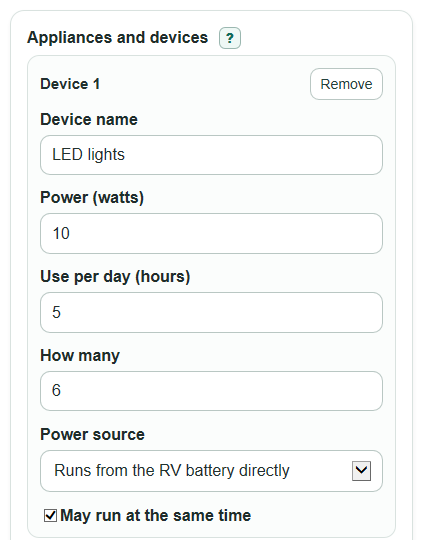
- Add each item in Appliances and devices with its watts, hours per day, quantity, power source, and whether it may run at the same time as other items.
- Enter Battery bank size (Ah), choose Battery system voltage (volts), then enter Solar panel size (watts) and Good sun per day (hours).
- Open Advanced options only if you want to change Usable battery amount (percent), Keep as backup (percent), Inverter efficiency (percent), Solar output after losses (percent), or Days you want without recharging (days).
- Select Calculate and read Battery energy used per day first, then compare Battery use per day with your usable battery amp-hours and Daily solar balance with zero.
- Sanity-check the result: big heat-making appliances should raise Battery energy used per day quickly, AC rows should use a little more battery energy than device energy, and Possible same-time running load should match only the rows you checked as same-time items.
Definitions
Appliances and devices: The table of RV items you want to count, including watts, hours per day, quantity, AC or DC source, and same-time use.
Watt (W): A rate of power use. A 60 W device uses energy faster than a 10 W device.
Watt-hour (Wh): Energy used over time. A 50 W device running for 2 hours uses 100 Wh.
Amp-hour (Ah): Battery capacity or battery use measured as amps over time at a specific voltage.
Battery energy used per day: The daily energy the battery must supply after AC inverter loss is added.
Energy used by your devices: The watts times hours total for the devices before inverter loss.
Inverter efficiency (percent): The share of battery energy that reaches wall-outlet AC devices after DC-to-AC conversion loss.
Good sun per day (hours): The daily sunlight converted into full-strength sun hours, not the number of daylight hours.
Daily solar balance: Solar energy added per sunny day minus Battery energy used per day. Positive is surplus, negative is shortfall.
Possible same-time running load: The total running watts for rows you marked as likely to run at the same time.
Common mistakes and quick fixes
Mistake: Marking a wall-outlet appliance in Appliances and devices as a direct battery load.
Fix: Set that row to the wall-outlet AC choice so Battery energy used per day includes Inverter efficiency (percent).
Mistake: Entering Battery bank size (Ah) for only one battery when several batteries are wired together as one bank.
Fix: Use the total amp-hours for the whole bank at the selected Battery system voltage (volts).
Mistake: Typing total daylight into Good sun per day (hours).
Fix: Use peak-sun-style hours, which are fewer than daylight hours and better match Solar energy added per sunny day.
Mistake: Setting Usable battery amount (percent) to 100 and Keep as backup (percent) to 0 when you want a safety buffer.
Fix: Lower Usable battery amount (percent) or raise Keep as backup (percent) before trusting Estimated battery-only runtime.
Mistake: Reading a negative Daily solar balance as an error.
Fix: A negative Daily solar balance is valid; it means solar is not replacing all of Battery energy used per day.
Mistake: Using Possible same-time running load as a motor starting surge estimate.
Fix: Treat Possible same-time running load and Same-time wall-outlet load as running-watt checks only, then add a surge margin from the appliance or inverter manual.
Limitations & Key Assumptions / Boundary Conditions
- The estimate depends on the watts and hours entered in Appliances and devices. Device labels can show maximum wattage, and real use can be lower or higher.
- Possible same-time running load and Same-time wall-outlet load are running watts only. They do not include short motor, pump, microwave, air-conditioner, or compressor starting surge.
- Solar energy added per sunny day uses Solar panel size (watts), Good sun per day (hours), and Solar output after losses (percent). It does not model shade minute by minute, roof angle, clouds, dirty panels, temperature curves, or charge-controller limits.
- Estimated battery-only runtime assumes Battery bank size (Ah), Battery system voltage (volts), Usable battery amount (percent), and Keep as backup (percent) match your actual battery bank.
- Battery bank needed for your day goal is a planning estimate. Real RV systems also need correct wiring, fuses, charge limits, inverter rating, ventilation, and battery manufacturer rules.
- Rows with 0 watts or 0 hours are allowed, but if total daily use is 0, runtime and sizing results should be treated as N/A rather than unlimited.
Methodology
Energy from each appliance
Each row in Appliances and devices is first converted to daily device energy. The basic method is watts times hours of use, which is the same idea used for appliance energy estimates by the Department of Energy [1].
row_device_wh = watts * hours_per_day * quantity
AC wall-outlet rows are then adjusted for inverter loss. DC rows are not adjusted because they run from the RV battery system directly. RV inverter loads commonly need a loss allowance [2].
if power_source is ac: row_battery_wh = row_device_wh / (inverter_efficiency_percent / 100)
if power_source is dc: row_battery_wh = row_device_wh
Daily battery and amp-hour results
The calculator adds all row totals. Device energy is useful for comparing appliances. Battery energy is the main off-grid planning number because it includes inverter loss for AC rows.
daily_device_wh = add all row_device_wh
daily_battery_wh = add all row_battery_wh
amp_hours_per_day = daily_battery_wh / battery_voltage
Battery runtime and battery size
Usable stored energy starts with the battery bank rating, then applies Usable battery amount (percent) and Keep as backup (percent).
usable_battery_wh = battery_capacity_ah * battery_voltage * (usable_battery_percent / 100) * (1 - reserve_percent / 100)
battery_runtime_days = usable_battery_wh / daily_battery_wh
battery_ah_needed = (daily_battery_wh * desired_off_grid_days) / (battery_voltage * (usable_battery_percent / 100) * (1 - reserve_percent / 100))
Solar replacement
Solar is estimated with panel rating, Good sun per day (hours), and Solar output after losses (percent). Daily solar balance stays signed so a shortfall is shown as a negative number.
solar_daily_wh = solar_panel_watts * peak_sun_hours * (solar_output_percent / 100)
net_wh_after_solar = solar_daily_wh - daily_battery_wh
solar_watts_needed = daily_battery_wh / (peak_sun_hours * (solar_output_percent / 100))
Same-time running watts
The same-time checks add only rows marked as likely to run together. They are running-watt checks, not surge checks.
same_time_running_watts = add watts * quantity for rows where same_time is true
same_time_ac_watts = add watts * quantity for rows where same_time is true and power_source is ac
Worked example
Using the default rows, device energy is 885 Wh/day. The laptop charger uses 65 W for 3 hours, so its device energy is 195 Wh; at 90% inverter efficiency, its battery energy is 216.7 Wh. Total Battery energy used per day is 906.7 Wh/day. At 12 volts, Battery use per day is 75.6 Ah/day. A 200 Ah battery bank with 80% usable and 10% backup has 1728 Wh available, so Estimated battery-only runtime is 1.91 days. A 300 W solar setup with 5 good sun hours and 75% output adds 1125 Wh/day, so Daily solar balance is +218.3 Wh/day.
Safety checks in the math
Percent inputs are divided by 100 before use. Hours per day are limited to 0 through 24. If Battery energy used per day is 0, runtime and battery sizing show N/A instead of infinity. If Good sun per day (hours) or Solar output after losses (percent) is 0, Solar watts needed to break even shows N/A instead of dividing by zero.