
Estimate the absorber face area and added sound absorption needed to move a rectangular room toward your chosen RT60 target.
Advanced options
This is a Sabine planning estimate, not a completed-room measurement.
Calculation details
Table of contents
How to use our Room Reverberation Time and Acoustic Treatment Calculator
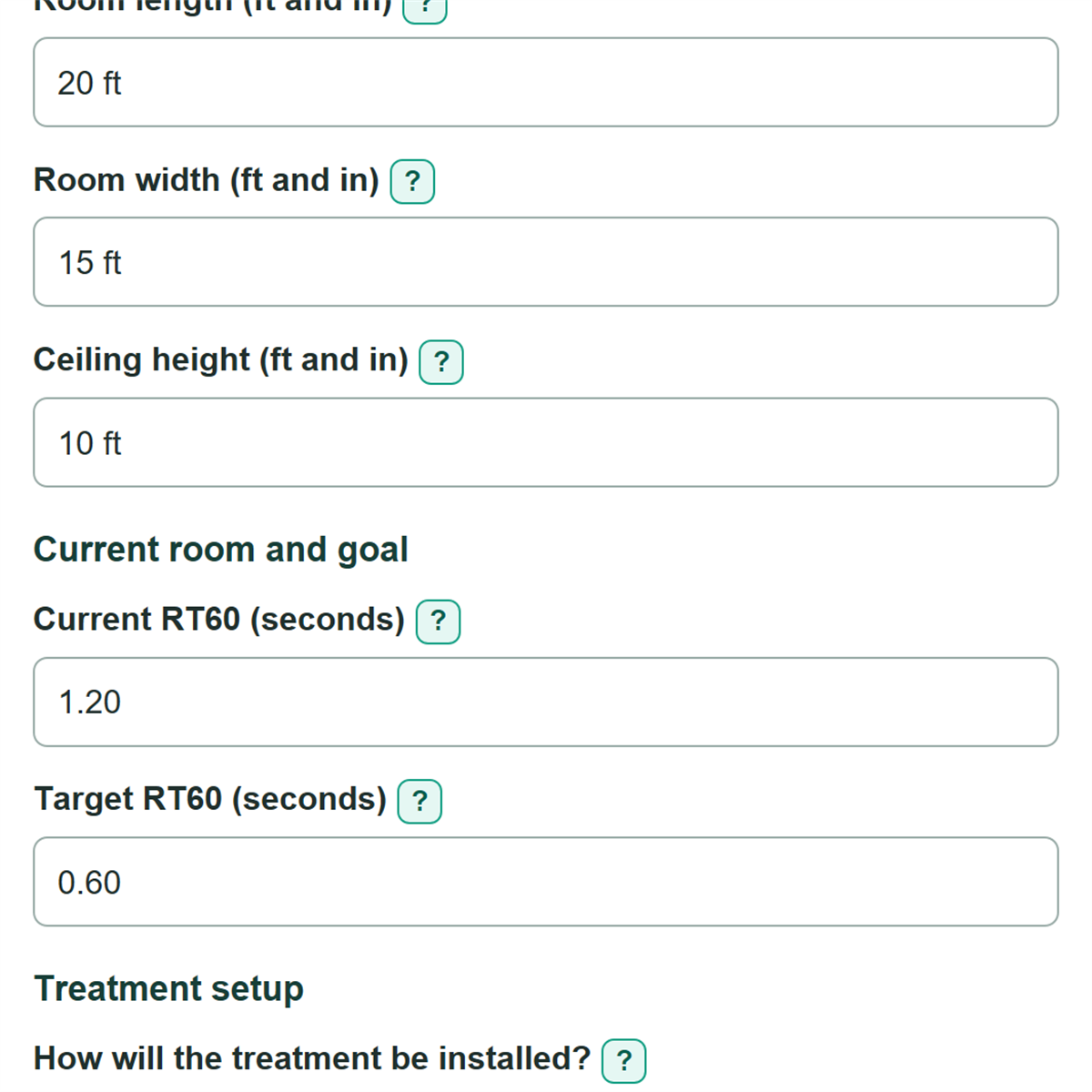
- Measure the inside Room length (ft and in), Room width (ft and in), and Ceiling height (ft and in). Enter values such as 20 ft, 20.5 ft, or 20 ft 6 in.
- Enter Current RT60 (seconds) from a room measurement, then enter the Target RT60 (seconds) from your project goal or specification.
- Choose how the treatment will be installed. Choose Added absorber for separately modeled or freestanding absorption, or Covers a surface when it will replace exposed wall, ceiling, or floor area.
- Copy the Treatment NRC from the exact product data sheet. If you chose Covers a surface, enter the Covered surface absorption value for the finish being covered.
- Calculate, then check that Predicted RT60 after treatment is close to your Target RT60 (seconds). Treat Approximate treatment face area as a planning quantity and round up only after considering panel sizes and placement.
Definitions
RT60: The time, in seconds, for sound energy in a room to drop by 60 decibels after the sound stops.
Target RT60: The decay time you want for this project. It is a project choice, not one universal number for every room.
NRC: Noise Reduction Coefficient, a broad product rating for sound absorption. Copy it from the product data sheet.
Absorption coefficient: A number describing how much sound a surface absorbs in the model. The Covered surface absorption value is subtracted when treatment covers that surface.
Sabin: A unit of equivalent sound absorption. On this calculator's imperial basis, one Sabin equals one square foot of perfectly absorbing area.
Treatment face area: The visible front area of absorbing treatment estimated in square feet, not the entire wall or ceiling area.
Common mistakes and quick fixes
Mistake: Entering outside dimensions instead of inside Room length (ft and in), Room width (ft and in), and Ceiling height (ft and in).
Fix: Measure the enclosed room space from finished interior surfaces.
Mistake: Using a guessed Current RT60 (seconds) as if it were a measured room value.
Fix: Use an RT60 measurement or report for the current room and treat phone readings as rough planning data.
Mistake: Entering an STC rating in Treatment NRC.
Fix: Copy the NRC for the exact treatment product; STC rates sound isolation through a construction, not room absorption.
Mistake: Choosing Added absorber for panels that cover an exposed finish.
Fix: Choose Covers a surface and enter the Covered surface absorption value so the existing finish is not counted twice.
Mistake: Expecting Approximate treatment face area to make the room soundproof.
Fix: Use this result for echo and decay control inside the room; it does not predict noise passing through walls, doors, or windows.
Limitations & Key Assumptions / Boundary Conditions
- The calculation treats the room as a rectangular volume. Sloped ceilings, open doorways, connected spaces, and irregular shapes can change real decay time.
- It uses one broadband Sabine estimate. Real rooms can have very different decay times at bass, middle, and treble frequencies.
- Current RT60 (seconds) drives the estimate. An inaccurate or unrepresentative measurement produces an inaccurate treatment quantity.
- Treatment NRC is a broad rating and may not predict the product's low-frequency absorption, mounting effect, air gap effect, or installed performance.
- For Covers a surface, the Covered surface absorption value must describe the finish being covered on a comparable frequency basis. The calculator blocks a treatment NRC that is not greater than that value.
- If Target RT60 (seconds) is longer than Current RT60 (seconds), adding absorption cannot reach it. The calculator shows zero treatment area and retains the negative signed absorption change.
- The result estimates reverberation control inside the room. It does not estimate soundproofing, speech privacy, or noise transfer through the building.
Methodology
Sabine calculation
The calculator first converts each room measurement to decimal feet, then models the room as a rectangular box. It uses the imperial Sabine coefficient 0.049 with volume in cubic feet and absorption in Sabins.
room volume = room length x room width x ceiling height
current room absorption = 0.049 x room volume / Current RT60
target room absorption = 0.049 x room volume / Target RT60
signed absorption change = target room absorption - current room absorption
Treatment accounting
Added absorber treats each square foot of treatment face as adding its Treatment NRC in Sabins. Covers a surface subtracts the Covered surface absorption value first because the treatment replaces the exposed surface in this model.
net treatment absorption = Treatment NRC
net treatment absorption, covers a surface = Treatment NRC - Covered surface absorption value
treatment face area = signed absorption change / net treatment absorption
If the signed absorption change is zero or negative, treatment face area is shown as 0 because adding absorption cannot create a longer RT60. The signed absorption result remains negative instead of being hidden.
Worked example
A 20 ft by 15 ft by 10 ft room has a volume of 3,000 cu ft. With Current RT60 (seconds) of 1.20, implied absorption is 0.049 x 3,000 / 1.20 = 122.5 Sabins. A Target RT60 (seconds) of 0.60 needs 245 Sabins, so the room needs 122.5 additional Sabins. With Added absorber and Treatment NRC of 0.80, the estimated treatment face area is 122.5 / 0.80 = 153.125 sq ft. Applying that area predicts an RT60 of 0.60 seconds before display rounding.
predicted RT60 = 0.049 x room volume / (current room absorption + treatment face area x net treatment absorption)