
Estimate likely rabbit kit colors from both parents' genotype choices, with clear percentages and notes when hidden genes could change the look.
Advanced options
How to use our Rabbit Color Calculator
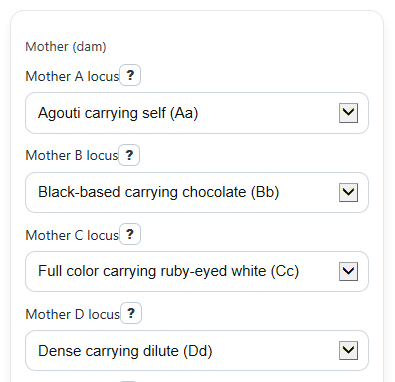
- Choose the five core loci for the mother and father: Mother A locus through Mother E locus, then Father A locus through Father E locus. Each choice includes a plain-English hint like agouti, self, chocolate-based, dilute, or non-extension.
- Open Advanced options if you also know Mother Vienna locus, Father Vienna locus, Mother broken locus, and Father broken locus. Set Show results as to color names, genotype groups, or both.
- Click Calculate to see Most likely kit colors, All possible kit outcomes, Base color breakdown, Pattern and white-marking outcomes, and Example genotype paths.
- Sanity-check the result by looking for simple gene rules: two non-extension (ee) parents should make all kits non-extension, and two ruby-eyed white (cc) parents should make all kits ruby-eyed white in the shown results.
- Read How certain this result is. If certainty is lower, use the suggested loci to learn which extra parent genotype details would narrow the prediction most.
Definitions
A locus: A color switch for agouti, tan pattern, or self/solid. In this calculator, A is agouti, at is tan pattern, and a is self.
B locus: The black-based versus chocolate-based switch. B gives black-based pigment, while bb gives chocolate-based pigment.
C locus: A color-series switch that can keep full color or reduce warm pigment. It is used here for full color, chinchilla, shaded, pointed white, and ruby-eyed white families.
D locus: The dense versus dilute switch. dd dilutes black-based colors toward blue and chocolate-based colors toward lilac.
E locus: A switch that affects how dark pigment extends over the coat. It can lead to extension, steel, harlequin, or non-extension families.
Vienna locus: An optional white-marking factor. Depending on the pair, it can be absent, carried, or homozygous and may affect eye color and white patterning.
Broken locus: The spotting pattern switch. It changes how much white spotting appears, but it does not change the underlying base color family.
Genotype: The allele pair at one or more loci, such as Aa or ee.
Phenotype: The visible color family or pattern name that the genotype produces.
Common mistakes and quick fixes
Mistake: Picking a phenotype name you like instead of the actual genotype option in Mother A locus or Father A locus .
Fix: Match the code and the plain hint together, such as choosing Agouti carrying self (Aa) only if that is the genotype you want to test.
Mistake: Leaving Mother Vienna locus and Father Vienna locus at their defaults, then reading Pattern and white-marking outcomes as proof that Vienna is impossible.
Fix: Treat Vienna results as based only on the values entered. If either parent may carry Vienna, change those fields before trusting the pattern summary.
Mistake: Reading Most likely kit colors as the only possible litter outcome.
Fix: Also check All possible kit outcomes , which includes lower-probability colors that can still appear.
Mistake: Forgetting that Mother broken locus and Father broken locus affect markings, not the base color family.
Fix: Use Base color breakdown for the underlying color genetics and Pattern and white-marking outcomes for broken or Charlie-style spotting effects.
Mistake: Expecting extension-based colors after selecting Non-extension (ee) for both Mother E locus and Father E locus .
Fix: When both parents are ee , read the results as non-extension families only. If you want steel or full extension possibilities, at least one parent must carry a different E-locus allele.
Mistake: Choosing Show results as = genotype groups, then feeling confused by the codes in Example genotype paths .
Fix: Switch Show results as to Both so you can see the genotype groups and the plain color-family labels together.
Limitations & Key Assumptions / Boundary Conditions
- This calculator models the listed loci only: A, B, C, D, E, Vienna, and broken. Other modifiers can change the final look.
- Results assume independent assortment across the modeled loci, so multi-locus probabilities are built by multiplying single-locus probabilities.
- Color names are grouped into neutral families when breed naming can differ. A listed family may cover more than one breeder term.
- If you leave Mother Vienna locus, Father Vienna locus, Mother broken locus, or Father broken locus at defaults, the output reflects those entered values only. It does not prove the traits are absent in real rabbits.
- Several different full genotypes can lead to the same visible color family, so phenotype percentages are often broader than genotype percentages.
- When a parent's real genotype is only partly known, the tool can estimate from the chosen pairs, but certainty stays limited because unmodeled or unknown alleles may still matter.
- Rounded percentages may add to slightly under or over 100%, especially in long outcome lists.
Methodology
How the calculator builds the odds
The tool treats each locus as its own small inheritance problem first, then combines them into full-kit genotype chances. A parent with two different alleles at one locus passes each allele half the time. A parent with two matching alleles always passes that same allele.
P(child genotype) = sum over all compatible gamete pairs of P(gamete from mother) * P(gamete from father)
After that, the calculator combines the locus probabilities across A, B, C, D, E, Vienna, and broken.
P(full genotype) = P(A) * P(B) * P(C) * P(D) * P(E) * P(V) * P(En)
If more than one genotype leads to the same visible color family, those genotype paths are added together into one phenotype percentage.
P(phenotype X) = sum of P(full genotype i) for all genotype combinations mapped to phenotype X
Finally, each probability is converted to a percent for display.
percent = probability * 100
Worked mini-example
Suppose Mother B locus is Bb and Father B locus is bb. The mother can pass B or b with 50% each, while the father always passes b. That gives 50% Bb kits and 50% bb kits at the B locus. If all other loci are fixed to self, full color, dense, and extension, the litter splits into about half black-based self family and half chocolate-based self family.
Another simple check: if both parents are Dd, the D locus gives 25% DD, 50% Dd, and 25% dd. That means about 25% of kits are dilute at that locus if the other needed color conditions are present.
How phenotype labels are assigned
The calculator uses the genotype groups to place kits into practical rabbit color families such as agouti, tan pattern, self, shaded, pointed white, ruby-eyed white, black-based, chocolate-based, dilute, non-extension, Vienna-related, and broken-pattern outcomes [1][3]. It combines duplicate visible outcomes so you do not see the same color family repeated just because several genotype paths can create it.
If you choose genotype-only output, the calculator still explains the main genotype family in plain language so the codes are easier to read.
Certainty and interpretation
How certain this result is is highest when the entered loci tightly determine the visible outcome, such as two cc parents producing 100% ruby-eyed white or two ee parents producing 100% non-extension at the E locus. Certainty is lower when several genotype paths remain possible or when visible naming depends on extra modifiers outside this model.
Assumptions used here
This calculator assumes the entered genotypes are correct, uses standard Mendelian segregation at each listed locus, and does not model every rabbit color modifier described by breeders [1][2][3]. Real litters can look broader or narrower if hidden genes outside these inputs are present.