
Enter your devices to estimate the battery size and output rating a portable power station should have.
Advanced options
Table of contents
How to use our Portable Power Station Size Calculator
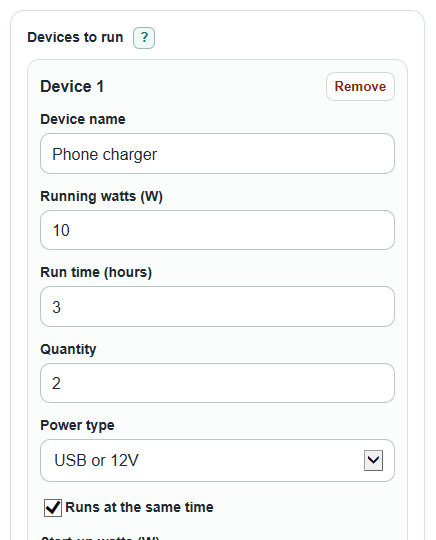
- Add each item under Devices to run, including watts, hours, quantity, AC or DC, whether it runs at the same time, and start-up watts if you know them.
- Open "Advanced options" for battery, inverter, cushion, model-check, solar or "Number display" settings. For solar checks, set "Device-use period (days)" to the number of days covered by your device hours.
- Click Calculate and start with Recommended battery size, then check Minimum continuous output and Suggested start-up output.
- Sanity-check the result: a device with higher watts, longer hours, or more quantity should raise Energy your devices use, and motor start-up watts should raise Suggested start-up output.
Definitions
Watts (W): How fast a device uses power at one moment. A 60 W laptop uses power faster than a 10 W phone charger.
Watt-hours (Wh): How much energy is used over time. The calculator finds this from watts times hours times quantity.
Kilowatt-hour (kWh): A larger energy unit. 1 kWh equals 1,000 Wh.
AC outlet: The household-style outlet on a power station. AC loads pass through an inverter, which can lose some energy as heat [1].
USB or 12V: Direct-current ports often used for phones, lights, routers, and car-style plugs.
Continuous output: The steady watt rating a power station can supply while devices run.
Start-up output: A short burst of power needed by some motors, compressors, pumps, and tools when they first turn on.
Usable battery before recharge: The percent of the rated battery you plan to use before charging again.
Common mistakes and quick fixes
Mistake: Using battery size for Power station output to check.
Fix: Enter the model's continuous output rating in Power station output to check, and enter its Wh rating in Power station battery to check.
Mistake: Mixing up watts and watt-hours in Devices to run.
Fix: Put running watts in the watts column; the calculator uses hours and quantity to find Energy your devices use.
Mistake: Leaving a fridge, pump, or tool start-up surge out of Devices to run.
Fix: Add start-up watts when you know them so Suggested start-up output is not too low.
Mistake: Marking every device as running at the same time when some are used later.
Fix: Only mark same-time devices in Devices to run so Minimum continuous output is not oversized.
Mistake: Setting AC outlet efficiency or USB or 12V efficiency to 100 percent without a reason.
Fix: Use the defaults unless you have tested data, because conversion losses can make Recommended battery size larger.
Mistake: Treating "Daily solar gap" as guaranteed power. Fix: Set "Device-use period (days)" correctly and treat the result as an average energy balance for good sun, not a promise of cloudy-day or overnight supply.
Limitations & Key Assumptions / Boundary Conditions
- The result depends on the watts and hours you enter. Device labels can be rough, and real use can change with brightness, temperature, speed, or duty cycle.
- Recommended battery size uses editable efficiency, usable battery, and cushion settings. A real station may perform better or worse than those assumptions.
- Minimum continuous output is based only on devices marked as running at the same time. If you later run more devices together, the needed output goes up.
- Suggested start-up output is only as good as the start-up watts entered in Devices to run. If start-up watts are blank, check the device manual for motors, compressors, pumps, and tools.
- Power station ports can have separate limits. A station may have enough total output but still overload one AC outlet, USB-C port, or 12V port.
- Solar charging uses panel rating, "Good sun per day" and "Solar charging efficiency". "Daily solar gap" subtracts battery energy needed per day, including AC/DC conversion losses, using "Device-use period (days)". It excludes separate idle draw and charging taper; weather, input limits and the timing of charging and use can change practical results.
- Battery gap for the model checked, Output gap for the model checked, and Daily solar gap can be negative. Negative means the checked model or solar plan falls short by that amount.
Methodology
Core energy math
For each row in Devices to run, the calculator first finds direct device energy before losses.
device_energy_wh = watts * hours * quantity
Rows marked AC use AC outlet efficiency, and rows marked DC use USB or 12V efficiency. These losses explain why Battery energy needed before cushion is larger than Energy your devices use.
battery_energy_before_cushion_wh = sum(ac_device_energy_wh / (ac_efficiency_percent / 100)) + sum(dc_device_energy_wh / (dc_efficiency_percent / 100))
The main answer then accounts for the planned usable battery percent and the Extra cushion setting.
recommended_capacity_wh = battery_energy_before_cushion_wh / (usable_battery_percent / 100) * (1 + extra_cushion_percent / 100)
recommended_capacity_kwh = recommended_capacity_wh / 1000
Output rating math
Battery size in Wh and output rating in W are separate checks. Output is based on devices marked as running at the same time.
minimum_continuous_output_w = same_time_running_watts * (1 + output_cushion_percent / 100)
If any row has start-up watts, the calculator tests the largest momentary starting load. If start-up watts are lower than running watts, running watts are used for that row in the surge check.
recommended_surge_output_w = max(minimum_continuous_output_w, max_for_each_starting_row((same_time_running_watts - running_watts_of_starting_row * quantity_of_starting_row) + max(startup_watts_of_starting_row, running_watts_of_starting_row) * quantity_of_starting_row) * (1 + output_cushion_percent / 100))
Model and solar checks
If you enter Power station battery to check or Power station output to check, the calculator subtracts the recommendation from the model rating. These gaps are not clamped, so a negative value shows a shortage.
model_capacity_gap_wh = model_capacity_wh - recommended_capacity_wh
model_output_gap_w = model_output_w - minimum_continuous_output_w
If "Solar panel size" is entered, estimated solar energy reaches the battery after "Solar charging efficiency" losses. Compare it with "Battery energy needed before cushion" divided by "Device-use period (days)". Reserve and shopping cushion enlarge the recommended battery but are not energy consumed each day.
solar_energy_per_day_wh = solar_panel_watts * peak_sun_hours * (solar_charge_efficiency_percent / 100)
solar_recharge_time_days = recommended_capacity_wh / solar_energy_per_day_wh
solar_daily_gap_wh = solar_energy_per_day_wh - battery_energy_before_cushion_wh / device_use_period_days
Mini-example
A 60 W laptop for 4 hours uses 240 Wh; a 60 W mini fridge for 24 hours uses 1,440 Wh; two 10 W phone chargers for 3 hours use 60 Wh. Total device energy is 1,740 Wh. At 90% AC and 95% DC efficiency, battery energy needed is about 1,929.82 Wh. With 85% usable battery and 20% extra cushion, the recommendation is about 2,724 Wh (2.72 kWh). Together these devices draw 140 W, giving 175 W minimum continuous output with 25% cushion. A 180 W fridge start-up raises suggested start-up output to 325 W.