
Convert total ounces into pounds plus ounces, decimal pounds, total ounces, and grams for labels, recipes, and scale readings.
Table of contents
How to use our Ounces to Pounds and Ounces Converter
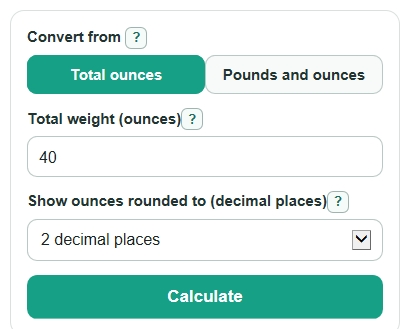
- Use Convert from to choose whether you want to type one total ounce value or a pounds-and-ounces weight.
- If you chose total ounces, enter the weight in Total weight (ounces); if you chose pounds and ounces, enter Pounds part (pounds) and Ounces part (ounces).
- Pick Show ounces rounded to (decimal places) based on your scale or label, such as 0 for whole ounces or 2 for hundredths of an ounce.
- Select Calculate, then read Full pounds in the answer with Ounces left after full pounds as the main mixed-weight answer.
- Sanity-check the result by comparing Same weight as total ounces with your original ounce value, and remember this is for weight ounces, not fluid ounces.
Definitions
Total weight (ounces): The whole weight written only in regular weight ounces.
Pounds part (pounds): The whole-pound part of a weight, before any extra ounces are added.
Ounces part (ounces): The extra ounce part of a pounds-and-ounces weight. Values of 16 or more are allowed and are rolled into pounds.
Decimal pounds: The same weight written as pounds with decimals, such as 2.5 lb.
Remaining ounces: The ounces left after all full 16-ounce pounds are counted.
Avoirdupois ounce: The regular weight ounce used with everyday US pounds. It is different from a fluid ounce and from a troy ounce.
Fluid ounce: A volume unit used for liquids. It is not the same thing as a weight ounce.
Troy ounce: A different weight ounce used in troy weight, which is not the regular pound-and-ounce system used here [2].
Common mistakes and quick fixes
Mistake: Using Total weight (ounces) for fluid ounces from a drink or measuring cup.
Fix: Use this converter only for weight ounces; fluid ounces measure volume, not weight.
Mistake: Leaving Pounds part (pounds) blank in pounds-and-ounces mode.
Fix: Enter a whole number such as 0, 2, or 15 before calculating.
Mistake: Thinking Ounces part (ounces) must be less than 16.
Fix: You may enter 16 or more, and the converter will roll those ounces into full pounds.
Mistake: Choosing 0 in Show ounces rounded to (decimal places) and expecting tiny ounce differences to stay visible.
Fix: Choose 1, 2, or 3 decimal places when your scale shows fractional ounces.
Mistake: Reading Same weight as decimal pounds as pounds plus ounces.
Fix: Use Full pounds in the answer and Ounces left after full pounds for the mixed pounds-and-ounces form.
Limitations & Key Assumptions / Boundary Conditions
- The converter uses regular avoirdupois weight ounces and pounds. It does not convert fluid ounces, troy ounces, or liquid volume.
- All weight inputs must be 0 or more. Negative weights are blocked because the mixed pounds-and-ounces format is meant for physical weights.
- Pounds part (pounds) must be a whole number. Fractional pounds should be entered with Total weight (ounces) instead.
- The mixed answer rounds only the displayed ounce remainder. Decimal pounds, total ounces, and grams are calculated from the unrounded total ounces.
- If rounding the ounce remainder reaches 16 oz, the converter adds 1 full pound and shows 0 oz left.
- Very large numbers can become unsafe in normal JavaScript number math, so the calculator asks for a smaller weight instead of returning a risky result.
- The grams result uses 28.349523125 grams per avoirdupois ounce, so it may differ from labels that round grams to the nearest whole gram.
Methodology
How the conversion works
The converter first finds one total weight in ounces, then turns that total into full pounds plus leftover ounces. It uses 16 ounces per pound for regular US weight measurements [1].
T = total_ounces
This formula is used when Convert from is set to Total ounces.
T = whole_pounds_input * 16 + extra_ounces_input
This formula is used when Convert from is set to Pounds and ounces. The ounces part is allowed to be 16 or more because it is normalized in the final mixed answer.
decimal_pounds = T / 16
whole_pounds_raw = floor(T / 16)
remaining_ounces_raw = T - whole_pounds_raw * 16
Rounding the mixed answer
The calculator rounds only the leftover ounces shown in the mixed answer. If that rounded leftover reaches 16 oz, it carries into the pounds part so the answer does not show something like 1 lb 16 oz.
remaining_ounces_rounded = round(remaining_ounces_raw, ounce_decimals)
if remaining_ounces_rounded >= 16, whole_pounds = whole_pounds_raw + 1 and remaining_ounces = 0
otherwise, whole_pounds = whole_pounds_raw and remaining_ounces = remaining_ounces_rounded
Metric supporting result
The grams result uses the standard avoirdupois ounce-to-gram factor.
grams = T * 28.349523125
Mini-example
If you enter 40 in Total weight (ounces), then T is 40 oz. Dividing by 16 gives 2.5 decimal pounds. The full pounds are 2, and the leftover is 40 - 2 * 16 = 8 oz, so the mixed answer is 2 lb 8 oz. The grams result is 40 * 28.349523125 = 1133.980925 g.