
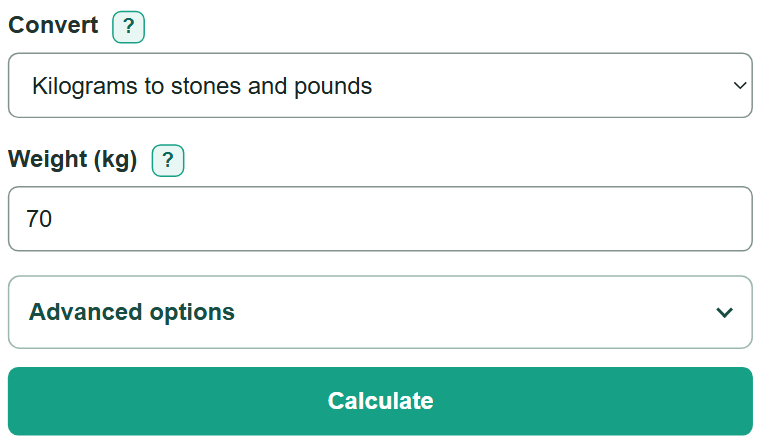
Enter kilograms to see whole stones and remaining pounds, or convert stones and pounds back to kilograms.
Advanced options
Whole stones are shown first, followed by the pounds left over.
This is the entire weight in pounds without separating out whole stones.
The digits after the decimal point are part of a stone, not pounds.
Table of contents
How to use our Kilograms to Stones and Pounds Converter
- Choose "Kilograms to stones and pounds" when your scale, app, record, or form shows kilograms.
- Enter "Weight (kg)" and select "Calculate" to see the mixed weight with whole stones first and pounds left over.
- To convert the other way, choose "Stones and pounds to kilograms" and enter "Stones (st)", "Additional pounds (lb)", or both.
- Check the mixed result: the pound part must be below 14. If rounding reaches 14 lb, the calculator carries it into the next stone.
- Open "Advanced options" if you need more or fewer decimal places in displayed results.
Definitions
Kilogram (kg): A metric unit used for body-weight readings on many scales, apps, and records.
Stone (st): A weight unit equal to 14 pounds. [1]
Additional pounds (lb): The pounds remaining after complete stones are counted. This value is from 0 up to, but not including, 14.
Decimal stones: A weight written as one decimal number of stones, such as 11.5 st. The digits after the decimal point are not a pound count.
Total pounds: The complete weight expressed in pounds without separating it into stones and pounds.
Common mistakes and quick fixes
Mistake: Reading 11.5 st as 11 st 5 lb.
Fix: The decimal part is a fraction of a stone, not pounds. Use the "Weight in stones and pounds" result for mixed weights.
Mistake: Entering 14 or more in "Additional pounds (lb)".
Fix: Add another stone first. Additional pounds must be from 0 up to, but not including, 14.
Mistake: Entering a negative number.
Fix: Enter 0 or a positive weight. Negative weights are not valid for this converter.
Mistake: Typing 1,01 to mean 1.01 kg.
Fix: Use a decimal point for fractions: 1.01. Use commas only for thousands, such as 1,000.
Mistake: Typing a stones-and-pounds reading as one number.
Fix: Choose "Stones and pounds to kilograms" and enter whole stones and additional pounds in their separate fields.
Limitations & Key Assumptions / Boundary Conditions
- The converter uses the international avoirdupois pound and 14 lb per stone.
- It converts the number entered and does not assess health, body composition, clothing weight, or scale accuracy.
- Displayed values are rounded for reading, while calculations use the unrounded converted value.
- In reverse conversion, stones must be whole nonnegative numbers, and additional pounds must be at least 0 and below 14.
- A copied scale reading can differ from another reading if the scale used a different unit setting or rounded its display.
Methodology
Conversion method
The calculator converts the entered weight to total pounds, then separates that total into complete groups of 14 lb and a pound remainder. One pound is exactly 0.45359237 kg, and one stone is 14 lb. [1]
total pounds = kilograms / 0.45359237
whole stones = floor(total pounds / 14)
remaining pounds = total pounds - (whole stones x 14)
For the reverse direction, the calculator combines whole stones and additional pounds before converting the total to kilograms.
total pounds = (stones x 14) + additional pounds
kilograms = total pounds x 0.45359237
Rounding
The pound remainder is rounded only for display. If rounding would produce 14 lb, the calculator adds one stone and displays 0 lb, so the mixed result stays valid.
Worked example
For 70 kg, total pounds are 70 / 0.45359237 = 154.3235835... lb. Eleven stones equal 154 lb, leaving 0.3235835... lb. At two decimal places, the mixed result is 11 st 0.32 lb.