
Estimate your oil change cost, DIY savings, yearly savings, and tool payback using your shop quote and parts prices.
Advanced options
Table of contents
How to use our Oil Change Cost Calculator
- Enter your Shop oil change price ($) as the total amount you would pay for one oil change at a shop.
- Enter Oil needed (quarts), Oil price ($ per quart), and Filter and small parts ($) from your owner's manual, receipt, or store prices.
- Enter Oil changes per year so the calculator can show yearly savings and tool payback time.
- Use Advanced options if you want tax, recycling fees, one-time tools, DIY time, or your time value included.
- Sanity-check the result: if DIY cash cost per change looks too low, make sure a 5-quart jug price was divided into Oil price ($ per quart) and not entered as one quart.
Definitions
Shop oil change price ($): The total price for one oil change at a shop, before comparing it with DIY.
DIY cash cost per change: The out-of-pocket DIY cost for one oil change: oil, filter and small parts, tax, and any recycling or disposal fee.
Cash savings per change: The shop price minus the DIY cash cost. A positive number means DIY saves cash. A negative number means DIY costs more cash.
Cash savings per year: The cash savings per change multiplied by your oil changes per year.
One-time DIY tool cost ($): Tools bought mainly for oil changes, such as a drain pan, filter wrench, ramps, or jack stands.
DIY tools pay back after: How many oil changes, or years, it takes for cash savings to cover the one-time tool cost.
DIY cost with your time: DIY cash cost plus the value of the time you spend on one oil change.
Common mistakes and quick fixes
Mistake: Entering the shop's base advertised price in Shop oil change price ($) but leaving out labor, oil type upcharges, or fees you already know about.
Fix: Use the total price you expect to pay for one complete shop oil change.
Mistake: Putting the full jug price into Oil price ($ per quart).
Fix: Divide the jug price by the number of quarts in the jug, such as $40 divided by 5 = $8 per quart.
Mistake: Guessing Oil needed (quarts) from another vehicle.
Fix: Check your owner's manual, oil cap area, or repair guide, then enter the amount for your engine.
Mistake: Leaving a real drain plug washer, filter, or small part out of Filter and small parts ($).
Fix: Include the oil filter and any small part you replace every oil change.
Mistake: Adding One-time DIY tool cost ($) into DIY cash cost per change by raising the parts price.
Fix: Put tools only in One-time DIY tool cost ($) so the payback result stays meaningful.
Mistake: Treating Savings after valuing your time as cash in your pocket.
Fix: Use Cash savings per change for cash savings, and use the time-adjusted result only when your time has a real personal cost.
Limitations & Key Assumptions / Boundary Conditions
- The calculator uses your entered prices. It does not know your exact vehicle, oil spec, filter part number, local labor rate, or coupon price.
- Shop oil change price ($) should include the real total quote when you know it. A before-fee advertised price will understate shop cost.
- Oil needed (quarts) must come from your vehicle information. Too few quarts makes DIY look cheaper than it is.
- One-time tools are not added to DIY cash cost per change. They are handled only through the break-even results.
- Break-even is shown as not applicable when DIY does not save cash per change, because tool cost cannot be paid back by negative or zero savings.
- The time-adjusted results depend on the Your time value ($ per hour) you choose. If you enter 0, time does not affect the comparison.
- Disposal rules and recycling access vary by location, so enter a Recycling or disposal fee ($) only when you actually pay one.
Methodology
Calculation steps
The calculator first finds the DIY parts cost before tax.
diy_parts_before_tax = oil_quarts * oil_price_per_quart + filter_parts_cost
It then adds tax on those DIY parts.
diy_tax = diy_parts_before_tax * sales_tax_percent / 100
The per-change DIY cash cost adds parts, tax, and any recycling or disposal fee.
diy_cash_per_change = diy_parts_before_tax + diy_tax + recycling_or_disposal_fee
Cash savings keep the sign, so a negative value is not hidden.
cash_savings_per_change = shop_price - diy_cash_per_change
Yearly cash savings use your expected number of oil changes.
annual_cash_savings = cash_savings_per_change * changes_per_year
Tool payback uses the same fixed-cost divided by savings-per-unit idea used in break-even analysis [1]. It is shown only when DIY saves cash per change.
if one_time_tool_cost == 0 and cash_savings_per_change > 0, break_even_changes = 0
else if cash_savings_per_change > 0, break_even_changes = one_time_tool_cost / cash_savings_per_change
else break_even_changes = not_applicable
Tool payback in years divides the oil-change payback count by your oil changes per year.
break_even_years = break_even_changes / changes_per_year
The time-adjusted result adds your time cost for one DIY oil change.
time_adjusted_diy_per_change = diy_cash_per_change + (diy_time_minutes / 60) * time_value_per_hour
Time-adjusted savings compare the shop price with that time-adjusted DIY cost.
time_adjusted_savings_per_change = shop_price - time_adjusted_diy_per_change
Mini example
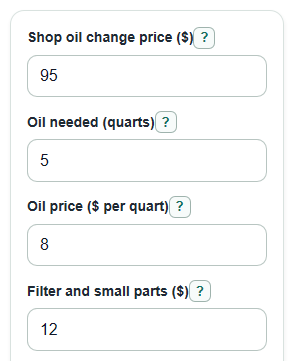
If the shop price is $95, the car needs 5 quarts, oil costs $8 per quart, and the filter and small parts cost $12, then DIY parts before tax are $52. With 0 percent tax and no disposal fee, DIY cash cost is $52. Cash savings per change are $95 - $52 = $43. At 2 oil changes per year, annual cash savings are $86. If one-time tool cost is $0 and DIY saves cash, payback is immediate, so both payback changes and payback years are 0.
Result interpretation
Cheaper choice compares the shop price with DIY cash cost before one-time tools and before time value. Cash savings per change is the best cash-only comparison. Savings after valuing your time is better when you want to treat your time like a cost. Negative savings means the shop is cheaper for that comparison.