
Use this mixed number calculator to add, subtract, multiply, or divide two values and see the simplified answer in three forms.
Advanced options
How to use our Mixed Number Calculator
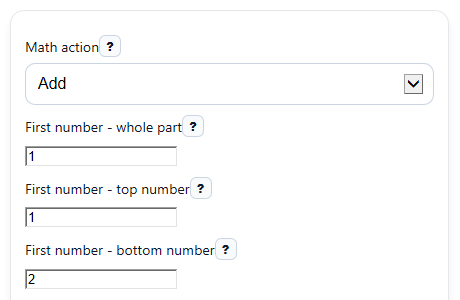
- Choose a Math action, then enter the whole part, top number, and bottom number for each value. Use 0 for the whole part if a value is only a fraction.
- Pick Final answer style to show the main Answer as a mixed number first or an improper fraction first.
- If you want, open Advanced options to choose Decimal places (rounding) and whether to Show worked steps.
- Click Calculate, then read Answer first and compare Mixed number form, Improper fraction form, and Decimal form to make sure they all describe the same value.
- Use First number as an improper fraction, Second number as an improper fraction, Operation step, and Simplify step to check your classwork and catch sign or simplification mistakes.
Definitions
Math action: The operation you want to do: add, subtract, multiply, or divide.
Whole part: The whole-number part of a mixed number, like the 2 in 2 1/3.
Top number: The numerator. It is the number above the fraction bar.
Bottom number: The denominator. It is the number below the fraction bar and cannot be 0.
Mixed number form: A value written as a whole number plus a proper fraction, such as 3 1/2. If the value is less than 1 in size, it may stay a simple fraction.
Improper fraction form: A fraction whose top number is greater than or equal to the bottom number, such as 7/4 [1].
Decimal form: The same value written as a decimal, such as 1.75.
Improper fraction conversion: Rewriting a mixed number as one fraction before doing the operation, such as 1 3/4 = 7/4 [1].
Greatest common divisor: The largest whole number that divides both the numerator and denominator. It is used to simplify a fraction fully.
Common mistakes and quick fixes
Mistake: Entering 0 in First number - bottom number or Second number - bottom number.
Fix: Use any nonzero denominator. A fraction cannot have a bottom number of 0.
Mistake: Typing only the fraction part and forgetting to set First number - whole part or Second number - whole part to 0.
Fix: If the value is just a fraction like 3/4, enter 0 for the whole part and then use top number 3 and bottom number 4.
Mistake: Expecting Divide to work when the second value is 0, such as Second number - whole part = 0 and Second number - top number = 0.
Fix: Change the second value so it is not zero before using Math action set to Divide.
Mistake: Thinking a negative Answer should be rewritten as positive.
Fix: Keep the sign shown in Answer, Mixed number form, Improper fraction form, and Decimal form. A negative result means the full value is below zero.
Mistake: Forgetting that top number can be larger than bottom number in an input, then trying to rewrite it first by hand.
Fix: You can enter it as is. The calculator will normalize it internally and still show a simplified Mixed number form and Improper fraction form.
Mistake: Reading Decimal form as exact when you changed Decimal places (rounding).
Fix: Use Improper fraction form for exact checking, and use Decimal form only as a rounded estimate unless it terminates exactly.
Limitations & Key Assumptions / Boundary Conditions
- This calculator is for two inputs only. It does not combine three or more mixed numbers in one step.
- Both bottom number inputs must be nonzero, or the calculator will show an error instead of a result.
- When Math action is Divide, the second value cannot equal 0. Division by zero is undefined.
- Decimal form is rounded based on Decimal places (rounding), so it may not match the exact fraction perfectly after rounding.
- The calculator treats the sign as applying to the whole value. Keep the fraction part entered as a magnitude unless your teacher wants a different notation style.
- Results are simplified using exact fraction math first, then converted to decimal last. This helps avoid rounding errors, but very large classroom-unusual inputs can still make the display harder to read.
Methodology
How the calculator works
Each input is first rewritten as an improper fraction, then the chosen operation is done with exact integer arithmetic. After that, the result is simplified, converted to a mixed number when needed, and finally shown as a decimal.
Step 1: Convert each mixed number to an improper fraction
improper numerator = sign x (|whole| x denominator + |top number|)
improper denominator = bottom number
This matches the usual mixed-number conversion rule, such as 1 3/4 becoming 7/4 [1]. If a value is negative, the minus sign applies to the whole value, not just the fraction part.
Step 2: Do the chosen operation
a/b + c/d = (a x d + b x c) / (b x d)
a/b - c/d = (a x d - b x c) / (b x d)
a/b x c/d = (a x c) / (b x d)
a/b / c/d = (a x d) / (b x c)
For addition and subtraction, the fractions are rewritten to a common denominator before combining numerators [2]. For division, the second fraction is inverted and multiplied [3].
Step 3: Simplify the fraction
g = gcd(|numerator|, |denominator|)
simplified numerator = numerator / g
simplified denominator = denominator / g
The denominator is kept positive in the final display. If no common factor greater than 1 exists, the fraction is already simplified.
Step 4: Convert to mixed number and decimal
whole = floor(|numerator| / denominator)
remainder = |numerator| mod denominator
decimal = numerator / denominator
If the remainder is 0, the result is a whole number. If the absolute value is less than 1, the mixed-number display stays as a simple fraction. The decimal is rounded only at the end, so the fraction math stays exact.
Mini example
Suppose you add 1 1/2 and 2 1/3.
1 1/2 = (1 x 2 + 1)/2 = 3/2
2 1/3 = (2 x 3 + 1)/3 = 7/3
3/2 + 7/3 = (3 x 3 + 2 x 7) / 6 = 23/6
gcd(23,6) = 1, so 23/6 is already simplified
23/6 = 3 5/6 = 3.833333...
So the calculator shows the same answer in three forms: mixed number, improper fraction, and decimal.
Assumptions used
The method assumes whole-number numerator and denominator inputs, nonzero denominators, and a nonzero second value when dividing. It also preserves negative results instead of forcing them positive, because the sign belongs to the full value.