
Enter a fraction's top and bottom numbers to reduce it to lowest terms and see the number used to divide both.
Table of contents
How to use our Simplifying Fractions Calculator
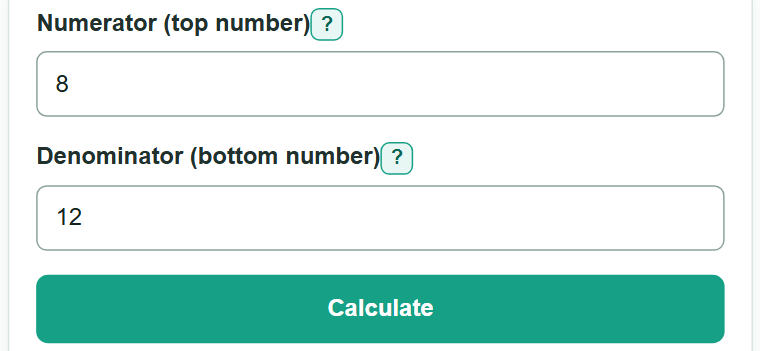
- Enter the numerator, the top number of your fraction, as one whole number. Negative whole numbers and zero are allowed.
- Enter the denominator, the bottom number, as one nonzero whole number.
- Click "Calculate" to see the equivalent fraction in lowest terms first.
- Check the greatest common factor and the reduction sentence to make sure the same number divided the top and bottom terms.
- If the reduced fraction is improper, use the mixed-number form as another way to write the same value.
Definitions
Numerator: The top number of a fraction. It tells how many equal parts are counted.
Denominator: The bottom number of a fraction. It tells how many equal parts make one whole and cannot be zero.
Greatest common factor (GCF): The largest positive whole number that divides both fraction terms evenly.
Lowest terms: A fraction whose numerator and denominator have no shared factor greater than 1.
Improper fraction: A fraction whose absolute numerator is greater than or equal to its positive denominator.
Mixed number: A whole number plus a proper fraction, such as 3 1/7.
Common mistakes and quick fixes
Mistake: Putting the bottom number in the numerator field and the top number in the denominator field.
Fix: Copy the top number into "Numerator (top number)" and the bottom number into "Denominator (bottom number)."
Mistake: Entering 0 as the denominator.
Fix: Use a nonzero bottom number. A fraction with denominator 0 is undefined.
Mistake: Typing a decimal, equation, or full fraction into one field.
Fix: Enter one integer in each field, such as -3, 0, or 8.
Mistake: Dividing both terms by a shared factor that is not the greatest common factor.
Fix: Divide by the greatest common factor to reach lowest terms in one step.
Mistake: Leaving a negative sign in the denominator.
Fix: Move the negative sign to the numerator. For example, 7/-3 is written as -7/3.
Limitations & Key Assumptions / Boundary Conditions
- Each entry must be an integer from -9007199254740991 to 9007199254740991.
- The denominator cannot be zero because division by zero is undefined.
- The calculator simplifies one fraction. It does not add, subtract, multiply, or divide fractions.
- A negative denominator is rewritten with its negative sign on the numerator so the displayed denominator stays positive.
- A zero numerator is valid and is displayed as 0/1 after simplification.
- A mixed number is shown only when the reduced fraction is improper and has a nonzero remainder.
Methodology
How the calculation works
The calculator first moves any negative sign from the denominator to the numerator. It then finds the greatest common factor of the absolute numerator and the positive denominator with the Euclidean algorithm. Dividing both terms by that positive factor keeps the fraction's value the same and produces lowest terms.
normalized numerator = denominator < 0 ? -numerator : numerator
normalized denominator = denominator < 0 ? -denominator : denominator
GCF = gcd(abs(normalized numerator), normalized denominator)
simplified fraction = (normalized numerator / GCF) / (normalized denominator / GCF)
Worked example
For 8/12, the greatest common factor is 4. Dividing both terms by 4 gives 2/3, so 8/12 and 2/3 are equivalent fractions. For 22/7, the greatest common factor is 1, so it is already in lowest terms; it can also be written as 3 1/7.