
Estimate the yearly cost of a merchant cash advance using factor rate, payback amount, payment speed, holdback, and fees.
Table of contents
How to use our Merchant Cash Advance APR Calculator
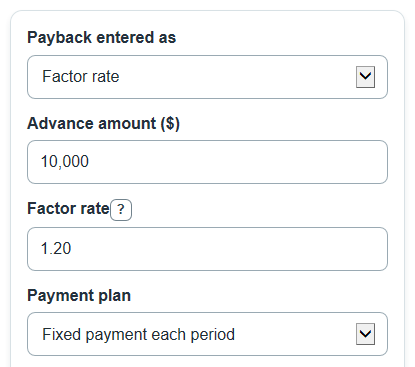
- Choose Payback entered as, then enter either Factor rate or Total payback amount based on the offer you received.
- Enter Advance amount, then choose the Payment plan and Payment frequency that match how the MCA will be collected.
- If the plan uses fixed payments, enter Payment each period; if it uses card sales, enter Average monthly card sales and Holdback from card sales.
- Open Advanced options only if the offer has a Fee charged at funding as a dollar amount or percent of the advance.
- After you calculate, sanity-check the Estimated number of payments, Regular payment used, and Total payback to lender before comparing the IRR-based true APR to another offer.
Definitions
Merchant cash advance (MCA): Business funding that is repaid from future sales or frequent scheduled payments, often with a fixed payback amount rather than normal loan interest [2].
APR: Annual percentage rate, a yearly borrowing cost that can include fees as well as the stated cost of money [1].
IRR: Internal rate of return, a cash-flow method that finds the per-payment rate that makes the cash received equal the value of all payments.
Factor rate: A multiplier used to find total repayment. For example, a 1.20 factor rate on a $10,000 advance gives a $12,000 payback [3].
Holdback from card sales: The percent of card sales taken for repayment. A higher holdback usually pays off the MCA faster if sales stay the same.
Net cash received: The advance amount minus fees charged at funding. This is the cash-flow starting point for the IRR-based APR.
Common mistakes and quick fixes
Mistake: Entering the amount you will repay in Advance amount.
Fix: Use Advance amount for the cash the business receives before fees, and use Total payback amount for the amount repaid to the lender.
Mistake: Typing a percent into Factor rate, such as 20 instead of 1.20.
Fix: Use Factor rate as the multiplier from the offer; a 1.20 factor rate on $10,000 means $12,000 of Total payback to lender.
Mistake: Leaving Payment frequency on daily when the offer collects weekly payments.
Fix: Set Payment frequency to the real collection schedule because it changes IRR-based true APR and Simplified APR estimate.
Mistake: Using gross business revenue for Average monthly card sales when the holdback applies only to card sales.
Fix: Enter the card sales amount used for the holdback, then check Regular payment used for a reasonable dollar amount.
Mistake: Ignoring Fee charged at funding because it is taken out before cash reaches the business.
Fix: Enter the fee in Advanced options so Total financing cost and IRR-based true APR include the reduced cash received.
Limitations & Key Assumptions / Boundary Conditions
- Daily, Monday to Friday uses 252 payments per year and ignores holidays, skipped payments, and bank processing delays.
- Percent of card sales assumes Average monthly card sales stay constant. Real sales changes can shorten or lengthen the payoff time.
- Fees are treated as charged at funding. The calculator does not model later fees, missed-payment fees, renewals, early-payoff discounts, or refinancing.
- The simplified APR estimate is only a rough annualized cost check. It does not account for the balance falling after each payment.
- The IRR-based true APR depends on the exact cash-flow timing and the payment frequency chosen. Different lenders may disclose cost using different rules.
- Tax effects, accounting treatment, legal classification, and the impact on business cash flow are outside this calculator.
Methodology
Calculation method
The calculator first finds the scheduled amount repaid to the MCA provider. If Payback entered as is Factor rate, it multiplies the Advance amount by the Factor rate. If Payback entered as is Total payback amount, it uses that entered amount.
total_payback = advance_amount * factor_rate
Fees charged at funding are added as a dollar fee plus any percent fee on the advance. Those fees reduce the cash the business effectively receives for the IRR calculation.
fees = upfront_fee + advance_amount * fee_percent / 100
net_proceeds = advance_amount - fees
For a fixed payment plan, Regular payment used is Payment each period. For a card sales plan, the calculator estimates a payment from Average monthly card sales, Holdback from card sales, and the selected Payment frequency.
periodic_payment = monthly_card_sales * holdback_percent / 100 / (payments_per_year / 12)
The payment count is rounded up so the last payment can be smaller than the regular payment.
n = ceil(total_payback / periodic_payment)
final_payment = total_payback - periodic_payment * (n - 1)
Total financing cost is the total payback plus funding fees, minus the advance amount. The simplified APR annualizes that cost over the estimated payoff time.
total_financing_cost = total_payback + fees - advance_amount
simplified_apr_percent = (total_financing_cost / advance_amount) * (payments_per_year / n) * 100
For the IRR-based true APR, the calculator solves for the per-payment rate that makes net proceeds equal the present value of the payment schedule. It then multiplies that rate by the number of payments per year. This is an actuarial cash-flow style approach, so repayment speed strongly affects the APR.
net_proceeds = sum(payment_i / (1 + r)^i)
true_apr_percent = r * payments_per_year * 100
estimated_payoff_months = n / payments_per_year * 12
Mini-example
Suppose the Advance amount is $10,000, the Factor rate is 1.20, Payment frequency is Daily, Monday to Friday, and Payment each period is $400 with no funding fees. Total payback to lender is $12,000, Total financing cost is $2,000, and the Estimated number of payments is 30. Using 252 payments per year, the simplified APR estimate is about 168%. The IRR-based true APR is higher, about 307.2%, because the business repays the $12,000 quickly while the effective cash received is $10,000.