
Enter measurement sources as stated to calculate a GUM-style expanded uncertainty budget for independent contributors.
Every sensitivity-adjusted contribution must end in this unit.
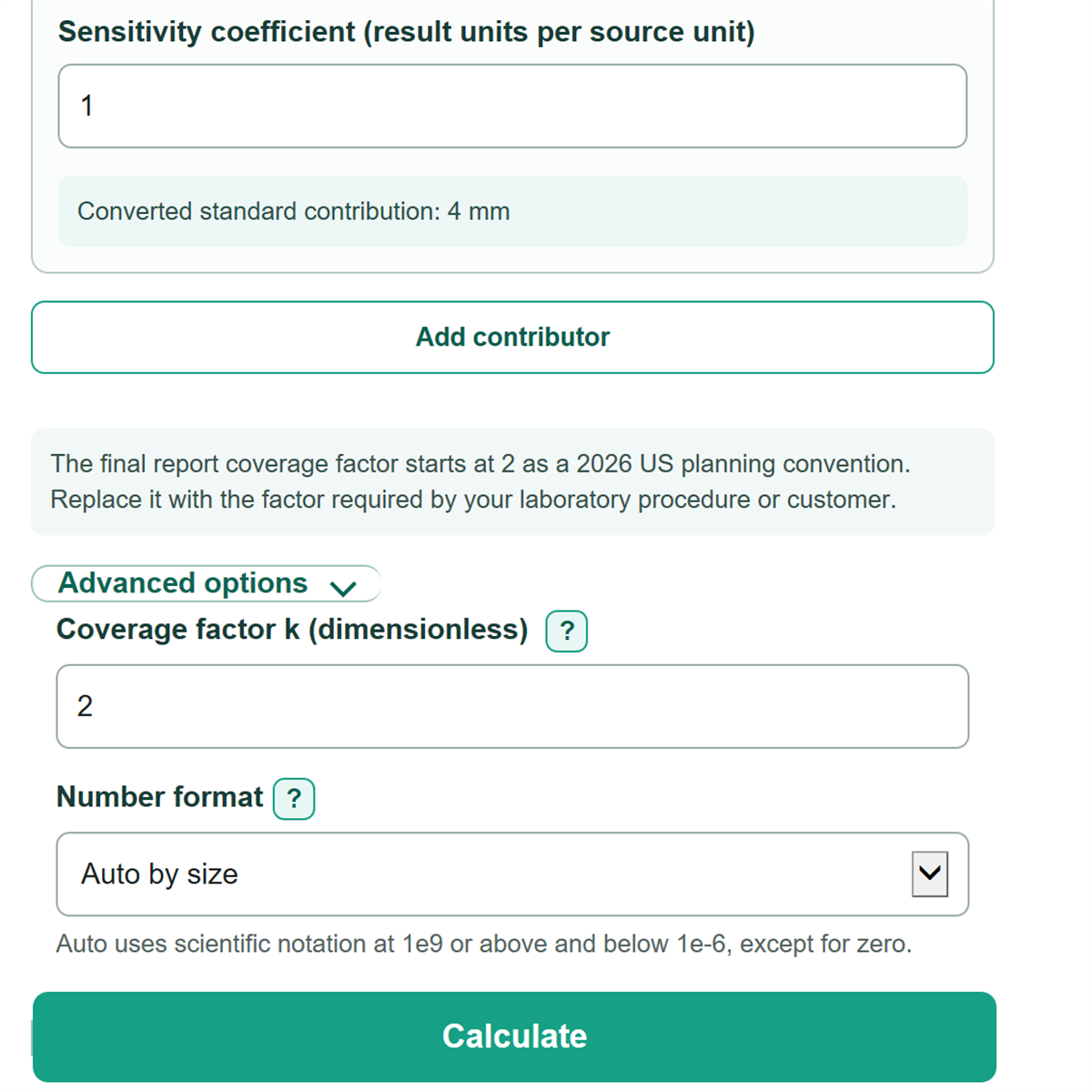
The final report coverage factor starts at 2 as a 2026 US planning convention. Replace it with the factor required by your laboratory procedure or customer.
Advanced options
Auto uses scientific notation at 1e9 or above and below 1e-6, except for zero.
Table of contents
How to use our Measurement Uncertainty Budget and GUM Propagation Calculator
- Enter the Measured value and Result unit exactly as they appear in your record.
- Review each Uncertainty contributors row, choose how the source was stated, and enter its magnitude, required conversion details, and sensitivity coefficient.
- Use Add contributor for each separate source, such as repeatability, a certificate, resolution, or a specification limit.
- Open Advanced options if needed to replace the final Coverage factor k or choose a Number format.
- Click Calculate, then check that the largest contributor and its share match the source you would expect to have the biggest effect.
Definitions
Standard uncertainty: A one-standard-uncertainty estimate for one source before it is combined with other sources.
Expanded uncertainty: Combined standard uncertainty multiplied by the final coverage factor k.
Coverage factor k: A dimensionless multiplier used to report expanded uncertainty. A value of 2 is often used for about 95 percent coverage only under suitable conditions; it is not a guarantee. [1]
Sensitivity coefficient: The multiplier that turns one source's standard uncertainty into its effect in the Result unit. It can be negative or zero.
Variance share: The percent of combined variance caused by one contributor. The largest share identifies the source with the greatest independent effect.
Resolution: The full display step, such as 0.1 mm. This calculator treats rounding across plus or minus half that step as a rectangular distribution.
Common mistakes and quick fixes
Mistake: Entering a certificate's expanded value as Standard uncertainty.
Fix: In Uncertainty contributors, choose the expanded form and copy the certificate's source coverage factor k from the same statement.
Mistake: Treating a plus or minus limit as a one-standard-uncertainty value.
Fix: Choose the bound form in Uncertainty contributors and select the distribution your procedure supports.
Mistake: Leaving Sensitivity coefficient at 1 when a source is in a different input unit.
Fix: Enter a coefficient that converts that source's uncertainty effect into the Result unit before it is combined.
Mistake: Using the final Coverage factor k as the source coverage factor k for every certificate row.
Fix: Keep each certificate's source factor in its own row; Coverage factor k is only for the final Expanded uncertainty.
Mistake: Combining sources that are correlated as though they were independent.
Fix: Do not rely on the Combined standard uncertainty from this calculator when an important shared source or correlation is known; use a method that includes covariance.
Limitations & Key Assumptions / Boundary Conditions
- This is a first-order, independent-contributor estimate. It adds squared sensitivity-adjusted contributions and does not include covariance or correlation.
- Each sensitivity coefficient must already convert its source effect into the selected Result unit. The calculator does not convert units or derive a measurement model.
- Choose a distribution only when it is justified by the source statement, method, or procedure. Type A and Type B do not choose a distribution by themselves.
- The final Coverage factor k is user selected. k = 2 is a planning convention, not an unconditional 95 percent confidence claim.
- Important nonlinear effects, asymmetric uncertainty statements, effective degrees of freedom, Monte Carlo analysis, guard bands, and pass/fail conformance decisions are outside this calculator.
- A zero sensitivity coefficient intentionally gives that contributor zero variance effect, even if its entered magnitude is not zero.
Methodology
Independent propagation
The calculator first converts each contributor into a standard uncertainty, then applies its sensitivity coefficient. For independent contributors, it squares the resulting effects, adds them, and takes the square root. This follows the first-order law of propagation of uncertainty. [2]
u_i = source standard uncertainty x sensitivity coefficient
u_c = sqrt(sum of u_i squared)
The conversion depends on the selected source form. A certificate's expanded uncertainty is divided by that row's source coverage factor k. A stated bound is divided by the selected distribution divisor. Resolution uses the full digit step divided by sqrt(12). Percent of reading and ppm use the absolute Measured value; percent of full scale uses the entered full-scale value.
Reported uncertainty
The final report factor is separate from any certificate source factor. The calculator multiplies combined standard uncertainty by the editable final Coverage factor k. NIST explains that the coverage interpretation of expanded uncertainty depends on the applicable assumptions. [1]
U = k x u_c
lower limit = measured value - U; upper limit = measured value + U
Worked example
For a measured value of 100 mm, a repeatability standard uncertainty of 3 mm, and a certificate value of 8 mm with source k = 2, the certificate converts to 4 mm. The combined standard uncertainty is sqrt(3 squared + 4 squared) = 5 mm. With final k = 2, expanded uncertainty is 10 mm and the report interval is 90 mm to 110 mm.
Assumptions and limits
The method assumes contributors are independent and the first-order sensitivity coefficients are suitable near the measured value. Correlations, strong nonlinear behavior, asymmetric statements, effective degrees of freedom, and formal conformance decisions need a more complete analysis.