
Convert lumens to candela using a beam angle, wide and tall beam angles, or a known solid angle.
Advanced options
Table of contents
How to use our Lumens to Candela Calculator
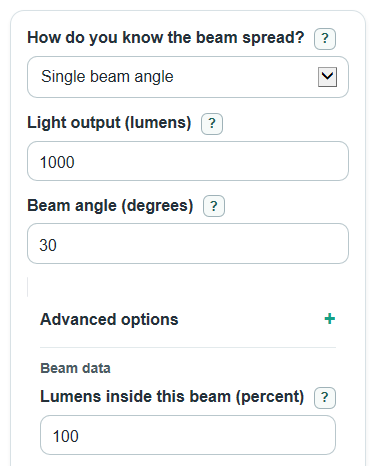
- Choose How do you know the beam spread? based on the information you have: Single beam angle, Wide and tall beam angles, or Solid angle.
- Enter Light output (lumens), then fill only the beam-spread fields shown for your selected method.
- Open Advanced options only if you need Lumens inside this beam (percent), Number format, or Digits to show.
- Select Calculate and read Luminous intensity first; higher candela means the same light is more focused in the chosen direction.
- Sanity-check Solid angle used and Share of a full sphere: a narrow beam should have a small steradian value and a small percent of the full sphere.
Definitions
Light output (lumens): The total visible light amount from the lamp or source. Lumens do not say how focused the light is.
Luminous intensity: Light focused in a direction, measured in candela. Higher candela means more light per steradian in the selected beam.
Beam angle: The full angle from one edge of the beam to the other edge, not the half-angle from the center to one edge.
Solid angle: A 3D angle that tells how much space a beam covers around the light source [2].
Steradian: The unit for solid angle. A full sphere is 4 * pi steradians, or about 12.566 sr.
Lumens inside this beam (percent): The percent of the entered lumens that the calculator treats as being inside the beam you are converting.
Share of a full sphere: The beam solid angle compared with all directions around the source.
Candela for each 1000 lumens: A focus comparison that removes the effect of total lumen output.
Common mistakes and quick fixes
Mistake: Entering half of the Beam angle (degrees) instead of the full edge-to-edge angle.
Fix: Use the full Beam angle (degrees) shown on the light data sheet or measured across the whole beam.
Mistake: Using Light output (lumens) for the whole lamp when the data sheet says only part of the lumens are in the main beam.
Fix: Put that share in Lumens inside this beam (percent) so Lumens used in the beam is not too high.
Mistake: Leaving How do you know the beam spread? on Single beam angle for a beam that is much wider one way than the other.
Fix: Choose Wide and tall beam angles, then enter both Wide beam angle (degrees) and Tall beam angle (degrees).
Mistake: Typing a Solid angle (steradians) larger than a full sphere.
Fix: Keep Solid angle (steradians) above 0 and no more than about 12.566.
Mistake: Comparing Luminous intensity without checking Candela for each 1000 lumens.
Fix: Use Candela for each 1000 lumens when you want to compare beam focus without the total lumen amount changing the comparison.
Limitations & Key Assumptions / Boundary Conditions
- The candela result assumes the selected lumens are spread evenly inside the chosen solid angle. Real beams can be brighter in the center and dimmer near the edge.
- Beam angle inputs must be full edge-to-edge angles. Using a half-angle will make the solid angle too small and the candela too high.
- The Wide and tall beam angles method is an estimate for oval or rectangular-style beams. It does not model detailed reflector, lens, or diffuser shape.
- The calculator converts lumens to candela. It does not calculate lux on a surface because distance and surface angle are not inputs.
- For very tiny beam angles, Luminous intensity can be very large. That can be mathematically valid, but it may be unrealistic if the beam angle measurement is noisy.
- Solid Angle (steradians) is limited to a full sphere, about 12.566 sr. Wider values are not physically meaningful for light spreading from one point.
Methodology
Core relationship
The calculator uses the standard photometry relationship that candela is lumens per steradian. The candela is the SI unit for luminous intensity [1]. It first finds Φ (lumens used in the beam) and Ω (solid angle in steradians), then divides.
Φ_beam = lumens * (beam_lumens_percent / 100)
I_cd = Φ_beam / Ω_sr
If Lumens inside this beam (percent) is 100, Φ_beam equals the entered Light output (lumens). If it is 80, the calculator uses 80 percent of the entered lumens.
Beam-spread conversion
When you enter one round Beam angle (degrees), the calculator converts the angle to radians, then treats the beam as a cone.
θ_rad = degrees * pi / 180
Ω_sr = 2 * pi * (1 - cos(θ_rad / 2))
When you enter Wide beam angle (degrees) and Tall beam angle (degrees), it converts both full angles to radians and estimates a non-round beam spread.
Ω_sr = 4 * asin(sin(horizontal_rad / 2) * sin(vertical_rad / 2))
When you enter Solid angle (steradians), that value is used directly after range checks.
Supporting results
Share of a full sphere compares the beam to all directions around the light source. A full sphere is 4 * pi steradians.
share_percent = 100 * Ω_sr / (4 * pi)
Candela for each 1000 lumens normalizes the result so two beams can be compared even when their total lumen ratings differ.
cd_per_1000_lm = I_cd * 1000 / Φ_beam
Worked example
For 1000 lumens with a 30 degree round beam and Lumens inside this beam (percent) set to 100, the cone formula gives Ω = 0.214093942 sr. The main result is 1000 / 0.214093942 = 4670.77 cd. The beam covers 100 * 0.214093942 / (4 * pi) = 1.7037 percent of a full sphere.