
Convert kilometers to centimeters or centimeters to kilometers fast, with the factor, formula, and simple examples to check your answer.
Table of contents
How to use our Kilometers to Centimeters Converter
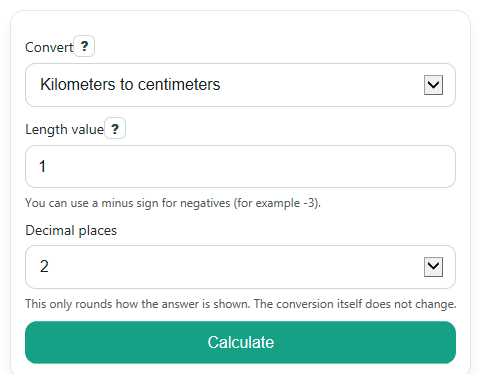
- Choose a direction in Convert: either Kilometers to centimeters or Centimeters to kilometers.
- Enter your number in Length value. You can use whole numbers, decimals, or a negative value if you are describing a change in position.
- Pick Decimal places to control how many digits show in the displayed answer.
- Click Calculate to see Converted value, Conversion factor used, Formula used, and Quick examples.
- Sanity-check the result: if you convert km to cm, the number should get much bigger; if you convert cm to km, the number should get much smaller.
Definitions
Kilometer (km): A metric length unit equal to 1,000 meters.
Centimeter (cm): A metric length unit equal to 1/100 of a meter.
Conversion factor used: The number that connects the two units. For km to cm, it is 100,000 cm per km. For cm to km, it is 0.00001 km per cm.
Formula used: The equation applied to your Length value, either cm = km x 100000 or km = cm / 100000.
Decimal places: How many digits appear after the decimal point in the displayed answer.
Common mistakes and quick fixes
Mistake: Leaving Length value blank and expecting a result.
Fix: Enter a number in Length value , then click Calculate .
Mistake: Picking the wrong option in Convert and getting a number that is far too big or too small.
Fix: Check whether your starting unit is kilometers or centimeters before reading Converted value .
Mistake: Thinking Decimal places changes the math itself.
Fix: Use Decimal places only to round the displayed Converted value ; the conversion factor stays the same.
Mistake: Reading Conversion factor used as the final answer.
Fix: Use Converted value as the answer and use Conversion factor used only to verify the math.
Mistake: Typing text or a value so large it is not a real number, which causes an error instead of a result.
Fix: Enter only a valid numeric Length value so the calculator can show Formula used and Converted value .
Limitations & Key Assumptions / Boundary Conditions
- The calculator uses the standard metric relationship 1 km = 100,000 cm and the reverse factor 1 cm = 0.00001 km.
- Decimal places changes only how the result is shown on screen; it does not change the internal conversion.
- Negative values are allowed mathematically, but a negative length usually makes sense only for direction or position change, not physical size.
- Very small or very large inputs may round in the displayed Converted value depending on the Decimal places setting.
- The tool converts one value at a time and does not account for measurement uncertainty, significant figures, or unit context from a larger physics problem.
Methodology
How the conversion works
The calculator uses one fixed metric relationship:
1 kilometer equals 100,000 centimeters. That comes from 1 kilometer = 1,000 meters and 1 meter = 100 centimeters [1][2].
cm = km x 100000
km = cm / 100000
What the calculator does
If Convert is set to Kilometers to centimeters, it multiplies Length value by 100,000. If Convert is set to Centimeters to kilometers, it divides Length value by 100,000.
The Conversion factor used output shows 100,000 cm per km in the first direction or 0.00001 km per cm in the reverse direction. Decimal places only rounds the displayed answer.
Mini example
If you enter 2.5 with Convert set to Kilometers to centimeters:
cm = 2.5 x 100000 = 250000
If you enter 12.34 with Convert set to Centimeters to kilometers:
km = 12.34 / 100000 = 0.0001234
Quick way to check your answer
Moving from kilometers to centimeters makes the number much larger because you are switching to a much smaller unit. Moving from centimeters to kilometers makes the number much smaller. The Quick examples output helps you compare your answer with nearby values.
Calculation choices
The calculator rejects blank, non-numeric, and infinite inputs. It allows negative values because the math still works, but that usually describes direction or position change rather than a physical length.