
Convert kilometers to millimeters fast, check the metric scale, and use the reverse check to confirm your input makes sense.
Table of contents
How to use our Kilometers to Millimeters Converter
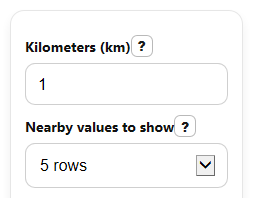
- Enter your distance in Kilometers (km). You can use whole numbers, decimals, 0, or a negative signed value.
- Choose Nearby values to show if you want a small comparison table around your entry.
- Click Calculate to see Millimeters, Same distance in meters, and Millimeters back to kilometers.
- Sanity-check the result: the Millimeters number should be much larger than the kilometer number because 1 km equals 1,000,000 mm.
- Use the Nearby conversion table to compare close values and catch a mistyped decimal or extra zero.
Definitions
Kilometer (km): A metric length unit equal to 1,000 meters.
Millimeter (mm): A metric length unit equal to one-thousandth of a meter, so it is much smaller than a kilometer.
Meter (m): The base metric length unit shown as a helpful middle step between kilometers and millimeters.
Conversion factor used: The fixed relationship for this page: 1 km = 1,000,000 mm.
Millimeters back to kilometers: A reverse check that converts the millimeter result back into kilometers to confirm the math.
Nearby conversion table: A short list of kilometer values near your entry and their matching millimeter values for quick checking.
Common mistakes and quick fixes
Mistake: Leaving Kilometers (km) blank and expecting a result.
Fix: Enter a number in Kilometers (km) , such as 1 or 0.25, then calculate again.
Mistake: Typing text or symbols into Kilometers (km) instead of a number.
Fix: Use digits only for Kilometers (km) . Decimals are fine, and commas or spaces should be removed if they cause an error.
Mistake: Thinking the Millimeters result is too big.
Fix: Check Conversion factor used . It should show that 1 km = 1,000,000 mm, so a much larger number is expected.
Mistake: Entering 0.001 in Kilometers (km) when you meant 1 km.
Fix: Compare your answer with Same distance in meters and the Nearby conversion table to spot a misplaced decimal.
Mistake: Picking the wrong Nearby values to show and missing a useful check range.
Fix: Change Nearby values to show to 5 rows or 10 rows if you want more comparison points around your entry.
Mistake: Seeing a negative Millimeters back to kilometers value and assuming the tool is broken.
Fix: A negative reverse check usually means your original Kilometers (km) value was negative, which can represent signed direction or offset.
Limitations & Key Assumptions / Boundary Conditions
- This converter uses the exact metric relationship 1 km = 1,000,000 mm. It does not estimate or round the core conversion factor.
- Displayed results may be rounded for readability, so the reverse check can differ by a tiny amount in the last shown digit even when the stored math is consistent.
- Negative inputs are allowed as signed lengths. They can describe direction or offset, but they do not describe a physical size by themselves.
- The nearby table is a checking aid, not a full reference chart. It only shows a small set of values around the number you entered.
- This page converts metric length units only. It does not handle mixed units such as miles, feet, inches, or centimeters on the same screen.
- If the kilometer entry is blank or not a valid number, the tool should stop and show an error instead of guessing what you meant.
Methodology
How the conversion is calculated
The calculation uses standard metric prefixes. A kilometer is 1,000 meters, and a meter is 1,000 millimeters, so 1 kilometer is 1,000,000 millimeters [2].
mm = km x 1000000
m = km x 1000
km = mm / 1000000
Worked mini-example
If you enter 0.25 for Kilometers (km), the main conversion is:
mm = 0.25 x 1000000 = 250000
The meter step is:
m = 0.25 x 1000 = 250
The reverse check is:
km = 250000 / 1000000 = 0.25
If the reverse-check value matches your starting kilometers, your conversion is internally consistent.
How to interpret the result
The Millimeters result gets much larger because millimeters are tiny compared with kilometers. That bigger number is normal, not a sign of an error. The Same distance in meters output helps you see the scale change in a simpler middle step.
Calculation choices
The converter accepts 0 and negative numbers. A value of 0 km gives 0 mm. A negative value keeps its sign through Millimeters and Millimeters back to kilometers.
Assumptions and limits
This method assumes standard metric units only and does not apply any measurement uncertainty. For very large or very precise decimal inputs, the displayed value may be rounded for readability even though the conversion rule itself stays exact.