
Use this calculator to find volts, joules, or coulombs from the same energy-charge relationship without mixing up what each value means.
Table of contents
How to use our Joules to Volts Calculator
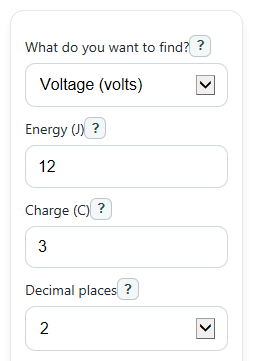
- Pick What do you want to find? and choose whether you want to calculate Voltage (V), Energy (J), or Charge (C).
- Enter the two known values shown on the form, such as Energy (J) and Charge (C) when solving for voltage.
- Choose Decimal places if you want the result rounded for homework, lab notes, or quick checking.
- Click Calculate to see Calculated value, Formula used, and What it means in plain language.
- Sanity-check the result: if Energy (J) goes up with the other input unchanged, the solved value should go up too; if the denominator is 0 in a division mode, you should get an error instead of a number.
Definitions
Energy (J): Energy measured in joules. In this calculator, it is the energy linked to moving electric charge.
Charge (C): Electric charge measured in coulombs.
Voltage (V): Energy per unit charge. A value of 1 volt means 1 joule for each 1 coulomb.
Coulomb (C): The SI unit used to measure electric charge.
Joule (J): The SI unit used to measure energy.
Calculated value: The missing quantity the calculator solves for, based on the two values you entered.
Formula used: The rearranged equation the calculator applied for your chosen unknown.
Common mistakes and quick fixes
Mistake: Treating Energy (J) like it can change directly into Voltage (V) by itself.
Fix: Also enter Charge (C), because voltage is energy per charge.
Mistake: Leaving a required visible field blank, such as Charge (C) when finding Calculated value for voltage.
Fix: Fill in every visible required input before you click Calculate.
Mistake: Entering 0 for Charge (C) when solving for Voltage (V).
Fix: Use a nonzero Charge (C), because the Formula used is V = E / Q and division by zero is undefined.
Mistake: Entering 0 for Voltage (V) when solving for Charge (C).
Fix: Use a nonzero Voltage (V), because the Formula used is Q = E / V and division by zero is undefined.
Mistake: Thinking a negative Calculated value is automatically wrong.
Fix: Keep the signs from Energy (J), Charge (C), and Voltage (V) consistent. Negative results can be valid for signed charge or signed electric potential.
Mistake: Reading a rounded answer as exact because Decimal places is set too low.
Fix: Increase Decimal places if you need more detail in Calculated value.
Limitations & Key Assumptions / Boundary Conditions
- This is not a direct unit converter from joules to volts. You must also know Charge (C) to find Voltage (V), or know Voltage (V) to find Charge (C).
- When solving with division, the denominator must be nonzero. Charge (C) cannot be 0 when finding voltage, and Voltage (V) cannot be 0 when finding charge.
- The calculator uses the simple relationship among energy, charge, and voltage only. It does not include resistance, current, time, capacitance, circuit losses, or battery behavior.
- Negative inputs and negative results are allowed because signed charge and signed electric potential can be meaningful in physics.
- Displayed results depend on the Decimal places setting, so rounded values may hide small differences.
- Very large or very small values may be harder to read in plain decimal form even though the math is still based on the same formulas.
Methodology
Core relationship
This calculator uses the standard relationship between voltage, energy, and charge: 1 volt equals 1 joule per coulomb.
V = E / Q
E = V x Q
Q = E / V
What each symbol means
V is voltage in volts, E is energy in joules, and Q is charge in coulombs.
How the calculator decides which formula to use
If you choose Voltage (V), it divides Energy (J) by Charge (C). If you choose Energy (J), it multiplies Voltage (V) by Charge (C). If you choose Charge (C), it divides Energy (J) by Voltage (V).
Mini example
If Energy (J) is 12 and Charge (C) is 3, then the calculator finds voltage like this:
V = 12 / 3 = 4
So the result is 4 V. In plain language, that means each coulomb is linked with 4 joules of energy difference.
If Voltage (V) is 9 and Charge (C) is 2, then energy is:
E = 9 x 2 = 18
So the result is 18 J.
Input checks
The calculator requires the visible inputs for the selected solve-for choice. It blocks division by zero because dividing by 0 does not produce a defined result. It also keeps negative values instead of forcing them to 0.
Assumptions behind the result
This method assumes you are using the basic physical definition of voltage as energy per unit charge. Real devices and full circuits can involve extra effects, so this tool is best for direct relationship problems, classwork, and quick checks.