
Estimate an investment property loan payment, cash flow, DSCR, returns, and a tougher rent, rate, and vacancy stress test.
Advanced options
Table of contents
How to use our Investment Property Loan Calculator
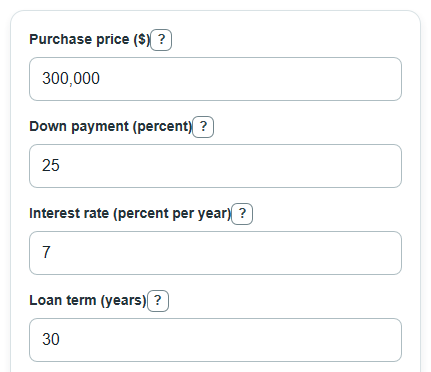
- Enter Purchase price, Down payment, Interest rate, and Loan term from the loan terms you want to test.
- Enter Monthly rent, Vacancy, and Monthly non-loan costs using monthly amounts before the loan payment.
- Open Advanced options if you want to add Other monthly income, Closing costs, or change the stress-test settings.
- Use Minimum DSCR to test as the rule you want the stressed deal to meet, then select Calculate.
- Sanity-check the results by comparing Monthly principal and interest with a lender quote and Base monthly net operating income with your own rent and expense budget.
Definitions
Monthly principal and interest: The base loan payment for borrowed principal and interest only. It does not include taxes, insurance, HOA dues, or other owner costs [1].
Monthly non-loan costs: Owner costs for the property before the loan payment, such as property taxes, insurance, HOA dues, management, maintenance, and utilities you pay.
Vacancy: The percent of rent expected to be lost because the property is empty or rent is not collected.
Base monthly net operating income: Rent and Other monthly income after Vacancy and Monthly non-loan costs, before the loan payment.
Debt service coverage ratio (DSCR): Base monthly net operating income divided by Monthly principal and interest. A higher ratio means more property income covers the loan payment.
Base cap rate: Annual net operating income divided by Purchase price. It ignores financing and income taxes.
Base cash-on-cash return: Annual Base monthly cash flow divided by Estimated cash needed to close.
Percentage points: A direct change to a percent rate. For example, a 1 percentage point rate increase changes 7 percent to 8 percent.
Common mistakes and quick fixes
Mistake: Typing the loan balance into Purchase price instead of the property price.
Fix: Put the property price in Purchase price; Estimated loan amount is calculated from Down payment.
Mistake: Entering 0.25 in Down payment when you mean 25 percent.
Fix: Enter 25 in Down payment for a 25 percent down payment.
Mistake: Putting property taxes, insurance, HOA, or management fees in Monthly principal and interest.
Fix: Keep Monthly principal and interest as the loan payment only, and put owner costs in Monthly non-loan costs.
Mistake: Leaving Vacancy at 0 when the property may be empty between tenants.
Fix: Enter a realistic Vacancy percent so Base monthly net operating income is not too high.
Mistake: Entering 0.01 in Rate increase for stress test when you mean a 1 percentage point increase.
Fix: Enter 1 in Rate increase for stress test to change a 7 percent rate to 8 percent in the stress case.
Mistake: Treating Stress-test pass or fail as a loan approval.
Fix: Use Minimum DSCR to test as a screening rule, then confirm lender rules and required reserves separately.
Limitations & Key Assumptions / Boundary Conditions
- The loan math assumes a fixed-rate, fully amortizing loan with equal monthly payments. It does not model adjustable rates, interest-only periods, balloon payments, or extra principal payments.
- Monthly non-loan costs must include the owner costs you want counted. If taxes, insurance, HOA dues, management, repairs, or utilities are left out, cash flow and DSCR will look too high.
- Income taxes, depreciation, appreciation, sale costs, major renovations, reserves, and future rent growth are not included.
- DSCR is a simplified monthly ratio using net operating income divided by principal and interest. A lender may use annual numbers, different expense rules, reserve requirements, or a different minimum DSCR.
- Closing costs are estimated as a percent of Purchase price. Real cash to close can differ because of lender fees, prepaid taxes and insurance, escrow deposits, points, and required reserves.
- The stress test is a user-chosen scenario, not a forecast. Stressed Vacancy is capped at 100 percent, and negative cash flow is shown instead of being forced to zero.
Methodology
How the loan payment is calculated
The calculator first finds the loan amount from the purchase price and down payment.
loan_amount = purchase_price * (1 - down_payment_percent / 100)
term_months = loan_term_years * 12
monthly_rate = interest_rate_percent / 100 / 12
If the monthly rate is 0, the principal and interest payment is the loan amount divided by the number of months.
monthly_pi = loan_amount / term_months
Otherwise, the calculator uses the standard fixed-payment loan formula.
monthly_pi = loan_amount * monthly_rate / (1 - (1 + monthly_rate)^(-term_months))
How income, cash flow, and DSCR are calculated
Base net operating income starts with rent and other income, subtracts vacancy loss, then subtracts monthly non-loan costs.
base_noi = (monthly_rent + other_monthly_income) * (1 - vacancy_percent / 100) - monthly_operating_expenses
base_monthly_cash_flow = base_noi - monthly_pi
base_dscr = base_noi / monthly_pi
If a payment ever calculated as zero, DSCR would be shown as unavailable instead of dividing by zero.
How the stress test is calculated
The stress test lowers rent, raises the interest rate, and raises vacancy by the amounts entered in Advanced options. Stressed vacancy is capped at 100 percent.
stress_rent = monthly_rent * (1 - stress_rent_drop_percent / 100)
stress_rate_percent = interest_rate_percent + stress_rate_increase_points
stress_vacancy_percent = min(100, vacancy_percent + stress_vacancy_increase_points)
The stressed principal and interest payment uses the same loan amount and term with the stressed interest rate.
stress_noi = (stress_rent + other_monthly_income) * (1 - stress_vacancy_percent / 100) - monthly_operating_expenses
stressed_monthly_cash_flow = stress_noi - stressed_monthly_pi
stressed_dscr = stress_noi / stressed_monthly_pi
Stress-test pass or fail passes only when Stress-test DSCR is at least Minimum DSCR to test and Stress-test monthly cash flow is not negative.
How return measures are calculated
Cap rate uses operating income before financing. Cash-on-cash return uses cash flow after financing.
cap_rate_percent = base_noi * 12 / purchase_price * 100
cash_needed_to_close = purchase_price * down_payment_percent / 100 + purchase_price * closing_cost_percent / 100
cash_on_cash_percent = base_monthly_cash_flow * 12 / cash_needed_to_close * 100
total_interest = monthly_pi * term_months - loan_amount
Mini example
For a $300,000 property with 25 percent down, a 7 percent rate, a 30-year term, $2,500 rent, 5 percent vacancy, and $700 monthly non-loan costs, the estimated loan amount is $225,000 and monthly principal and interest is about $1,496.93. Base monthly net operating income is $1,675, so base monthly cash flow is about $178.07 and base DSCR is about 1.119. With a 10 percent rent drop, a 1 percentage point rate increase, and 5 extra vacancy points, stressed monthly cash flow is about -$325.97 and stressed DSCR is about 0.803.