
Estimate net savings, payback time, and first-year bill savings for a home electrification plan using your own costs and energy bill estimates.
Advanced options
Table of contents
How to use our Home Electrification Savings Calculator
- Choose your Home situation so the planning note can flag common approval or scope issues.
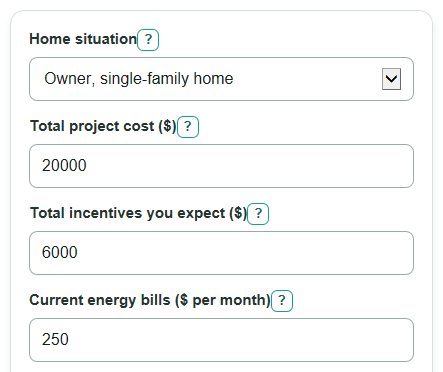
- Enter Total project cost, Total incentives you expect, Current energy bills, and Expected energy bills after upgrades using average monthly energy bills.
- Open Advanced options if you want to change Years to compare or Yearly bill price increase from the defaults.
- Click Calculate, then read Estimated net savings over selected years first; positive means bill savings beat the net upfront cost during that time.
- Sanity-check the result by comparing Estimated monthly bill savings with your real bills or contractor estimate; a small monthly change can make payback much longer.
Definitions
Total project cost: The installed cost in dollars for all upgrades included in this plan.
Total incentives you expect: Rebates, tax credits, or other support you expect to receive for the same upgrades.
Net cost after incentives: Total project cost minus Total incentives you expect. It can be negative if incentives are larger than the entered cost.
Current energy bills: Your average monthly energy cost before upgrades, including electric plus fuels such as gas, propane, or oil when they apply.
Expected energy bills after upgrades: Your estimated average monthly energy cost after the upgrades are in use.
Yearly bill price increase: The percent used to grow future yearly bill savings in the selected-years result.
Estimated net savings over selected years: Cumulative bill savings over Years to compare minus Net cost after incentives.
Estimated payback time: The estimated time needed for bill savings to cover Net cost after incentives.
Common mistakes and quick fixes
Mistake: Entering one upgrade in Total project cost but including incentives for several upgrades in Total incentives you expect.
Fix: Make Total project cost and Total incentives you expect cover the same project bundle.
Mistake: Using only your electric bill for Current energy bills when your home also uses gas, propane, or oil.
Fix: Put the average monthly total of all current home energy bills in Current energy bills.
Mistake: Typing a rebate you might not qualify for into Total incentives you expect.
Fix: Use only incentives you reasonably expect, or run a second calculation with a lower Total incentives you expect.
Mistake: Treating Expected energy bills after upgrades as a guaranteed bill.
Fix: Use a realistic average in Expected energy bills after upgrades and test a higher number if you are unsure.
Mistake: Leaving Yearly bill price increase at 3 percent without thinking about future fuel and electric prices.
Fix: Try 0 percent and a higher Yearly bill price increase to see how much the payback changes.
Mistake: Reading Estimated cash change in year 1 as a financed payment plan.
Fix: Use Estimated cash change in year 1 as a simple upfront-cost-minus-first-year-savings check, not a loan schedule.
Limitations & Key Assumptions / Boundary Conditions
- The calculator does not look up live rebates, tax rules, utility rates, or local program caps. Enter incentives you have checked yourself.
- Results depend on your bill estimates. Weather, thermostat settings, fuel prices, occupancy, and equipment performance can change real savings.
- The selected-years result is not a discounted present value calculation. It does not include inflation, loan interest, investment returns, or the time value of money.
- Tax credit timing, rebate payment delays, permit fees, maintenance, panel upgrades, and resale value are not modeled unless you include them in Total project cost or Total incentives you expect.
- The calculation treats the plan as one bundle. It does not split savings by heat pump, water heater, stove, insulation, wiring, or appliance.
- Renters, condo owners, and HOA properties may need approval before upgrades. The Home situation planning note is a prompt, not a legal or lease review.
Methodology
Core calculations
The calculator compares your entered upfront cost with your entered before-and-after monthly energy bills. This follows the common project evaluation idea of comparing initial cost with future savings over an analysis period [1].
net_cost_after_incentives = project_cost - incentives
monthly_bill_savings = current_monthly_energy_cost - expected_monthly_energy_cost
annual_bill_savings = monthly_bill_savings * 12
For the selected-years total, the first-year bill savings are grown by the Yearly bill price increase. The percent entry is divided by 100 before it is used.
g = annual_bill_increase_percent / 100
if g = 0: cumulative_bill_savings = annual_bill_savings * analysis_years
if g is not 0: cumulative_bill_savings = annual_bill_savings * (((1 + g) ^ analysis_years - 1) / g)
net_savings_over_period = cumulative_bill_savings - net_cost_after_incentives
year1_cash_change = annual_bill_savings - net_cost_after_incentives
Payback calculation
Payback time is the point where accumulated bill savings equal the net cost after incentives. If net cost after incentives is zero or negative, payback time is shown as 0 years. If annual bill savings are zero or negative while net cost is positive, bill savings do not pay back the upfront net cost.
if net_cost_after_incentives <= 0: payback_years = 0
else if annual_bill_savings <= 0: payback_years = no payback from bill savings
else if g = 0: payback_years = net_cost_after_incentives / annual_bill_savings
else: payback_years = ln(1 + (net_cost_after_incentives * g / annual_bill_savings)) / ln(1 + g)
Mini-example
If Total project cost is $20,000 and Total incentives you expect is $6,000, Net cost after incentives is $14,000. If Current energy bills are $250 per month and Expected energy bills after upgrades are $190 per month, Estimated monthly bill savings are $60 and Estimated first-year bill savings are $720. With 15 Years to compare and a 3 percent Yearly bill price increase, cumulative bill savings are about $13,391.22, so Estimated net savings over selected years are about -$608.78. The negative value means the plan has not fully paid back within the selected 15 years.
Calculation choices
Negative savings and negative net cost are kept instead of being forced to zero. This is important because higher after-upgrade bills, very large incentives, or short comparison periods can change the decision. Money outputs are rounded to cents, and payback time is rounded for display.