
Estimate when removing a gas meter pays back by comparing the upfront cost with the fixed monthly charges you stop paying.
Table of contents
How to use our Gas Meter Removal Break-Even Calculator
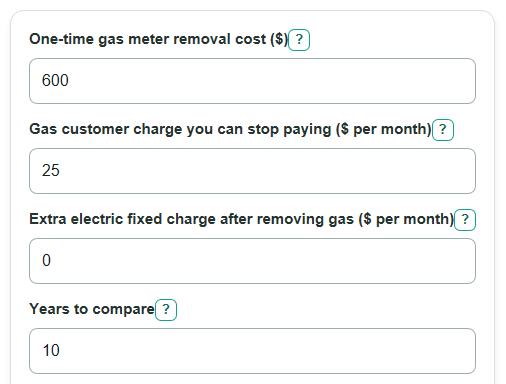
- Enter the One-time gas meter removal cost, including utility, permit, and safe line-capping costs if they apply.
- Enter the Gas customer charge you can stop paying and any Extra electric fixed charge after removing gas; use fixed monthly charges only, not fuel or appliance energy use.
- Set Years to compare for your planning period, then enter a Possible gas reconnection cost later or 0 if you do not want that what-if.
- Click Calculate and read Cash change from removing gas after chosen years first; positive means removing gas is ahead, while negative means keeping gas service is ahead.
- Sanity-check the answer by confirming that Net fixed bill savings each month equals the gas fixed charge minus the extra electric fixed charge, and that the break-even time is reasonable for your upfront cost.
Definitions
Gas customer charge: A fixed gas bill fee that is charged each month for service access, meter service, or basic service, even when little or no gas is used.
Fixed charge: A bill charge that does not change with how much energy you use that month.
One-time gas meter removal cost: The upfront amount paid to disconnect service, remove the meter, get permits, or safely cap the gas line if those items apply.
Extra electric fixed charge: Any added monthly electric service fee caused by removing gas. It does not include the electricity used by new appliances.
Net fixed bill savings each month: The gas fixed charge avoided each month minus any extra fixed electric charge.
Break-even month: The first month when the accumulated fixed-charge savings have paid back the one-time removal cost.
Cash change: The remove-vs-keep difference. Positive means removing gas is ahead. Negative means keeping gas service is ahead.
Common mistakes and quick fixes
Mistake: Using total gas spending for Gas customer charge you can stop paying , including gas used for heat, hot water, or cooking.
Fix: Enter only the fixed monthly charge you pay even with little or no gas use.
Mistake: Putting new appliance electricity use into Extra electric fixed charge after removing gas .
Fix: Enter only a change in the fixed electric bill charge, or enter 0 if the fixed charge stays the same.
Mistake: Leaving contractor or permit costs out of One-time gas meter removal cost .
Fix: Add all one-time costs needed to disconnect, remove, cap, or make the gas line safe.
Mistake: Setting Years to compare longer than you expect to keep the home or stay without gas.
Fix: Use the time period you actually want to test, such as 5 years or 10 years.
Mistake: Treating Possible gas reconnection cost later as certain when it is only a what-if.
Fix: Use 0 for the main comparison, then try a reconnection cost to see how it changes the risk.
Mistake: Reading a negative Cash change from removing gas after chosen years as an input error.
Fix: A negative value can be valid; it means fixed-charge savings have not beaten the upfront cost over that period.
Limitations & Key Assumptions / Boundary Conditions
- The calculator compares fixed monthly bill charges only. It does not estimate gas usage, electric usage, appliance efficiency, weather, or fuel price changes.
- Actual utility rules can differ. Some utilities may charge special disconnect, reconnect, inspection, minimum-service, or account fees not listed on a normal bill.
- The reconnection amount is a what-if cost, not a prediction. If reconnecting gas later is unlikely, use 0 for that input.
- Results are before tax effects, rebates, financing, inflation, and investment return on the upfront money.
- The break-even month uses whole months, so a cost that pays back partway through a month is rounded up to the next month.
- If net monthly fixed savings are zero or negative, fixed charges alone cannot pay back a positive removal cost.
Methodology
How the comparison is calculated
The calculator compares two simple choices: keep gas service and keep paying the gas fixed charge, or remove gas service and pay the one-time removal cost. The monthly change is calculated first.
Net fixed bill savings each month = Gas customer charge you can stop paying - Extra electric fixed charge after removing gas
Then the chosen-years cash change is the accumulated monthly fixed savings minus the upfront removal cost.
Cash change from removing gas after chosen years = Net fixed bill savings each month * Years to compare * 12 - One-time gas meter removal cost
The break-even month is the first whole month when the accumulated fixed-charge savings equal or exceed the removal cost.
Break-even month = ceiling(One-time gas meter removal cost / Net fixed bill savings each month)
If the one-time removal cost is $0 and monthly savings are positive, the break-even month is 0 because there is no upfront cost to pay back. If monthly savings are zero or negative and the removal cost is positive, the break-even result is shown as no break-even.
Break-even time in years = Break-even month / 12
Cash change from removing gas after 1 year = Net fixed bill savings each month * 12 - One-time gas meter removal cost
The reconnection what-if subtracts the possible future cost from the chosen-years comparison.
Cash change if gas is reconnected later = Cash change from removing gas after chosen years - Possible gas reconnection cost later
Mini-example
If removal costs $600, the avoided gas customer charge is $25 per month, the added electric fixed charge is $0, and the comparison period is 10 years, monthly fixed savings are $25. The break-even month is ceiling($600 / $25), which is month 24. The 10-year cash change is $25 * 10 * 12 - $600 = $2,400, so removing gas is ahead by $2,400 before any reconnection what-if.
Calculation choices
Cash change outputs keep their sign instead of being floored at $0. A negative value is useful because it shows how far the remove option is behind the keep option for the chosen period. The calculator uses 12 months per year for all yearly conversions.