
Convert half-dollar coins to dollars, or turn a dollar amount into the exact number of half-dollar coins.
Table of contents
How to use our Half Dollars to Dollars Converter
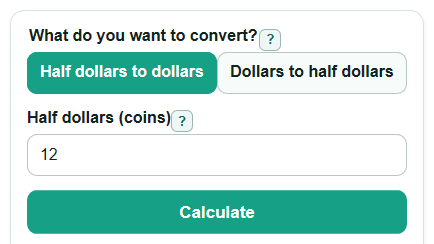
- Choose the direction in What do you want to convert?.
- If you choose Half dollars to dollars, enter a whole number in Half dollars (coins).
- If you choose Dollars to half dollars, enter dollars and cents in Dollar amount ($), such as 6.00 or 12.75.
- Click Calculate and read Converted amount first, then check Can this be made with whole half dollars?.
- Sanity-check the answer: each half dollar adds 50 cents, so 12 coins should equal $6.00 and 600 cents.
Definitions
Half dollar: A U.S. coin with a face value of 50 cents, or $0.50 [1].
Half dollars (coins): The number of physical half-dollar coins. This must be a whole number.
Dollar amount ($): A money amount written in dollars and cents, such as 6.00 or 12.75.
Converted amount: The main answer. It is dollars in the coin-to-dollar direction and coins in the dollar-to-coin direction.
Whole half dollars: A dollar amount that can be made exactly using only 50-cent coins.
Value in cents: The same money value counted in cents, where $1.00 equals 100 cents.
Common mistakes and quick fixes
Mistake: Typing 12.5 in Half dollars (coins) as if half a physical coin can be counted.
Fix: Enter a whole number in Half dollars (coins), such as 12 or 13.
Mistake: Leaving Dollar amount ($) blank after choosing dollars to half dollars.
Fix: Fill in Dollar amount ($) with a nonnegative amount, such as 6.00.
Mistake: Entering 6.125 in Dollar amount ($), which has more than two decimal places.
Fix: Use dollars and cents in Dollar amount ($), such as 6.12 or 6.13.
Mistake: Reading Converted amount of 25.5 coins as a possible physical coin count.
Fix: Check Can this be made with whole half dollars? ; if it says no, use Nearest whole-coin amounts.
Mistake: Changing What do you want to convert? but looking at the old input field.
Fix: After switching What do you want to convert?, enter the value in the visible field before calculating again.
Limitations & Key Assumptions / Boundary Conditions
- This converter uses face value only. It does not estimate collector value, silver value, wear, mint mark, or resale price.
- Half dollars (coins) must be a nonnegative whole number because physical coins are counted one at a time.
- Dollar amount ($) must be nonnegative and use no more than two decimal places because U.S. cash is counted in cents.
- In dollars-to-coins mode, amounts like $12.75 give an exact decimal coin count, but they cannot be made exactly using only half-dollar coins.
- Very large entries are formatted with comma separators when possible, but values that are too large for safe browser math should be treated as invalid.
- The converter ignores the hidden input from the other direction, so an old Dollar amount ($) does not affect a coin-to-dollar conversion, and an old Half dollars (coins) value does not affect a dollar-to-coin conversion.
Methodology
Core idea
A half-dollar coin is worth $0.50, so each coin adds 50 cents to the total. The calculator converts money through cents where possible to avoid common decimal rounding mistakes.
dollars = half_dollar_count * 0.50
half_dollar_count = dollars / 0.50
Whole-coin check
For a dollar amount to be made exactly from half-dollar coins, its cent value must divide evenly by 50.
is_whole_coin_amount = (cents % 50 == 0)
If the amount is not exact, the converter still shows the decimal coin count, then finds the nearest lower and higher amounts that can be made with whole coins.
lower_coins = floor(cents / 50)
upper_coins = ceil(cents / 50)
lower_dollars = lower_coins * 0.50
upper_dollars = upper_coins * 0.50
Mini-example
If Half dollars (coins) is 12, the dollar value is 12 * $0.50 = $6.00, and the cent value is 600 cents. If Dollar amount ($) is 12.75, the exact coin count is 12.75 / 0.50 = 25.5 coins. Because 1,275 cents is not divisible by 50, the nearest whole-coin amounts are 25 coins = $12.50 and 26 coins = $13.00.
Validation choices
The calculator rejects blank required entries, negative values, non-whole coin counts, and dollar amounts with more than two decimal places. Zero is allowed because 0 coins equals $0.00.