
Calculate measured leaching fraction and estimate the next greenhouse irrigation runtime from microirrigation or overhead sprinkler measurements.
Microirrigation measurements
Overhead sprinkler weights
Runtime goal
Table of contents
How to use our Greenhouse Leaching Fraction and Irrigation Runtime Calculator
- Choose Irrigation method for the tested zone. Use microirrigation for direct emitter collection or overhead sprinkler for the container-weight method.
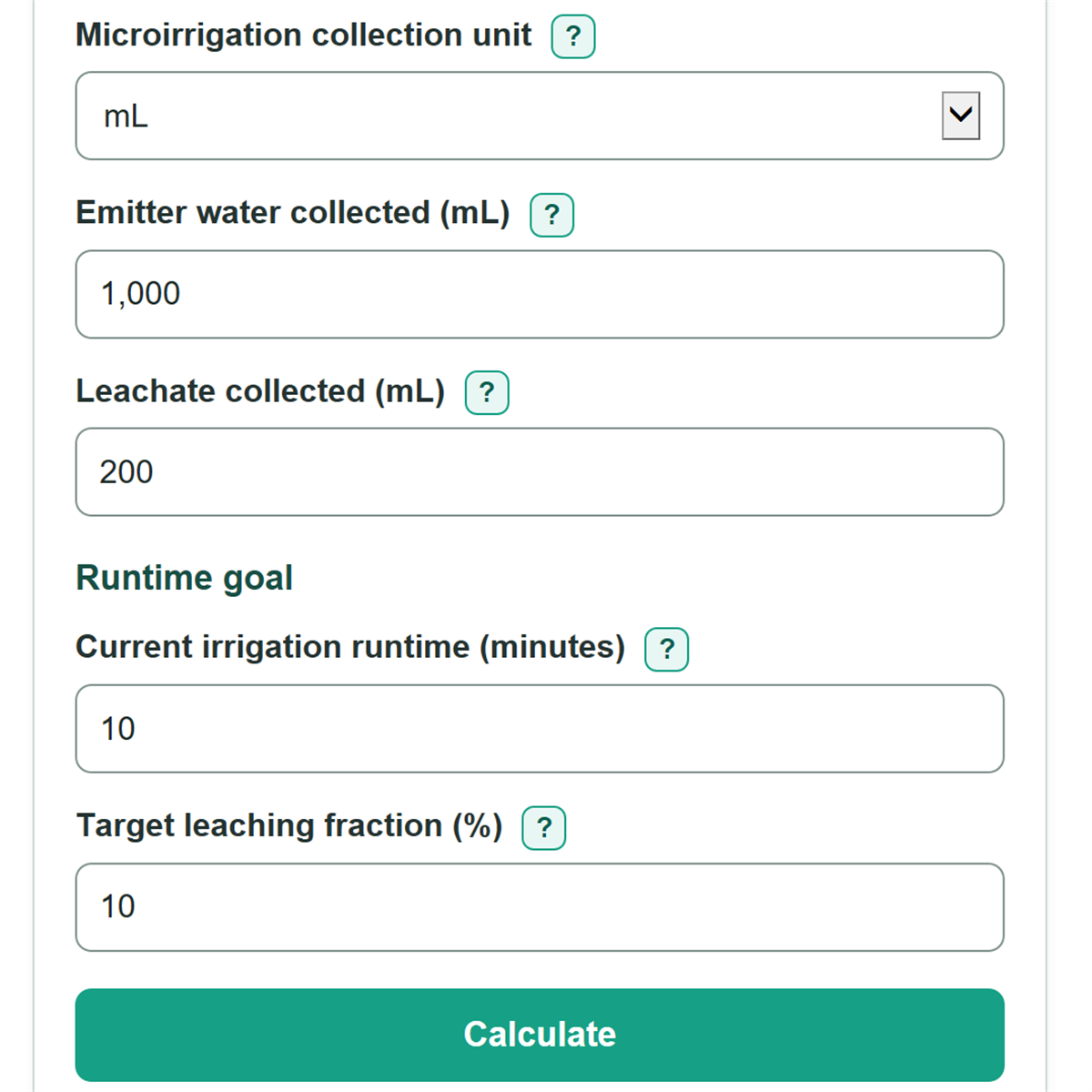
- For microirrigation, choose Microirrigation collection unit and enter Emitter water collected (mL, fl oz, or g) and Leachate collected (mL, fl oz, or g) from the same irrigation event.
- For overhead sprinklers, weigh the same planted container before irrigation and after drainage, then enter the collected drainage weight in Leachate collected (g).
- Enter the controller's Current irrigation runtime (minutes) and your Target leaching fraction (%), then select Calculate.
- Check that Measured leaching fraction matches your field observation and that the direction of Runtime change from the tested event makes sense. Test the recommended next event and measure again before making a large schedule change.
Definitions
Leaching fraction (LF): The share of water applied to a planted container that drains out as leachate, shown here as a percent.
Leachate: Drainage water collected beneath a container after irrigation.
Applied water: Water that entered the tested planted container. For microirrigation, it is direct emitter collection. For overhead sprinklers, it is container weight gain plus collected leachate.
Retained water: The estimated water left in the container after drainage. It equals applied water minus leachate.
Target leaching fraction: The drainage percentage chosen for the crop and production conditions. It is a management target, not a universal setting.
Runtime change from the tested event: Recommended next irrigation runtime minus the tested runtime. A negative number means reduce runtime.
Common mistakes and quick fixes
Mistake: Entering 0.15 in Target leaching fraction (%) when the intended target is 15%.
Fix: Enter 15 for a 15% target because this field uses percent values, not decimal fractions.
Mistake: Using different units for Emitter water collected (mL, fl oz, or g) and Leachate collected (mL, fl oz, or g) .
Fix: Choose one Microirrigation collection unit and use it for both measurements.
Mistake: Entering empty-container catch-can water as Emitter water collected (mL, fl oz, or g) for an overhead sprinkler test.
Fix: Choose overhead sprinkler and use the same planted container's before and after weights plus Leachate collected (g) .
Mistake: Recording Container weight after drainage (g) before the container has finished draining or using a different container than the before reading.
Fix: Weigh the same planted container after drainage collection using the same scale setup.
Mistake: Copying a different controller program into Current irrigation runtime (minutes) .
Fix: Enter the exact runtime that produced the water and leachate measurements.
Mistake: Treating one container's Measured leaching fraction as the value for an entire uneven irrigation zone.
Fix: Sample representative containers and use the result as a next-event estimate, especially before a large runtime adjustment.
Limitations & Key Assumptions / Boundary Conditions
- The next-runtime estimate assumes the next event has similar plant size, substrate moisture, weather, irrigation pressure, and application pattern as the tested event.
- The calculation holds estimated retained water constant while changing the leaching fraction. It does not calculate crop water use, fertilizer concentration, salinity, or irrigation-system uniformity.
- For microirrigation, emitter water and leachate must be collected during the same runtime and recorded in the same unit.
- For overhead sprinklers, use the same planted container for both weight readings, include the same container components each time, and tare the leachate collector.
- One tested container may not represent variation within an irrigation zone. Sample representative containers before applying a zone-wide runtime change. [2]
- A large difference between measured and target leaching fraction makes the scaled runtime less certain. Treat it as a next-event estimate and measure again. [1]
- The target must be at least 0% and below 100%. A 100% target leaves no retained-water amount in the runtime equation.
Methodology
Calculation method
The calculator first chooses the measurement workflow from Irrigation method. Direct emitter collection is used for microirrigation. The overhead workflow estimates water entering a planted container from its weight gain plus collected drainage. This distinction helps account for water intercepted by the plant canopy during overhead irrigation. [1]
applied water = emitter water collected
applied water = container weight after drainage - container weight before irrigation + leachate collected
measured leaching fraction (%) = 100 x leachate / applied water
The recommended runtime scales the tested runtime while holding estimated retained water constant.
recommended next runtime = current runtime x (1 - measured LF / 100) / (1 - target LF / 100)
runtime change = recommended next runtime - current runtime
Worked example
Suppose microirrigation delivers 1,000 mL and 200 mL drains out during a 10-minute event. Measured LF is 20%. With a target of 10%, the next-runtime estimate is 10 x 0.80 / 0.90 = 8.89 minutes. The runtime change is -1.11 minutes, so the estimate calls for a shorter event.
Practical use
Use the calculated runtime for a similar next irrigation event, then collect another sample. LF-based runtime adjustments work best as measured corrections, not as a substitute for checking irrigation distribution, crop condition, water quality, and container-to-container variation. [1]