
Compare hay quotes by bale or short ton using dry matter, crude protein, TDN, delivery, shrink, and feeding waste.
Advanced options
Table of contents
How to use our Hay Dry Matter and Nutrient Cost Calculator
- Choose how the seller quoted the hay under "How is the hay priced?" Then enter either "Hay price" and "Average bale weight" or the quoted per-ton "Hay price."
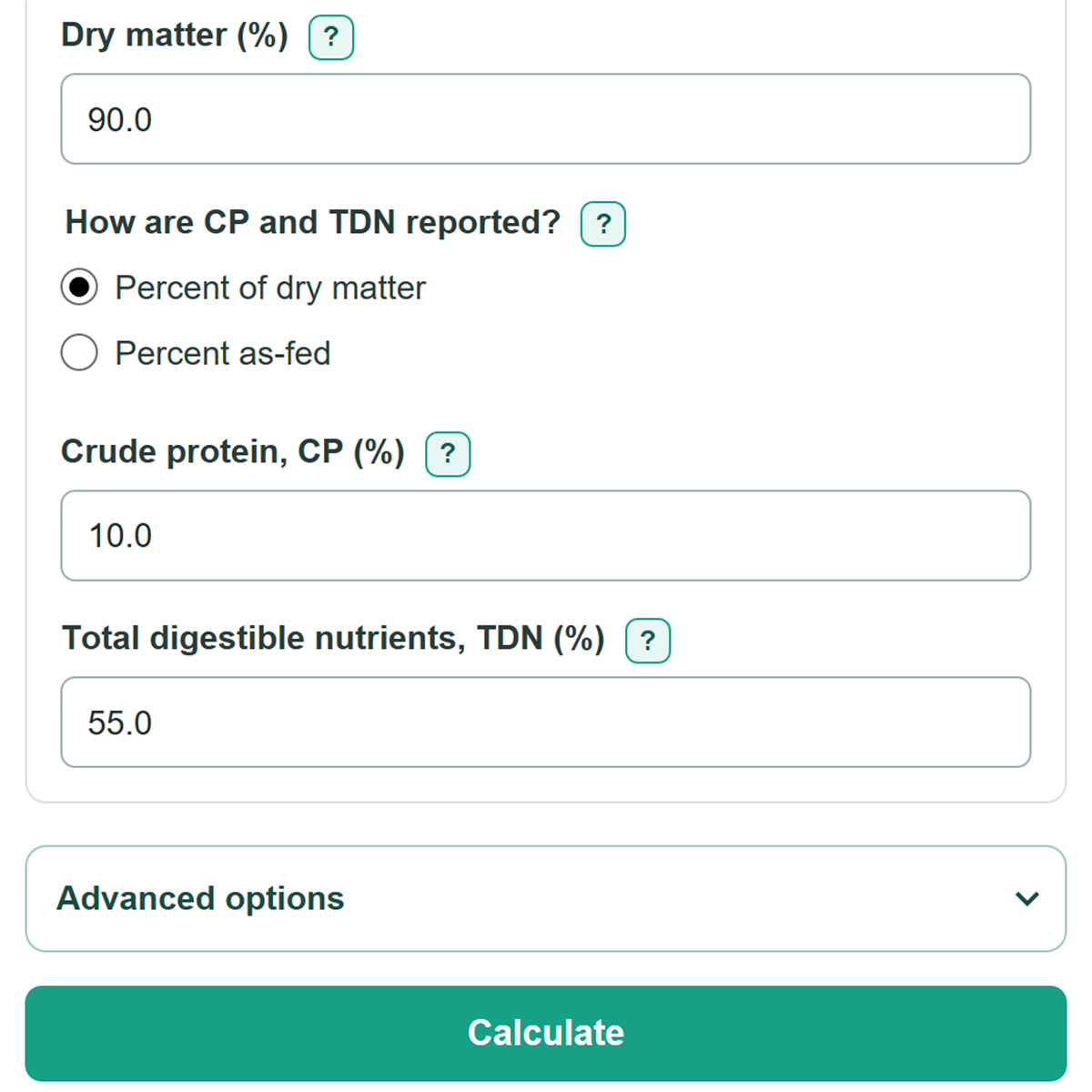
- Under "Which water value is on the report?", choose the heading used by your forage report and enter either "Dry matter" or "Moisture."
- Choose how the report lists nutrients under "How are CP and TDN reported?" Enter "Crude protein, CP" and "Total digestible nutrients, TDN" from that same report basis.
- Open Advanced options only if needed. Enter "Added delivery cost ($ per short ton)" only when delivery is not already included, plus any separate "Transport shrink (%)" or "Feeding waste (%)."
- Click Calculate. Check that the landed as-fed cost matches the quote path you entered, then compare the dry-matter and nutrient costs across hay lots using the same report basis.
Definitions
As-fed: Hay weight or nutrient content including its water.
Dry matter (DM): The part of hay left after its water is removed. A 90% DM hay lot is 90% dry material by weight.
Moisture: The water share of hay. Dry matter plus moisture equals 100%.
Crude protein (CP): A forage-report estimate of protein concentration, entered as a percent on either a dry-matter or as-fed basis.
Total digestible nutrients (TDN): A forage-report energy estimate, entered as a percent on either a dry-matter or as-fed basis.
Short ton: A US short ton equals 2,000 lb.
Transport shrink: Hay weight lost between purchase and delivery.
Feeding waste: Delivered hay that is offered but not eaten.
Common mistakes and quick fixes
Mistake: Entering a $50 bale price as "Hay price" for a short-ton quote.
Fix: Choose the matching option under "How is the hay priced?" A bale quote also needs "Average bale weight."
Mistake: Treating "Moisture" as if it were "Dry matter."
Fix: Choose the report heading under "Which water value is on the report?" Dry matter is 100% minus moisture.
Mistake: Selecting percent of dry matter while copying as-fed "Crude protein, CP" and "Total digestible nutrients, TDN."
Fix: Match "How are CP and TDN reported?" to the exact column heading on the forage report.
Mistake: Adding freight twice through "Added delivery cost ($ per short ton)."
Fix: Leave added delivery at zero when the seller's "Hay price" already includes delivery.
Mistake: Combining "Transport shrink (%)" and "Feeding waste (%)" into one number.
Fix: Enter transport shrink for loss before delivery and feeding waste for hay that is delivered but not eaten.
Mistake: Typing a malformed number such as 1,01 for "Hay price."
Fix: Use commas only for thousands, such as 1,000.00, and use a decimal point for cents.
Limitations & Key Assumptions / Boundary Conditions
- Results depend on the seller's stated bale weight and the forage report values. Weigh representative bales when the stated average is uncertain.
- This calculator treats "Added delivery cost ($ per short ton)" as a separate per-ton charge. It does not convert a truckload charge, mileage charge, or total invoice charge into a per-ton amount.
- Transport shrink changes the delivered cost, while feeding waste changes only the effective nutrient cost after hay is offered. Storage loss is not included unless you include it in your own shrink or waste estimate.
- CP and TDN costs compare reported nutrient concentration and price. They do not test mineral balance, fiber, intake, animal needs, forage safety, or whether a hay lot makes a complete ration.
- For as-fed nutrient entries, CP and TDN cannot exceed the dry-matter share because water does not supply those dry nutrients.
- Negative delivery charges and loss rates of 100% or more are outside the calculation because they would produce an invalid delivered amount.
Methodology
Calculation method
The calculator first puts the seller quote on an as-fed short-ton basis. It then adds any separate delivery cost and adjusts for transport shrink. A short ton is 2,000 lb.
dry_matter_fraction = dry_matter_percent / 100, or 1 - moisture_percent / 100
quoted_asfed_cost_per_ton = price_per_bale * 2000 / bale_weight, or price_per_ton
landed_cost_per_ton_asfed = (quoted_asfed_cost_per_ton + delivery_cost_per_ton) / (1 - transport_shrink_percent / 100)
cost_per_ton_dm = landed_cost_per_ton_asfed / dry_matter_fraction
For nutrients reported on a dry-matter basis, the calculator multiplies the report percentage by the dry-matter fraction once to get the as-fed nutrient share. For nutrients reported as-fed, it uses the entered percentage directly.
cost_per_lb_cp = landed_cost_per_ton_asfed / (2000 * cp_fraction_asfed)
cost_per_lb_tdn = landed_cost_per_ton_asfed / (2000 * tdn_fraction_asfed)
after_waste_cost = landed_nutrient_cost / (1 - feeding_waste_percent / 100)
Worked example
A $50 bale weighing 1,000 lb converts to $100 per short ton as-fed. At 90% dry matter, the cost is $111.11 per short ton DM. If CP is 10% of dry matter, the as-fed CP share is 9%, so CP costs $100 divided by 180 lb, or about $0.56 per lb. If feeding waste is 10%, the effective CP cost becomes about $0.62 per lb eaten.