
Convert grams to estimated Calories by choosing whether your grams are one nutrient, a macro breakdown, or a food label amount per 100 g.
Advanced options
Table of contents
How to use our Grams To Calories Calculator
- Pick the matching option in "What are your grams for?" so the calculator uses the right method for your label, recipe, or food entry.
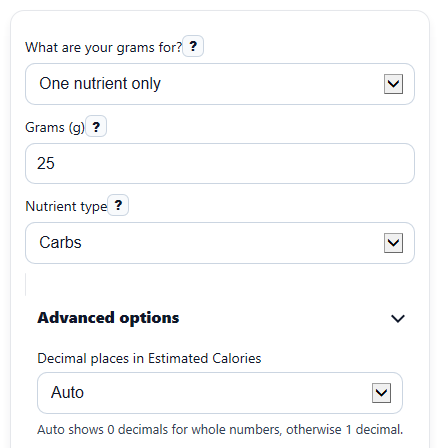
- If you choose "One nutrient only," enter "Grams (g)" and select the correct "Nutrient type" such as carbs, protein, fat, or alcohol.
- If you choose "Carbs, protein, and fat grams," enter "Carbs (g)," "Protein (g)," and "Fat (g)," then add "Alcohol (g)" only if you know it.
- If you choose "Food label calories per 100 g," enter the food weight in "Grams (g)" and the label value in "Calories per 100 g (kcal)."
- Click "Calculate," then sanity-check the result: "Estimated Calories" should match the method you picked, and "Average Calories per gram" should look reasonable for that nutrient or food.
Definitions
Calories: On food labels, Calories with a capital C mean kilocalories, the food energy your body can use [1].
Grams (g): A measure of weight. In this calculator, grams can mean nutrient grams or food weight, depending on the method you choose.
Nutrient type: The kind of gram you entered in "One nutrient only": carbs, protein, fat, or alcohol.
Calories per 100 g (kcal): How many Calories a food has in 100 grams. This lets you scale up or down for the amount you eat.
Macro breakdown: A food's grams of carbs, protein, fat, and sometimes alcohol, used together to estimate total Calories.
Average Calories per gram: The estimated Calories divided by the grams used in the active method. Higher values mean the nutrient or food is more energy-dense.
Common mistakes and quick fixes
Mistake: Entering total food weight in "Grams (g)" while using "One nutrient only."
Fix: Use "Food label calories per 100 g" for food weight, or enter the actual nutrient grams and the right "Nutrient type."
Mistake: Picking the wrong "Nutrient type" for "Grams (g)."
Fix: Match the grams to the nutrient source: carbs and protein use 4 kcal per gram, fat uses 9, and alcohol uses 7.
Mistake: Leaving "Calories per 100 g (kcal)" blank in the per-100 g method.
Fix: Enter the label or database value for "Calories per 100 g (kcal)" before calculating.
Mistake: Using serving Calories as if they were "Calories per 100 g (kcal)."
Fix: First convert the serving label to a 100 g basis, then enter that number in "Calories per 100 g (kcal)."
Mistake: Entering all zeros for "Carbs (g)," "Protein (g)," and "Fat (g)" in macro mode.
Fix: Enter at least one non-zero macro, and add "Alcohol (g)" only if it applies.
Mistake: Treating "Rounded Calories for quick logging" as more exact than "Estimated Calories."
Fix: Use "Estimated Calories" for the fuller value and use "Rounded Calories for quick logging" only when you want a simple whole-number log entry.
Limitations & Key Assumptions / Boundary Conditions
- This calculator gives an estimate based on common energy factors: 4 kcal per gram for carbs, 4 for protein, 9 for fat, and 7 for alcohol.
- Food-label Calories may not match a simple 4-4-9 estimate exactly because labels and databases can use approved calculation methods and rounding.
- In "One nutrient only," the grams must be for that nutrient, not the whole food weight.
- In "Food label calories per 100 g," you need both "Grams (g)" and "Calories per 100 g (kcal)". Weight alone is not enough to determine Calories.
- Fiber, sugar alcohols, water content, and recipe differences can make real food energy differ from a simple macro estimate.
- Results depend on the numbers you enter. If your label, recipe, or database entry is off, the estimate will be off too.
Methodology
How the calculator works
The calculator uses one of three methods, based on what your grams represent. This helps avoid the common mistake of treating all grams as if they had the same Calories.
Formulas
Estimated Calories = Grams x factor
factor = 4 for carbs, 4 for protein, 9 for fat, 7 for alcohol
Estimated Calories = 4 x Carbs (g) + 4 x Protein (g) + 9 x Fat (g) + 7 x Alcohol (g)
Estimated Calories = Grams (g) x Calories per 100 g (kcal) / 100
Average Calories per gram = Estimated Calories / active grams input
What the factors mean
The 4-4-9 rule is the common quick method for carbs, protein, and fat, and alcohol adds 7 kcal per gram [2][3]. US food labels use Calories to mean kilocalories [1].
Mini examples
If you enter 25 grams as carbs in "One nutrient only," the estimate is 25 x 4 = 100 kcal.
If you enter 30 g carbs, 20 g protein, 10 g fat, and 5 g alcohol in macro mode, the estimate is 120 + 80 + 90 + 35 = 325 kcal.
If a food has 250 kcal per 100 g and you eat 43 g, the estimate is 43 x 250 / 100 = 107.5 kcal.
Rounding and display
The main result shows "Estimated Calories" using the selected decimal setting. "Rounded Calories for quick logging" is a whole-number version for faster tracking.
Assumptions and limits
This method is best for quick tracking, label checks, and recipe estimates. Real labels can differ because of rounding, approved labeling methods, and food-specific composition differences, so treat the result as an estimate rather than an exact lab measurement.