
Convert MPG to L/100 km or reverse, choose US or UK gallons, and quickly see which direction means better fuel use.
Table of contents
How to use our MPG to L/100 km Converter
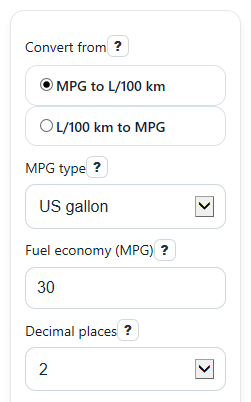
- Choose Convert from to pick whether you are starting with Fuel economy (MPG) or Fuel use (L/100 km).
- Select MPG type as US gallon or UK gallon so the conversion uses the right gallon size.
- Enter the active value only: Fuel economy (MPG) for MPG conversions or Fuel use (L/100 km) for metric conversions. The number must be greater than 0.
- Pick Decimal places, then click Calculate to see Converted value, Same value in km/L, and the Formula used.
- Sanity-check the result with What counts as better: higher MPG is better, but lower L/100 km is better, so a better car should move in opposite directions in those two units.
Definitions
MPG: Miles per gallon. It tells you how many miles a vehicle can travel on one gallon of fuel. Higher MPG means better fuel use.
L/100 km: Liters per 100 kilometers. It tells you how many liters of fuel a vehicle uses to go 100 kilometers. Lower L/100 km means better fuel use.
MPG type: The gallon standard used for MPG. A US gallon is smaller than a UK, or Imperial, gallon, so the same MPG number does not convert the same way.
km/L: Kilometers per liter. It is another fuel economy unit. Higher km/L means better fuel use.
Converted value: The main answer in the other unit, either L/100 km or MPG depending on Convert from.
Formula used: The exact conversion relationship the calculator applied so you can check the math.
Common mistakes and quick fixes
Mistake: Leaving MPG type on US gallon when your source uses UK or Imperial mpg.
Fix: Change MPG type before you calculate. US and UK gallons are different, so Converted value will change.
Mistake: Typing into Fuel economy (MPG) when Convert from is set to L/100 km to MPG.
Fix: Match the entry box to Convert from . Use Fuel use (L/100 km) for that direction.
Mistake: Thinking a bigger Converted value always means better fuel use.
Fix: Read What counts as better . Higher MPG is better, but lower L/100 km is better.
Mistake: Entering 0 or a negative number in Fuel economy (MPG) or Fuel use (L/100 km) .
Fix: Enter a number greater than 0. Zero and negative values are not valid for this conversion.
Mistake: Rounding too early and then wondering why Formula used and Converted value do not match your hand math exactly.
Fix: Keep full precision while calculating and use Decimal places only for the displayed result.
Limitations & Key Assumptions / Boundary Conditions
- This converter uses fixed unit conversions and does not estimate real driving conditions, weather, traffic, speed, tire pressure, or vehicle load.
- You must enter a value greater than 0 for the active input. Zero, negative values, and blank required entries are invalid.
- The result depends on MPG type. If a listing does not say whether mpg is US or UK, your converted value may be off.
- Rounding changes only the displayed digits. Internal math should stay more precise than the shown result.
- Very small positive inputs can produce very large outputs. That can be mathematically correct even if it looks unusual.
- This tool converts among MPG, L/100 km, and km/L only. It does not compare fuel costs, energy content, or electric vehicle efficiency measures.
Methodology
How the conversion works
The calculator uses a direct inverse relationship between MPG and L/100 km. That means if one goes up, the other goes down. This is why higher MPG is better, but lower L/100 km is better.
L/100 km = 235.214583 / MPG (US)
L/100 km = 282.480936 / MPG (UK)
MPG (US) = 235.214583 / L/100 km
MPG (UK) = 282.480936 / L/100 km
km/L = 100 / L/100 km
km/L = MPG (US) x 1.609344 / 3.785411784
km/L = MPG (UK) x 1.609344 / 4.54609
Where the constants come from
The constants come from exact unit conversions for miles to kilometers and gallons to liters [1]. For US mpg, 235.214583 is computed from 100 x 3.785411784 / 1.609344. For UK mpg, 282.480936 is computed from 100 x 4.54609 / 1.609344.
Mini example
If Convert from is MPG to L/100 km, MPG type is US gallon, and Fuel economy (MPG) is 30, then:
L/100 km = 235.214583 / 30 = 7.8404861
km/L = 30 x 1.609344 / 3.785411784 = 12.7543203
With 2 decimal places, the calculator shows 7.84 L/100 km and 12.75 km/L.
Assumptions used
This tool assumes the input value is already a valid fuel economy measurement in the selected unit system. It does not adjust for test cycles, country-specific rating rules, or real-world driving differences. Display rounding can slightly change the shown digits, but not the underlying conversion math.