
Use this electrolysis calculator to find mass made, charge used, time needed, current needed, or gas volume from one setup.
Optional: enter charge to use it instead of current and time. Leave this blank to calculate charge from current and time.
Advanced options
Real-world cell settings
Gas volume settings
Number display
How to use our Electrolysis Calculator
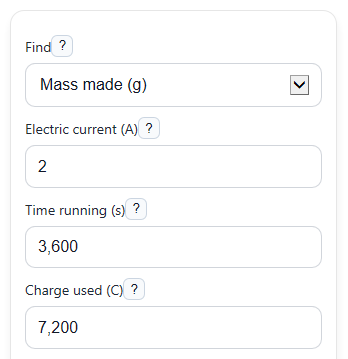
- Choose an option in Find, then enter the visible values such as Electric current (A), Time running (s), Mass made (g), or Charge used (C).
- Enter Electrons per particle, n for the reaction you are using, and add Molar mass (g/mol) when you are solving a mass question.
- If you picked gas mode, choose Gas made and, in Advanced options, pick Gas conditions. Change Faradaic efficiency (%) only if your problem is not ideal.
- Click Calculate to get the Main answer plus helpful checks like Moles of product, Moles of electrons moved, Charge used, and Time in plain words when it applies.
- Sanity-check the result: if you double Electric current (A) or Time running (s), the amount made should also double, and lower Faradaic efficiency (%) should give less product or require more time or current.
Definitions
Electric current (A): How fast electric charge flows. One amp means one coulomb each second.
Charge used (C): Total electric charge that passes through the cell.
Electrons per particle, n: Number of electrons needed to make one particle of product in the electrode reaction.
Molar mass (g/mol): Mass of 1 mole of the product. This is needed for mass questions.
Faradaic efficiency (%): Percent of the charge that actually makes your chosen product instead of being lost to side reactions.
Moles of product: Chemical amount of the substance made or required.
Moles of electrons moved: Chemical amount of electrons that passed through the circuit and reaction.
Gas conditions: The temperature and pressure rule used to convert moles of gas into volume.
Custom molar volume (L/mol): The liters taken up by 1 mole of gas under the condition your class or lab uses.
Common mistakes and quick fixes
Mistake: Typing minutes or hours into Time running (s) instead of total seconds.
Fix: Convert first. For example, 1 hour = 3600 s before you calculate.
Mistake: Using the ion charge as Electrons per particle, n without checking the actual electrode reaction.
Fix: Enter the number of electrons needed per particle made. For copper metal from Cu2+, use n = 2.
Mistake: Entering the wrong substance in Molar mass (g/mol) for a mass problem.
Fix: Use the molar mass of the product whose Mass made (g) you want, not the whole compound left in solution.
Mistake: Leaving Faradaic efficiency (%) below 100 when your class expects an ideal textbook answer.
Fix: Use 100% unless the problem says some charge is wasted on side reactions.
Mistake: Forgetting to set Gas conditions in gas mode, then comparing your Main answer to a class value from a different convention.
Fix: Match the condition your teacher uses, such as STP, SATP, or Custom molar volume (L/mol) .
Mistake: Mixing up Charge used (C) with current.
Fix: Remember that current is a rate in amps, while charge is the total amount that passed. They are linked by time.
Limitations & Key Assumptions / Boundary Conditions
- This calculator uses Faraday's law, so it assumes the electrode reaction and Electrons per particle, n are chosen correctly.
- For ideal textbook problems, set Faradaic efficiency (%) to 100. Lower real-world efficiency means less product from the same charge.
- Gas volume made depends on the selected Gas conditions. Different classroom conventions give different liters for the same moles.
- The gas mode treats gas volume with a simple molar-volume conversion and does not model non-ideal gas behavior.
- Inputs that should be positive, such as current, time, molar mass, electron count, and custom molar volume, must be greater than 0.
- This tool helps with direct electrolysis stoichiometry but does not balance chemical equations for you.
Methodology
Core idea
Electrolysis connects electricity to chemistry. The amount made depends on electric current, time, and the number of electrons needed per particle [1].
Q = I x t
n_e = Q / F
n_product = (Q x η) / (n x F)
Here, Q is charge in coulombs, I is electric current in amps, t is time in seconds, n_e is moles of electrons, η is Faradaic efficiency as a decimal, n is electrons per particle, and F is the Faraday constant, 96485.33212 C/mol.
How each answer is found
For mass problems, the calculator first finds moles of product and then converts to grams.
m = n_product x M
For gas problems, it converts moles of gas to liters with the chosen molar volume.
V = n_product x V_m
For time or current problems, the calculator rearranges the same idea after converting the target amount into moles of product.
t = (n x F x target_moles) / (η x I)
I = (n x F x target_moles) / (η x t)
If the target is mass, then target_moles = m / M. If the target is gas volume, then target_moles = V / V_m.
Mini example
Suppose copper is made with 2 A for 3600 s, with M = 63.546 g/mol, n = 2, and 100% efficiency.
Q = 2 x 3600 = 7200 C
n_e = 7200 / 96485.33212 = 0.07465 mol e-
n_product = 7200 / (2 x 96485.33212) = 0.03733 mol
m = 0.03733 x 63.546 = 2.372 g
So the main answer is about 2.372 g of copper.
Assumptions in the math
The calculator uses constant current, treats efficiency as one overall percent, and assumes the chosen product is formed directly from the entered electron count. In gas mode, volume is based only on the selected molar volume, so real lab measurements can differ if temperature, pressure, or gas collection conditions differ.