
Calculate kWh used between two electricity meter readings and estimate the bill with rates, charges, rollover, and multiplier settings.
Advanced options
Table of contents
How to use our Electricity Usage from Meter Readings Calculator
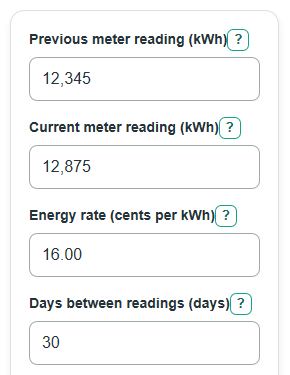
- Enter the Previous meter reading and Current meter reading in kWh from your meter or bill.
- Enter the Energy rate in cents per kWh, then enter the Days between readings so the calculator can show daily average use.
- Open Advanced options only if you need Meter rolls over after, Meter multiplier, Fixed charge or credit, or Extra adjustment.
- Click Calculate and check Electricity used after multiplier first, then compare Estimated bill after charges and adjustments with your bill estimate.
- Sanity-check the output: if Meter rollover corrections used is 1 or Average electricity used per day looks much higher than normal, recheck the readings, rollover size, and multiplier.
Definitions
Previous meter reading: The earlier kWh number from your meter or bill.
Current meter reading: The later kWh number from your meter or bill.
Kilowatt-hour (kWh): A unit of electrical energy. One kWh is the energy used by 1 kilowatt of power for 1 hour [1].
Energy rate: The usage price in cents per kWh. It is not the full bill amount.
Meter rolls over after: The kWh number the meter reaches before returning to 0, such as 100,000 for many 5-digit displays.
Meter multiplier: A factor that turns the register change into billable kWh. Most home meters use 1, but some meters use a larger printed multiplier [2].
Average power over the period: The steady kW level that would use the same total kWh over the entered number of days.
Effective cost per kWh after all charges: The estimated total bill divided by the kWh used, shown in cents per kWh.
Common mistakes and quick fixes
Mistake: Entering Energy rate as dollars, such as 0.16 for 16 cents per kWh.
Fix: Enter Energy rate in cents per kWh, so 16 cents is typed as 16.
Mistake: Swapping Previous meter reading and Current meter reading when the meter did not roll over.
Fix: Put the earlier number in Previous meter reading and the later number in Current meter reading.
Mistake: Leaving Meter rolls over after at 100,000 for a 4-digit meter that rolls after 10,000 kWh.
Fix: Set Meter rolls over after to the number after the highest display value, such as 10,000 or 100,000.
Mistake: Using Meter multiplier as 0 because the bill does not show one.
Fix: Use 1 for Meter multiplier unless your meter or bill gives a different multiplier.
Mistake: Entering a negative Fixed charge or credit by accident when it should be a charge.
Fix: Use a positive Fixed charge or credit for a charge and a negative value only for a credit.
Mistake: Putting the billing period length in months instead of Days between readings.
Fix: Count calendar days between the two readings and enter that number in Days between readings.
Limitations & Key Assumptions / Boundary Conditions
- The calculator supports either no rollover or one rollover between the two readings. It does not count two or more rollovers.
- If the current reading is lower than the previous reading, the rollover limit must be greater than both readings.
- Estimated bill after charges and adjustments is a simple estimate. Real utility bills may include tiered rates, demand charges, time-of-use prices, taxes, minimum bills, credits, or fees not entered here.
- Meter multiplier must come from the meter, bill, or utility record. Guessing this value can make the kWh estimate much too high or too low.
- Average electricity used per day and Average power over the period use the exact Days between readings value. A wrong day count changes both averages.
- Effective cost per kWh after all charges is shown as N/A when Electricity used after multiplier is 0 because dividing by zero is not valid.
- Negative Fixed charge or credit, Extra adjustment, Percent adjustment added or subtracted, or Estimated bill after charges and adjustments can be valid when credits are larger than charges.
Methodology
How the reading change is found
The calculator first compares Current meter reading with Previous meter reading. If the current reading is greater than or equal to the previous reading, it uses the direct difference.
register_kwh_counted = current_reading - previous_reading
If the current reading is lower, the calculator treats the meter as rolling back to 0 once, but only when Meter rolls over after is greater than both readings.
register_kwh_counted = (rollover_limit - previous_reading) + current_reading
How usage and bill amounts are calculated
The register change is multiplied by Meter multiplier to get the main usage output.
electricity_used_kwh = register_kwh_counted * meter_multiplier
The usage charge uses Energy rate in cents per kWh and converts cents to dollars by dividing by 100.
energy_charge = electricity_used_kwh * energy_rate_cents / 100
Fixed charge or credit is added before the percent adjustment. Extra adjustment can be positive for a surcharge or negative for a discount.
subtotal = energy_charge + fixed_charge
adjustment_amount = subtotal * adjustment_percent / 100
estimated_total_bill = subtotal + adjustment_amount
Daily use and average load use the entered day count. The average load formula divides by 24 hours per day.
daily_average_kwh = electricity_used_kwh / days_between_readings
average_load_kw = electricity_used_kwh / (days_between_readings * 24)
Effective cost per kWh includes fixed charges and adjustments, so it can be different from Energy rate.
effective_rate_cents = estimated_total_bill / electricity_used_kwh * 100
Mini example
Suppose Previous meter reading is 12,345, Current meter reading is 12,875, Energy rate is 16, Days between readings is 30, and Meter multiplier is 1. The register change is 530 kWh, so Electricity used after multiplier is 530 kWh. Energy charge from kWh use is 530 x 16 / 100 = $84.80. With no fixed charge and no adjustment, Estimated bill after charges and adjustments is $84.80. Average electricity used per day is 530 / 30 = 17.67 kWh per day, and Average power over the period is 530 / (30 x 24) = 0.736 kW.