
Convert dimes to dollars or dollars to dimes, with cents and a simple whole-dollar coin breakdown to help you check your counting.
Advanced options
Table of contents
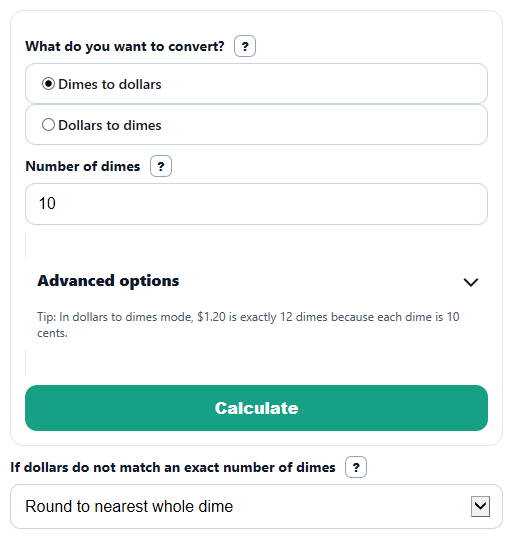
How to use our Dimes to Dollars Calculator
- Choose "Dimes to dollars" or "Dollars to dimes" under "What do you want to convert?".
- Enter either "Number of dimes" as a whole coin count or "Dollar amount ($)" as a standard money amount with up to 2 decimal places.
- If you are converting dollars to dimes, pick a rule in "If dollars do not match an exact number of dimes" to round to the nearest whole dime, down, or up.
- Click "Calculate" to see the converted amount, the "Value in cents", and any extra details such as "Whole dollars", "Leftover dimes after whole dollars", or "Exact dimes before rounding".
- Sanity-check the result: 10 dimes should equal $1, and the "Value in cents" should match your money amount times 100.
Definitions
Dime: A U.S. coin worth 10 cents, or $0.10.
Dollar amount ($): The money value entered in dollars and cents, such as 1.23 for $1.23.
Value in cents: The same amount written in cents instead of dollars.
Whole dollars: The number of full $1 groups you can make from the dimes entered.
Leftover dimes after whole dollars: The extra dimes left after making as many full dollars as possible.
Exact dimes before rounding: The decimal coin count found from the dollar amount before any rounding rule is applied.
Rounding: A rule that changes a decimal coin count to a whole number of dimes by going to the nearest whole dime, down, or up.
Common mistakes and quick fixes
Mistake: Entering 3.5 in "Number of dimes".
Fix: Use a whole number in "Number of dimes" because coin counts cannot include half a dime.
Mistake: Typing a negative value in "Number of dimes" or "Dollar amount ($)".
Fix: Enter 0 or a positive amount only.
Mistake: Entering more than 2 decimal places in "Dollar amount ($)", such as 1.235.
Fix: Use a standard money amount with 0 to 2 decimal places, such as 1.23.
Mistake: Forgetting that "Converted amount" may be rounded in dollars-to-dimes mode.
Fix: Check "Exact dimes before rounding" and "Rounding note" when the dollar amount is not an exact multiple of 10 cents.
Mistake: Reading "Whole dollars" as the full answer in dimes-to-dollars mode.
Fix: Use "Converted amount" for the total value, and use "Whole dollars" plus "Leftover dimes after whole dollars" only as a breakdown.
Mistake: Thinking "Value in cents" should be different from the coin value shown elsewhere.
Fix: Use "Value in cents" as a check: each dime adds 10 cents, and $1 equals 100 cents.
Limitations & Key Assumptions / Boundary Conditions
- This tool assumes every dime is worth exactly $0.10 and uses standard U.S. money relationships.
- In "Dimes to dollars" mode, "Number of dimes" must be a whole number. Decimal coin counts are rejected.
- In "Dollars to dimes" mode, "Dollar amount ($)" is limited to normal money entry with 0 to 2 decimal places.
- If a dollar amount does not equal a whole number of dimes, the reported dime count depends on the selected rounding rule.
- The calculator is for value conversion only. It does not account for damaged coins, collector value, bank roll rules, or fees.
- Negative amounts are treated as invalid for this use case.
Methodology
How the calculator works
The math is based on one simple fact:
1 dime = $0.10, so 10 dimes = $1.
dollars = dimes / 10
cents = dimes * 10
whole_dollars = floor(dimes / 10)
leftover_dimes = dimes mod 10
exact_dimes = dollars / 0.10
What each formula means
For dimes to dollars, divide the number of dimes by 10 because 10 dimes make 1 dollar. To show cents, multiply the dimes by 10 because each dime is worth 10 cents.
For the breakdown, the calculator finds how many full groups of 10 dimes fit into the total. Those groups become "Whole dollars". Any remaining dimes become "Leftover dimes after whole dollars".
For dollars to dimes, divide the dollar amount by 0.10 to get the exact number of dimes. If that result is not a whole number, the calculator also applies your selected rounding rule to produce the main whole-coin answer.
Mini example
If you enter 37 for "Number of dimes":
dollars = 37 / 10 = 3.7
cents = 37 * 10 = 370
whole_dollars = floor(37 / 10) = 3
leftover_dimes = 37 mod 10 = 7
So the total value is $3.70, which is 370 cents, with 3 whole dollars and 7 leftover dimes.
If you enter 1.23 for "Dollar amount ($)":
exact_dimes = 1.23 / 0.10 = 12.3
That is not a whole number of coins, so the final dime count depends on your rounding choice. Nearest gives 12, down gives 12, and up gives 13.
Assumptions used
The calculator assumes standard U.S. coin values and normal money formatting. It rejects negative amounts, rejects decimal dime counts, and rejects dollar entries with more than 2 decimal places because those do not match ordinary cash amounts for this tool.