
Convert cups plus tablespoons to fluid ounces, or turn fluid ounces into an easy cup-and-spoon measuring plan.
Advanced options
Table of contents
How to use our Cups and Tablespoons to Fluid Ounces Converter
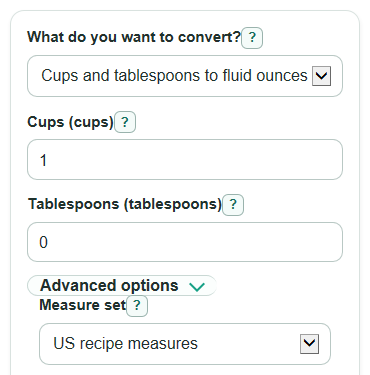
- Pick What do you want to convert? so the visible boxes match the amount you have.
- For cups and spoons to fl oz, enter Cups and Tablespoons as numbers, using 0 for either part you do not have.
- For fl oz back to a measuring plan, enter Fluid ounces, then choose Round spoon amount in Advanced options if you want easier spoon measuring.
- Use Measure set only when needed: US recipe measures fits most recipes, while US nutrition label measures fits label-style household amounts.
- Sanity-check the answer: in US recipe measures, 1 cup is 8 fl oz and 2 tablespoons is 1 fl oz, so 1 cup plus 2 tablespoons should be 9 fl oz.
Definitions
Fluid ounce: A US volume unit used on liquid measuring cups. It is not the same as an ounce of weight.
Cup: In US recipe measures, 1 cup is 8 fluid ounces. In US nutrition-label measures, this converter uses 240 mL per cup.
Tablespoon: In US recipe measures, 1 tablespoon is 1/2 fluid ounce. In US nutrition-label measures, this converter uses 15 mL per tablespoon.
Measure set: The size standard used for Cups and Tablespoons. Changing it can change the final fluid-ounce answer.
Round spoon amount: An optional reverse-conversion setting that rounds the leftover Tablespoons after the whole cups are counted.
Rounding change: The signed difference between the exact Fluid ounces you entered and the rounded measuring plan.
Common mistakes and quick fixes
Mistake: Entering weight ounces from a food scale in Fluid ounces.
Fix: Use Fluid ounces only for liquid volume lines on a measuring cup, not weight ounces.
Mistake: Putting leftover spoon amounts into Cups instead of Tablespoons.
Fix: Enter the whole-cup part in Cups and the extra spoon part in Tablespoons.
Mistake: Leaving Cups or Tablespoons blank because the amount is zero.
Fix: Type 0 in Cups or Tablespoons when that part of the recipe is not used.
Mistake: Using Measure set = US nutrition label measures for a normal recipe by accident.
Fix: Keep Measure set on US recipe measures unless you are matching a nutrition label household amount.
Mistake: Turning on Round spoon amount and ignoring Rounding change.
Fix: Check Rounding change to see whether the rounded cup-and-spoon plan measures slightly more or less.
Limitations & Key Assumptions / Boundary Conditions
- Results in Fluid ounces are US fluid ounces, not Imperial fluid ounces and not weight ounces.
- US recipe measures use 1 cup = 8 fl oz and 1 tablespoon = 0.5 fl oz. Some cookware or international recipes may use different cup or spoon sizes.
- US nutrition label measures use 240 mL per cup and 15 mL per tablespoon, so those answers can differ from standard recipe-measure answers.
- Round spoon amount changes only the reverse cup-and-spoon plan. It can make the measured amount slightly higher or lower than the exact Fluid ounces entered.
- The converter does not adjust for ingredient density. For example, 8 fl oz of oil and 8 fl oz of water have the same volume but not the same weight.
- Very small or very large values are computed mathematically, but real measuring cups and spoons may not be practical or precise at those sizes.
Methodology
Measure sizes used
The calculator first chooses the cup and tablespoon sizes from Measure set. US recipe measures use 1 cup = 8 fl oz and 1 tablespoon = 0.5 fl oz, matching common kitchen conversions [2]. US nutrition label measures use 240 mL per cup and 15 mL per tablespoon.
if Measure set is US recipe measures: cup_mL = 8 * 29.5735295625 and tbsp_mL = 0.5 * 29.5735295625
if Measure set is US nutrition label measures: cup_mL = 240 and tbsp_mL = 15
Cups and tablespoons to fluid ounces
When What do you want to convert? is Cups and tablespoons to fluid ounces, the calculator reads Cups and Tablespoons, converts both to milliliters, and then divides by the US fluid-ounce size.
total_mL = Cups * cup_mL + Tablespoons * tbsp_mL
Fluid ounces = total_mL / 29.5735295625
Same amount in cups = total_mL / cup_mL
Same amount in tablespoons = total_mL / tbsp_mL
Example with US recipe measures: 1 cup plus 2 tablespoons is 8 fl oz plus 1 fl oz, so the total is 9 fl oz. The same amount is 1.125 cups, 18 tablespoons, and about 266.16 mL.
Fluid ounces to cups and tablespoons
When What do you want to convert? is Fluid ounces to cups and tablespoons, the calculator converts Fluid ounces to milliliters, counts the largest whole-cup amount, then converts the leftover volume to Tablespoons after the cups.
total_mL = Fluid ounces * 29.5735295625
Whole cups = floor(total_mL / cup_mL)
Tablespoons after the cups = (total_mL - Whole cups * cup_mL) / tbsp_mL
If Round spoon amount is Exact decimal, the leftover tablespoon amount is not rounded. If a rounding step is selected, the leftover tablespoons are rounded to the nearest 1/4 tablespoon, 1/2 tablespoon, or whole tablespoon. If rounding creates a full cup or more of leftover tablespoons, the calculator carries that into Whole cups.
rounded tablespoons = round(exact tablespoons / rounding step) * rounding step
Rounding change = (rounded measuring plan mL - exact total_mL) / 29.5735295625
Input handling
The calculator strips commas and spaces before reading numbers. It rejects blank visible number boxes, negative volumes, and non-numeric text. Hidden mode inputs are not read, so Cups and Tablespoons do not affect reverse mode and Fluid ounces does not affect forward mode.