
Convert fluid ounces into cups, tablespoons, teaspoons, milliliters, and a recipe-ready measuring plan.
Advanced options
Table of contents
How to use our Fluid Ounces to Cups and Tablespoons Converter
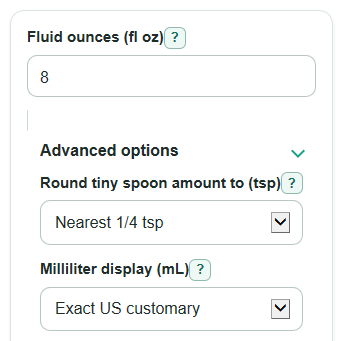
- Enter the liquid amount in Fluid ounces (fl oz); use liquid volume ounces, not ounces by weight.
- Open Advanced options only if you want to change Round tiny spoon amount to or Milliliter display.
- Click Calculate and read Easy measuring plan amount first, then measure Whole cups to measure, Extra cup fraction, Extra tablespoons, and Extra teaspoons in that order.
- Check Change from spoon rounding; 0 means the plan matches exactly, a positive number means it measures a little more, and a negative number means it measures a little less.
- Use Decimal cups, Total tablespoons, Total teaspoons, or Milliliters when a recipe or label needs one single unit.
Definitions
Fluid ounce (fl oz): A US liquid volume unit. It is different from an ounce of weight.
Cup: A US recipe volume unit equal to 8 fl oz in this converter.
Tablespoon (tbsp): A spoon volume unit. This converter uses 2 tbsp per fl oz.
Teaspoon (tsp): A smaller spoon volume unit. This converter uses 3 tsp per tbsp.
Easy measuring plan amount: The volume made by the listed cups, cup fraction, tablespoons, and teaspoons.
Change from spoon rounding: The measuring plan amount minus the exact entered amount. Positive means a little more; negative means a little less.
Milliliter display: The choice between exact US customary milliliters and rounded household label milliliters.
Common mistakes and quick fixes
Mistake: Entering dry ounces in Fluid ounces (fl oz) for flour, sugar, or butter by weight.
Fix: Use this converter only when the recipe gives liquid volume in Fluid ounces (fl oz) ; dry ounces need an ingredient density.
Mistake: Leaving Fluid ounces (fl oz) blank or typing words with the number.
Fix: Enter numbers only, such as 8, 2.5, or 1,000.
Mistake: Treating Extra cup fraction as an extra amount after using Decimal cups .
Fix: Use either the measuring plan parts or the single Decimal cups value, not both.
Mistake: Ignoring Change from spoon rounding when Round tiny spoon amount to is set to 1/4 tsp or 1/2 tsp.
Fix: If the change matters, switch Round tiny spoon amount to to Exact amount or Nearest 1/8 tsp.
Mistake: Comparing Milliliters to a label without checking Milliliter display .
Fix: Use Exact US customary for precise conversion, or Nutrition label rounded when matching many US food labels.
Limitations & Key Assumptions / Boundary Conditions
- This converter is for US liquid volume. It does not convert dry ounces by weight to cups, tablespoons, or teaspoons.
- The measuring plan favors common cup fractions first: 1/4, 1/3, 1/2, 2/3, and 3/4 cup. Another cook may choose a different but equal set of measures.
- Spoon rounding changes only the practical measuring plan. Exact Decimal cups, Total tablespoons, Total teaspoons, and Milliliters stay based on the entered amount.
- Very small amounts can round to 0 tsp when Round tiny spoon amount to uses a coarse setting. Check Change from spoon rounding before using the plan.
- The rounded label milliliter option uses 30 mL per fl oz and 240 mL per cup as household labeling-style amounts, so it will differ from exact US customary milliliters.
- Real measuring cups and spoons have fill-line and leveling error, so actual kitchen results can vary slightly.
Methodology
Core conversions
The converter first treats the entry as US fluid ounces. For kitchen units, it uses 1 cup = 8 fl oz, 1 fl oz = 2 tbsp, and 1 tbsp = 3 tsp. NIST household cooking equivalents list related rounded kitchen measures such as 1 tablespoon as 15 mL and 1 fluid ounce as 30 mL for metric kitchen use [1].
decimal_cups = amount_fl_oz / 8
total_tablespoons = amount_fl_oz * 2
total_teaspoons = amount_fl_oz * 6
Milliliters
The exact US customary option uses 29.5735295625 mL per fl oz. The nutrition-label-style rounded option uses 30 mL per fl oz, so 8 fl oz displays as 240 mL.
milliliters = amount_fl_oz * ml_per_fl_oz
Measuring plan
The practical plan converts the amount to teaspoons, takes as many whole cups as possible, then chooses the largest common cup fraction that does not go over the remaining amount. After that it uses whole tablespoons and the leftover teaspoons.
exact_total_tsp = amount_fl_oz * 6
whole_cups = floor(exact_total_tsp / 48)
fraction_cups = largest value in 0, 1/4, 1/3, 1/2, 2/3, 3/4 that is not over the remaining cups
tablespoons = floor(remaining_tsp / 3)
plan_teaspoons = remaining teaspoons rounded to the selected spoon size
measuring_plan_total_fl_oz = plan_total_tsp / 6
rounding_change_fl_oz = measuring_plan_total_fl_oz - amount_fl_oz
Mini-example
For 2.6 fl oz, exact cups are 2.6 / 8 = 0.325 cups. Total tablespoons are 2.6 * 2 = 5.2 tbsp, and total teaspoons are 2.6 * 6 = 15.6 tsp. The plan uses 1/4 cup, then 1 tbsp, then 0.75 tsp when rounding to the nearest 1/4 tsp. That plan equals 2.625 fl oz, so Change from spoon rounding is +0.025 fl oz.