
Estimate annual fuel, water, sewer, treatment, and total operating savings from returning additional hot condensate to your boiler system.
Temperature and boiler
Site costs
Advanced options
Return loss
Water assumptions
Estimated cold makeup water displaced by usable returned condensate.
A negative value means the condensate is colder than the makeup water and adds a heating load.
Estimated liquid mass reaching the feedwater system each year.
Calculation details
Table of contents
How to use our Condensate Return Energy and Water Savings Calculator
- Enter only the additional condensate available for the project in Additional condensate available, along with its Annual operating hours.
- Enter Condensate temperature and Makeup-water temperature measured at comparable points near the boiler feedwater system.
- Enter Boiler efficiency as a whole percent, such as 80, then copy marginal fuel and variable water-cost lines from site invoices.
- Open Advanced options if a known share is lost before liquid return, or if a site study provides different water-property values.
- Calculate, then check that Annual condensate returned after losses and Annual makeup water avoided match the scale of your flow and operating schedule before using the savings estimate.
Definitions
Condensate: Hot liquid water left after steam gives up heat. Returning it can replace colder boiler makeup water.
Makeup water: New water added to replace water not returned to the boiler system.
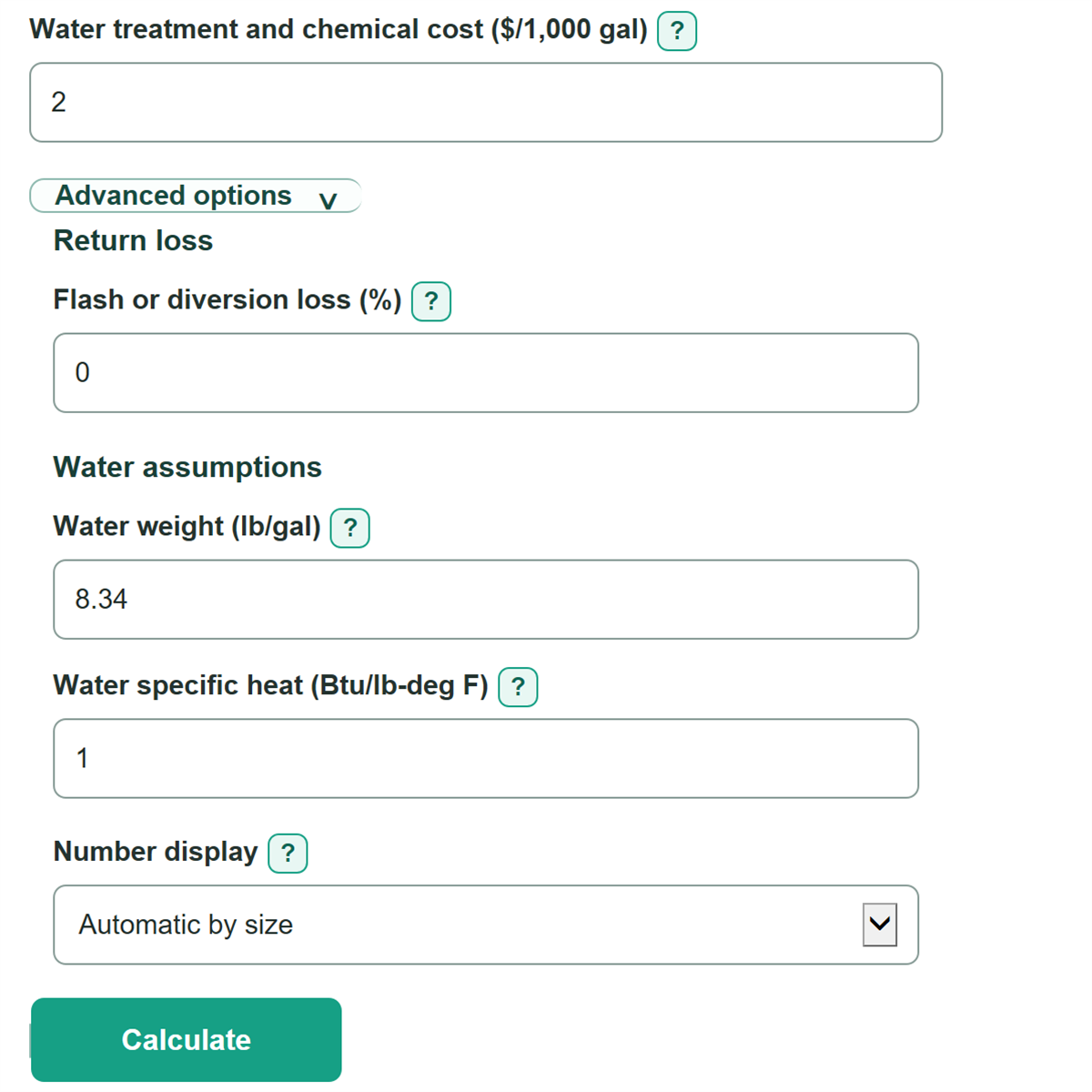
Flash or diversion loss: The percent of available condensate that does not reach the feedwater system as liquid.
Marginal fuel cost: The fuel charge per MMBtu that decreases when the boiler uses less fuel; fixed account charges do not belong in this rate.
MMBtu: One million British thermal units, a unit of energy.
Water weight: The mass of one gallon of water. The default 8.34 lb/gal is a planning approximation because water density changes with temperature and other conditions. [1]
Specific heat: The heat needed to warm one pound of water by 1 deg F. The default 1.00 Btu/lb-deg F is a simplified planning value.
Common mistakes and quick fixes
Mistake: Entering all plant condensate in Additional condensate available instead of only the extra flow this project can return.
Fix: Enter only the added lb/hr expected because of the proposed change.
Mistake: Entering 0.80 in Boiler efficiency when the field expects a percent.
Fix: Enter 80 for an 80% boiler efficiency.
Mistake: Copying a fuel invoice price per therm, gallon, or other unit into Marginal fuel cost.
Fix: Convert the variable fuel price to $/MMBtu before entering it.
Mistake: Including fixed utility fees in Variable water cost or Variable sewer cost.
Fix: Enter only charges that actually decrease when fewer gallons are purchased or discharged.
Mistake: Adding Flash or diversion loss (%) when the entered flow is already measured at the feedwater system.
Fix: Leave Flash or diversion loss (%) at 0% to avoid counting the same loss twice.
Mistake: Comparing a Condensate temperature reading far upstream with a Makeup-water temperature measured near the boiler.
Fix: Use readings from comparable points near the feedwater system.
Limitations & Key Assumptions / Boundary Conditions
- This is an annual planning estimate for an additional liquid-condensate return stream, not a full steam-system model.
- It uses sensible heat from the entered temperature difference. It does not calculate steam-table properties, pressure changes, latent heat, or heat loss along the return line.
- Enter temperatures measured near comparable feedwater-system points. Different measurement locations can overstate or understate recovered heat.
- Water weight and specific heat use editable simplified assumptions. Actual water properties vary with temperature and dissolved material.
- Only variable fuel, water, sewer, treatment, and chemical charges are included. Fixed fees, minimum bills, pump electricity, maintenance, installation cost, and capital cost are excluded.
- A negative fuel-energy or fuel-savings value is kept when condensate is colder than makeup water. It means the entered stream adds heating load under this model.
- Zero annual operating hours correctly produces zero annual return, energy, water, and cost savings.
Methodology
Calculation method
The estimate treats usable returned condensate as water that replaces the same mass of colder makeup water. Returning hot condensate can reduce boiler fuel demand because less heat is needed to raise feedwater temperature. [2]
annual available condensate (lb/year) = additional condensate available (lb/hr) x annual operating hours
annual condensate returned (lb/year) = annual available condensate x (1 - flash or diversion loss / 100)
annual makeup water avoided (gal/year) = annual condensate returned / water weight
recovered heat (Btu/year) = annual condensate returned x water specific heat x (condensate temperature - makeup-water temperature)
annual boiler fuel energy avoided (MMBtu/year) = recovered heat / 1,000,000 / (boiler efficiency / 100)
fuel savings ($/year) = annual boiler fuel energy avoided x marginal fuel cost
water, sewer, or treatment savings ($/year) = annual makeup water avoided / 1,000 x that category's variable cost
total annual operating savings = fuel savings + water savings + sewer savings + treatment savings
Worked example
With 1,000 lb/hr available for 4,000 hours, 0% loss, 180 deg F condensate, 60 deg F makeup water, and 80% efficiency, annual returned condensate is 4,000,000 lb. Using 8.34 lb/gal, this displaces about 479,616 gal/year. The 120 deg F temperature gap gives 600 MMBtu/year of avoided boiler fuel energy. At $8/MMBtu plus $4, $6, and $2 per 1,000 gal for water, sewer, and treatment, total annual operating savings are about $10,555.
Assumptions and limits
The model keeps signed temperature differences. If condensate is colder than makeup water, recovered heat and fuel savings are negative rather than changed to zero. A blank Flash or diversion loss (%) is treated as 0%. The calculation does not include fixed charges or project costs.