
Estimate cattle cost of gain, break-even sale and purchase prices, and projected profit or loss per head from your feeding plan.
Calculation details
Table of contents
How to use our Cattle Feed Cost of Gain and Break-Even Price Calculator
- Choose "Quick total" if you already know an all-in cost of gain, or choose "Build from costs" to estimate it from ration and operating costs.
- Enter Starting weight, Target sale weight, Purchase price, and Expected sale price from your records, bids, or feeding plan.
- For Quick total, enter All-in cost of gain. For Build from costs, choose the Ration price and feed conversion basis, then enter ration, performance, yardage, and health costs on that same basis.
- Open Advanced options only to add Freight and marketing cost, Financing cost, Death loss, or Other cost when those amounts are not already included.
- Check that the projected cost of gain is close to a comparable closeout and that the break-even sale price is realistic for your marketing plan before relying on the profit or loss estimate.
Definitions
cwt: Hundredweight. In this calculator, 1 cwt equals 100 lb, so $1.20 per lb gained equals $120 per cwt gained.
Cost of gain: Post-purchase feeding and operating cost divided by pounds gained. It does not include the original purchase cost.
As-fed: A feed basis that includes the water in the ration.
Dry matter: A feed basis that excludes water. Ration price and Feed used per pound gained must use the same basis.
Feed conversion: Pounds of feed needed for each pound of live-weight gain, such as 6 lb feed per lb gain.
Average daily gain: Average pounds gained per head per day. It is used to estimate days on feed and yardage.
Death-loss allocation: An added cost per expected surviving head after spreading planned costs across the surviving share.
Break-even sale price: The sale price per cwt needed to make projected profit or loss exactly zero at the target sale weight.
Maximum break-even purchase price: The highest purchase price per cwt that makes projected profit or loss exactly zero under the entered sale and cost assumptions.
Common mistakes and quick fixes
Mistake: Entering a Target sale weight that is equal to or below Starting weight.
Fix: Enter a Target sale weight higher than Starting weight so Planned weight gain is positive.
Mistake: Reading Purchase price as dollars per pound when the label says $ per cwt.
Fix: Use the price in $ per cwt; divide a dollars-per-pound quote by nothing and multiply it by 100 before entering it as $ per cwt.
Mistake: Using an as-fed Ration price with a dry-matter Feed used per pound gained.
Fix: Set Ration price and feed conversion basis to the basis used by both numbers, then use matching ration price and feed conversion records.
Mistake: Adding Yardage, Health and processing cost, or Financing cost after entering an All-in cost of gain.
Fix: Use Quick total for one all-in figure, or switch to Build from costs and enter each cost category once.
Mistake: Treating Yardage as a one-time charge.
Fix: Enter Yardage as $ per head per day because it is multiplied by Estimated days on feed.
Mistake: Entering 2.00 for Death loss when the intended rate is 2 percent, then assuming it means 200 percent.
Fix: Check How do you want to enter feeding costs? and then recalculate. Enter 2 for 2 percent. The calculator accepts Death loss from 0 percent up to, but not including, 100 percent.
Limitations & Key Assumptions / Boundary Conditions
- This is a planning estimate per head. It does not forecast local cattle prices, basis, premiums, shrink, grade, yield, or actual sale settlement.
- Quick total assumes All-in cost of gain already includes every intended post-purchase cost. Build-only costs are ignored in Quick total to prevent double-counting.
- Build from costs assumes Ration price and Feed used per pound gained use the same As-fed or Dry matter basis. Mixing bases can materially distort feed cost.
- Days on feed is planned weight gain divided by Average daily gain. Actual gain, weather, health, intake, and marketing timing can change it.
- Death loss is a risk allocation across expected surviving head, not a prediction that a specific animal will die.
- Freight and marketing cost, Financing cost, Death loss, and Other cost are optional and count as zero when left blank. Add them only if they are not already included in another entered cost.
- A negative projected profit or loss or Maximum break-even purchase price remains negative. It means the entered sale revenue does not cover the relevant projected costs.
Methodology
Core calculations
The calculator uses 100 lb per cwt and 2,000 lb per US short ton. Planned weight gain is the target sale weight minus the starting weight.
planned gain (lb per head) = target sale weight - starting weight
Purchase cost uses the starting weight, while expected sale revenue uses the target sale weight.
purchase cost per head = starting weight x purchase price per cwt / 100
expected sale revenue per head = target sale weight x expected sale price per cwt / 100
Quick total method
Quick total treats All-in cost of gain as the complete post-purchase cost. It does not add ration, yardage, health, freight, financing, other cost, or death loss fields.
feeding and other cost per head = planned gain x all-in cost of gain per cwt / 100
projected profit or loss per head = expected sale revenue - purchase cost - feeding and other cost
Build from costs
Build from costs calculates feed from planned gain, feed conversion, and ration price. It calculates yardage from days on feed. Blank optional per-head costs count as zero.
days on feed = planned gain / average daily gain
feed cost per head = planned gain x feed used per pound gained x ration price per ton / 2,000
yardage cost per head = days on feed x yardage per day
When Death loss is entered, the calculator divides purchase and Build costs by the expected surviving share. The difference is shown as Death-loss allocation per surviving head.
total cost after death loss = cost before death loss / (1 - death loss percent / 100)
Break-even prices
Break-even sale price is the sale price that recovers total cost at the target weight. Maximum break-even purchase price is the starting-cattle price supported by expected sale revenue after post-purchase costs.
break-even sale price per cwt = projected total cost per head / target sale weight x 100
cost of gain per cwt = feeding and other cost per head / planned gain x 100
Worked example
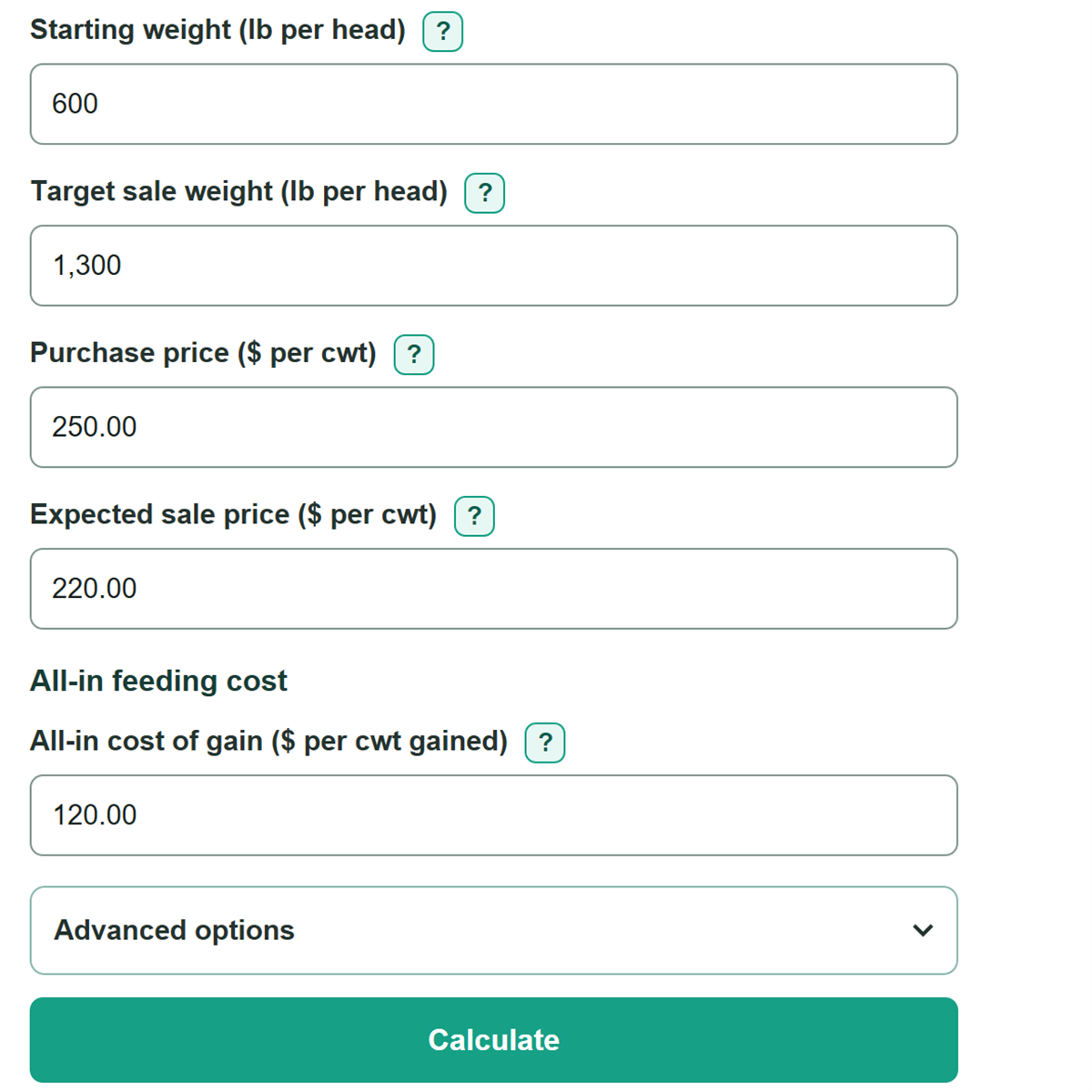
In Quick total mode, a 600 lb steer bought at $250 per cwt and sold at 1,300 lb for $220 per cwt gains 700 lb. With an all-in cost of gain of $120 per cwt, post-purchase cost is $840 per head. Purchase cost is $1,500, sale revenue is $2,860, and projected profit is $520 per head.