
Calculate dry fertilizer for a greenhouse stock tank using your target ppm N, injector ratio, fertilizer label, and tank size.
Advanced options
Table of contents
How to use our Greenhouse Fertilizer Injector and Stock Solution Calculator
- Choose "Use nitrogen percent" if you know the first number in the fertilizer grade, or choose "Use a label recipe" if the bag gives a stock mixing rate.
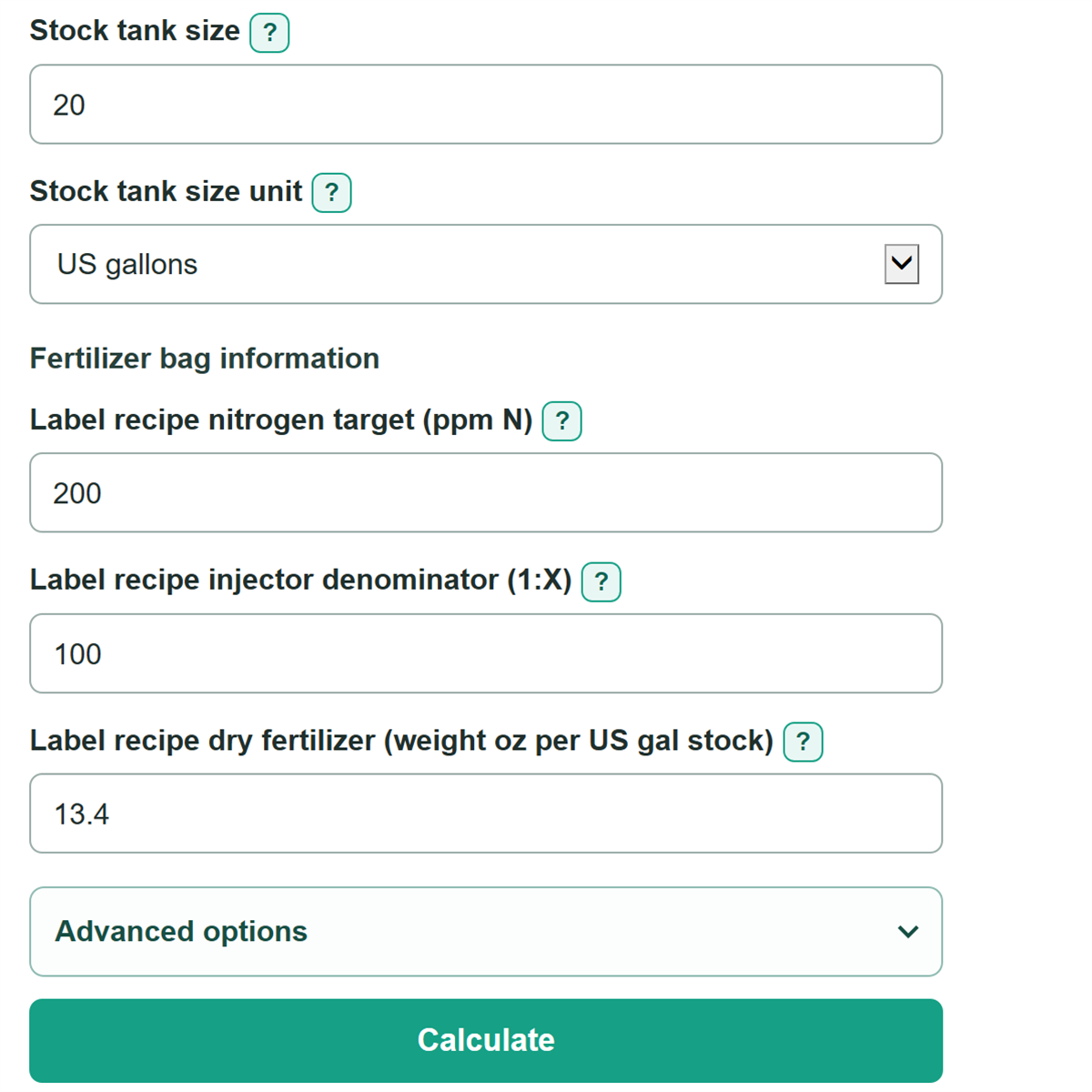
- Enter the target nitrogen in final irrigation water, the injector ratio denominator, and the working Stock tank size with its unit.
- For the nitrogen-percent method, enter only the first grade number, such as 20 from 20-10-20. For the label-recipe method, copy all three reference values from the bag.
- Click Calculate, then use Dry fertilizer per US gallon of stock to mix the stock and Dry fertilizer for this stock batch to weigh the full tank amount.
- Sanity-check that the Injector ratio used in the recipe matches the injector dial or a field calibration, and confirm that dry weight ounces were not confused with liquid fluid ounces.
Definitions
ppm N: Parts per million nitrogen. In irrigation water, it is the target nitrogen concentration after the stock is diluted.
Injector ratio (1:X): The proportion of stock solution drawn into irrigation water. A denominator of 100 means 1 part stock is mixed with 100 parts water.
Stock solution: The concentrated fertilizer mixture held in the stock tank before the injector dilutes it.
Nitrogen percent (% N): Nitrogen by weight in the fertilizer. For a 20-10-20 grade, the nitrogen percent is 20.
Dry weight ounce: An ounce of fertilizer mass. It is different from a liquid fluid ounce.
Field calibration: A test that measures collected irrigation water and stock solution used to find the actual injector ratio.
Common mistakes and quick fixes
Mistake: Entering 20-10-20 in Nitrogen on fertilizer label.
Fix: Enter only 20, because this calculation uses the nitrogen percentage only.
Mistake: Treating Target nitrogen in final irrigation water as the concentration in the stock tank.
Fix: Enter the diluted ppm N you want at the plant. The calculator makes the stronger stock recipe.
Mistake: Entering 100 ppm in Injector ratio denominator.
Fix: Enter the number after 1: on the injector, such as 100 for a 1:100 ratio.
Mistake: Using liquid fluid ounces for Label recipe dry fertilizer.
Fix: Copy dry fertilizer weight oz per US gal stock from the label. Fluid ounces are used only for Stock solution used during test (liquid fl oz).
Mistake: Filling only Irrigation water collected during test (US gal) or only Stock solution used during test (liquid fl oz).
Fix: Enter both measurements from the same test, or clear both fields to use Injector ratio denominator.
Mistake: Using the tank's maximum capacity instead of Stock tank size.
Fix: Enter the amount of stock solution you will actually prepare in this batch.
Limitations & Key Assumptions / Boundary Conditions
- The calculation is for fully water-soluble fertilizer used through a proportional injector. It does not check product solubility, compatibility, precipitation, or mixing order.
- Target nitrogen in final irrigation water must come from your crop program, fertilizer label, or advisor. The calculator does not recommend a crop rate.
- The nitrogen-percent method calculates fertilizer mass from the first fertilizer-grade number only. It does not calculate phosphorus, potassium, micronutrients, alkalinity, or electrical conductivity.
- A field calibration is only as accurate as the collected irrigation-water volume and measured stock drawdown. Take both measurements during the same test.
- The result assumes the injector ratio stays consistent during use. Wear, pressure changes, flow conditions, and equipment settings can change actual dilution.
- Tank size is the working stock volume. It does not estimate how long the batch will last because irrigation flow and runtime are not entered.
Methodology
Calculation method
The calculator first chooses the injector denominator. It uses the entered Injector ratio denominator unless both field-calibration measurements are present. A calibration measurement overrides the entered setting because it describes the tested dilution ratio. Injector pumps should be checked and calibrated as part of their operation and maintenance. [1]
X = collected irrigation water (US gal) × 128 / stock solution used (liquid fl oz)
For the nitrogen-percent method, ppm N is treated as milligrams of nitrogen per liter of final irrigation water. The calculation multiplies that target by the injector denominator, converts the needed nitrogen mass to fertilizer mass using the fertilizer's percent N, and converts the result to dry weight ounces per US gallon of stock.
dry oz per US gal = target ppm N × X × 3.785411784 / (1000 × (percent N / 100) × 28.349523125)
For the label-recipe method, the bag's dry fertilizer rate is scaled directly by the new target ppm N and the injector denominator used in the recipe.
dry oz per US gal = label dry oz per US gal × (target ppm N / label ppm N) × (X / label injector denominator)
The full batch weight multiplies the stock rate by tank volume in US gallons. Liters are converted using 3.785411784 liters per US gallon. Pounds use 16 dry ounces per pound, and grams use 28.349523125 grams per dry ounce.
batch dry oz = dry oz per US gal × stock tank volume (US gal)
Worked example
With a target of 200 ppm N, a 1:100 injector, and fertilizer containing 20% N, the nitrogen-percent method gives about 13.35 dry weight oz per US gallon of stock. For a 20 US gallon stock batch, that is about 267.05 dry oz, or 16.69 lb. If a calibration collects 10 US gal of irrigation water while using 10 liquid fl oz of stock, the measured ratio is 1:128, so the required stock concentration increases.