
Estimate a realistic trade-in offer, loan equity, and possible tax savings from a similar dealer listing price.
Table of contents
How to use our Car Trade-In Value Calculator
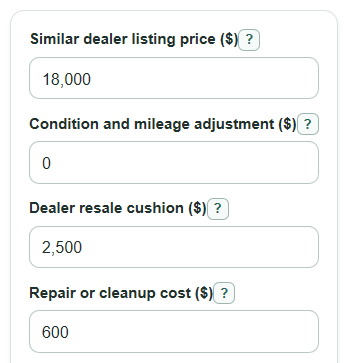
- Enter the Similar dealer listing price for a close match to your car at a dealer, not a private-party ad.
- Use Condition and mileage adjustment to move the comparison up or down, then enter the Dealer resale cushion and Repair or cleanup cost.
- Enter your Current loan payoff if you still owe money on the car.
- Open Advanced options if you want to change the Likely offer range size or estimate Possible sales tax savings.
- Sanity-check the result: if the Estimated trade-in offer is close to the dealer listing price, your cushion or repair costs may be too low.
Definitions
Similar dealer listing price: The asking price for a similar car at a dealer. It is the retail starting point for this estimate.
Condition and mileage adjustment: A dollar change that makes the comparison closer to your car. Use a negative number if your car has more miles or worse condition.
Dealer resale cushion: The dollar amount subtracted for dealer negotiation room, business costs, and profit before resale.
Repair or cleanup cost: Estimated dollars for items a dealer may subtract, such as tires, detailing, dents, warning lights, or reconditioning.
Current loan payoff: The amount needed to fully pay off the auto loan now; it may differ from the current balance or the sum of remaining payments [3].
Trade equity after loan payoff: The estimated trade offer minus your loan payoff. Negative equity means you owe more than the car is worth [1].
Possible sales tax savings: Estimated tax avoided when a trade-in lowers the taxable price of the next car. This depends on state and deal rules [2].
Net help for the next deal: Trade equity after loan payoff plus possible sales tax savings. Negative means the trade may add cost to the next deal.
Common mistakes and quick fixes
Mistake: Using a private-party price for Similar dealer listing price .
Fix: Use a dealer asking price for a similar year, trim, mileage, and condition.
Mistake: Entering a positive Condition and mileage adjustment when your car has worse condition or higher miles than the comparison.
Fix: Enter a negative dollar amount for worse condition or higher miles.
Mistake: Putting monthly payments into Current loan payoff .
Fix: Use the payoff amount from your lender, because it can differ from the remaining payment total.
Mistake: Setting Dealer resale cushion to $0 and expecting a dealer to pay full retail.
Fix: Include room for negotiation, business costs, and profit before resale.
Mistake: Choosing Yes for Trade-in lowers taxable price? without checking your state or deal rules.
Fix: Choose No unless your trade-in can reduce the taxable price on the next car.
Mistake: Typing the tax dollars into Sales tax rate .
Fix: Enter the percent rate, such as 6.25, not the dollar amount of tax.
Limitations & Key Assumptions / Boundary Conditions
- This is a transparent estimate, not a VIN-based market database quote or a dealer guarantee.
- The result depends heavily on the Similar dealer listing price. Dealer asking prices can be above or below final sale prices.
- Dealer resale cushion, Repair or cleanup cost, and Condition and mileage adjustment are estimates. A dealer inspection can change them.
- The Estimated trade-in offer is floored at $0, but Trade equity after loan payoff and Net help for the next deal can be negative.
- Possible sales tax savings is included only when you choose that the trade-in lowers taxable price. State rules, local rules, fees, and lease deals can differ.
- The tax credit base is capped by Next car price before trade, so the calculator does not create a negative taxable price.
- Current loan payoff can change with interest, payment timing, and lender payoff rules. Use a current payoff quote for a real deal.
Methodology
How the estimate is built
The calculator starts with a comparable dealer retail listing and subtracts the main costs and resale room a dealer may need before offering a trade value.
raw_trade_offer = comparable_retail_price + condition_mileage_adjustment - dealer_resale_cushion - repair_cleanup_cost
The offer for the car itself is not allowed to go below $0.
estimated_trade_offer = max(0, raw_trade_offer)
Offer range
The low and high estimates use the range percent you enter around the middle offer.
likely_offer_low = max(0, estimated_trade_offer * (1 - offer_range_percent / 100))
likely_offer_high = max(0, estimated_trade_offer * (1 + offer_range_percent / 100))
Loan and tax impact
Loan equity is signed, so it can be negative when the payoff is higher than the estimated offer. The FTC describes this as owing more than the car is worth [1].
net_trade_equity = estimated_trade_offer - loan_payoff
If you choose that the trade-in lowers taxable price, the tax credit base is the smaller of the estimated trade offer and the next car price. If not, the base is $0.
tax_credit_base = min(estimated_trade_offer, replacement_vehicle_price) when trade_tax_credit is yes; otherwise 0
sales_tax_savings = tax_credit_base * sales_tax_rate / 100
effective_trade_value = estimated_trade_offer + sales_tax_savings
net_help_for_next_deal = net_trade_equity + sales_tax_savings
Mini-example
If a similar dealer listing is $18,000, the condition adjustment is $0, the dealer resale cushion is $2,500, and repair or cleanup cost is $600, the raw offer is $14,900. With an 8 percent range, the low offer is $13,708 and the high offer is $16,092. If the loan payoff is $0 and there is no tax credit, the net help for the next deal is $14,900.