
Enter any two known capacitor values to calculate charge, capacitance, or voltage, plus the ideal electric energy stored.
Signed charge on the referenced capacitor plate.
Signed voltage for the referenced plate.
Energy is different from charge and is never negative for a positive capacitance.
This ideal, settled-voltage calculation does not include charging time, leakage, resistance, tolerance, temperature, aging, or voltage-dependent capacitance.
Table of contents
How to use our Capacitor Charge Calculator
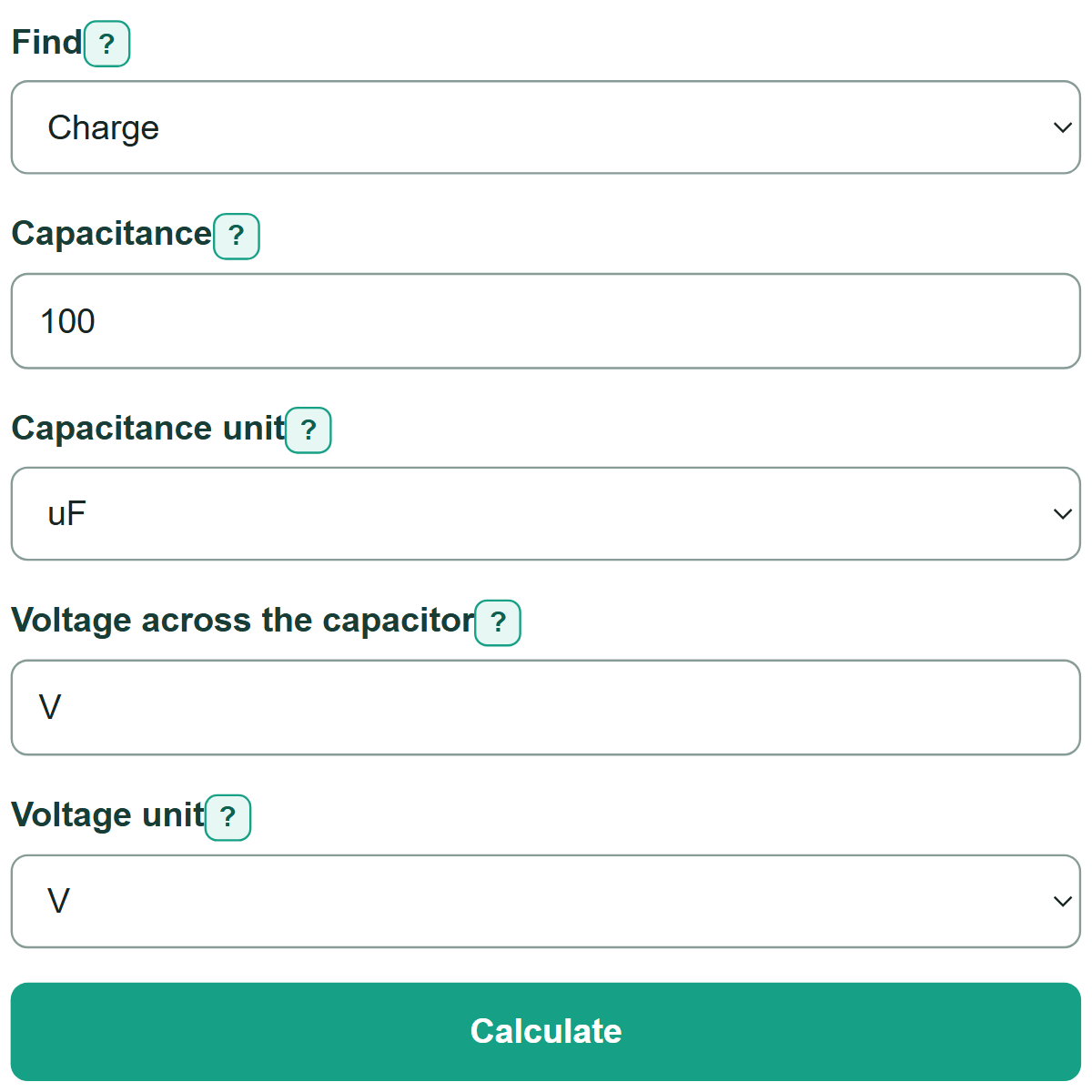
- Select what you need to find in "Find": "Charge", "Capacitance", or "Voltage".
- Enter the two values shown for that choice and select the unit printed with each value.
- For voltage, use the voltage across the capacitor's two terminals, which may not equal the supply voltage.
- Click "Calculate" and use the first result as your requested quantity; stored electric energy is a separate result in joules.
- Sanity-check the prefixes before using the answer. For example, changing a capacitance unit from nF to uF changes its value by 1,000.
Definitions
Capacitance (C): A capacitor's ability to store electric charge for each volt across it. Its SI unit is the farad (F).
Charge (Q): Electric charge on a referenced capacitor plate. Its SI unit is the coulomb (C).
Voltage (V): The electrical potential difference between the capacitor's two terminals, measured in volts (V).
SI prefix: A unit scale marker. For example, 1 uF is 0.000001 F, while 1 nF is 0.000000001 F.
Stored electric energy: Energy held by an ideal charged capacitor, measured in joules (J). It is not the same quantity as charge.
Common mistakes and quick fixes
Mistake: Selecting uF when the capacitor marking says nF.
Fix: Match the prefix exactly. Moving from nF to uF changes the capacitance scale by 1,000.
Mistake: Entering the supply voltage instead of the voltage across the capacitor.
Fix: Use the voltage between the capacitor's two terminals from the circuit, measurement, or design condition.
Mistake: Treating charge and stored electric energy as the same thing.
Fix: Charge is measured in coulombs, while energy is measured in joules. Read the two results separately.
Mistake: Trying to find capacitance with zero voltage.
Fix: Enter a nonzero voltage. Charge divided by zero voltage is undefined.
Mistake: Using opposite signs for charge and voltage when finding capacitance.
Fix: Use matching signs so the calculation produces a positive ideal capacitance.
Limitations & Key Assumptions / Boundary Conditions
- The calculation assumes an ideal capacitor at a settled voltage.
- It does not calculate charging or discharging time because resistance and time are not included.
- It does not include leakage, equivalent series resistance (ESR), tolerance, temperature effects, aging, dielectric absorption, or voltage-dependent capacitance.
- Capacitance must be greater than zero. Finding capacitance also requires nonzero voltage and charge and voltage signs that produce positive capacitance.
- Use the actual voltage across the capacitor terminals; it does not always equal the circuit supply voltage.
- A calculated value does not confirm that a component's voltage rating, polarity, ripple-current rating, or safety requirements are suitable.
Methodology
Calculation method
The calculator converts each selected prefix to base SI units: farads, volts, and coulombs. For an ideal capacitor, charge equals capacitance times voltage. [1]
Q = C x V
Q is charge in coulombs, C is capacitance in farads, and V is voltage in volts. To find capacitance, it divides charge by voltage. To find voltage, it divides charge by capacitance.
C = Q / V
V = Q / C
Energy calculation
The calculator then finds ideal stored electric energy from capacitance and voltage. Since voltage is squared, energy is zero or positive when capacitance is positive, even if voltage is negative.
E = 0.5 x C x V x V
Mini-example
For 100 uF at 12 V, capacitance is 0.0001 F. The charge is 0.0001 x 12 = 0.0012 C, or 1.2 mC. The stored energy is 0.5 x 0.0001 x 12 x 12 = 0.0072 J.