
Estimate heating bill savings from a higher AFUE rating and see if the extra installed cost is likely to pay back.
Table of contents
How to use our AFUE Savings Calculator
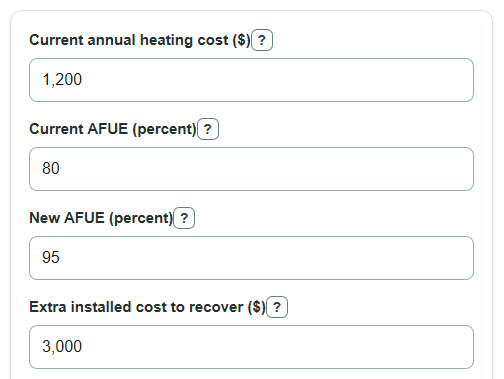
- Enter your Current annual heating cost using only space-heating fuel cost if you can separate it from other uses.
- Enter the Current AFUE and New AFUE as percentages, such as 80 or 95, not as decimals.
- Enter the Extra installed cost to recover, meaning the added cost of the higher-efficiency option compared with the lower-efficiency option.
- Open Advanced options only if you want Expected fuel price increase or Discount rate for today's-money view to change the long-term estimate.
- Check the First-year heating bill change against your bill size; if it looks too large, recheck whether the heating cost includes water heating, cooking, or non-heating charges.
Definitions
AFUE: Annual Fuel Utilization Efficiency. It is the percent of fuel energy a furnace or boiler turns into usable heat over a typical heating season.
Current annual heating cost: Your yearly cost for space heating only, before the upgrade.
Extra installed cost to recover: The added upfront cost you want bill savings to pay back. For two bids, this is the higher-efficiency bid minus the lower-efficiency bid.
Simple payback time: Extra installed cost divided by first-year heating bill savings. It does not adjust future savings for fuel price changes or discounting.
Breakeven year: The first whole year when cumulative today's-money savings equal or exceed the extra installed cost.
Today's-money view: A way to reduce future savings by a discount rate so future dollars are compared in present-value terms.
Common mistakes and quick fixes
Mistake: Using the full gas or oil bill as Current annual heating cost when it also includes water heating or cooking.
Fix: Estimate only the space-heating part before entering Current annual heating cost.
Mistake: Typing Current AFUE or New AFUE as 0.80 instead of 80.
Fix: Enter AFUE as a percent, so 80 percent is entered as 80.
Mistake: Entering the full furnace price as Extra installed cost to recover when you are comparing two quotes.
Fix: Use the difference between the higher-efficiency quote and the lower-efficiency quote for Extra installed cost to recover.
Mistake: Treating Simple payback time as a promise that the equipment will pay for itself exactly on that date.
Fix: Read Breakeven year and 15-year net savings after extra cost too, especially if you used Expected fuel price increase or Discount rate for today's-money view.
Mistake: Ignoring a negative First-year heating bill change when New AFUE is lower than Current AFUE.
Fix: A negative First-year heating bill change means the new setup is estimated to cost more to run, not less.
Limitations & Key Assumptions / Boundary Conditions
- This is a same-fuel estimate. It compares AFUE changes, not a switch between gas, oil, electricity, or heat pumps.
- The calculator assumes the home needs the same useful heat after the upgrade. Weather, insulation, thermostat changes, duct losses, and equipment sizing can change real bills.
- Current annual heating cost should exclude non-heating fuel use when possible. Using the full utility bill can overstate savings.
- AFUE is a seasonal equipment rating. It does not include every real-world loss in ducts, pipes, venting, standby use, or controls.
- Projected 5-, 10-, and 15-year bill savings use the Expected fuel price increase you enter. Actual fuel prices may rise, fall, or stay flat.
- 15-year net savings after extra cost uses end-of-year savings and the Discount rate for today's-money view. Taxes, rebates, financing, maintenance, and repair differences are not included.
- Breakeven year is searched only through 30 years. If savings do not recover the extra installed cost by then, the result reports no breakeven within 30 years.
Methodology
Cost after the AFUE change
The calculator treats your current bill as the cost of producing the same useful heat with your current equipment. AFUE percentages are first converted to decimals.
current_eff = current_afue / 100
new_eff = new_afue / 100
The estimated annual heating cost after the upgrade is scaled by the ratio of current efficiency to new efficiency.
new_annual_cost = current_annual_heating_cost * current_eff / new_eff
The first-year bill change is signed. A positive value means the higher AFUE lowers the bill. A negative value means the entered new AFUE is estimated to cost more to run.
annual_savings = current_annual_heating_cost - new_annual_cost
percent_savings = annual_savings / current_annual_heating_cost * 100
Multi-year savings and payback
Projected bill savings add each year's bill savings before subtracting installed cost. The fuel price increase is entered as a percent per year, then converted to a decimal called g.
projected_savings_N = sum y = 1 to N of annual_savings * (1 + g)^(y - 1)
Simple payback divides the extra installed cost by first-year savings. If the extra installed cost is 0 or less, the calculator reports it as already recovered. If first-year savings are 0 or negative and the extra installed cost is positive, there is no payback from bill savings.
simple_payback_years = upgrade_cost / annual_savings
For the today's-money view, each future year's savings is divided by the discount factor for that year. The discount rate is entered as a percent per year, then converted to a decimal called d.
pv_savings_N = sum y = 1 to N of annual_savings * (1 + g)^(y - 1) / (1 + d)^y
fifteen_year_net_savings_today = pv_savings_15 - upgrade_cost
Breakeven year is the first whole year from 1 through 30 where cumulative today's-money savings reach the extra installed cost.
breakeven_year = first y from 1 to 30 where cumulative_pv_savings_y >= upgrade_cost
Mini-example
Suppose Current annual heating cost is $1,200, Current AFUE is 80, New AFUE is 95, and Extra installed cost to recover is $1,500. The estimated annual heating cost after upgrade is $1,200 * 0.80 / 0.95 = $1,010.53. First-year heating bill change is $1,200 - $1,010.53 = $189.47. With 0 percent fuel price increase and 0 percent discount rate, simple payback is $1,500 / $189.47 = 7.92 years, breakeven is year 8, and 15-year net savings after extra cost is $2,842.11 - $1,500 = $1,342.11.