
Use this calculator to estimate your adult BMI, see your BMI category, and compare your current weight with the healthy range for your height.
How to use our Healthy Weight Calculator
- Choose Unit system, then enter either Height (feet), Height (inches), and Weight (lb) or enter Height (cm) and Weight (kg).
- Check that height is greater than zero, weight is greater than zero, and if you use US units, Height (inches) is from 0 up to but not including 12.
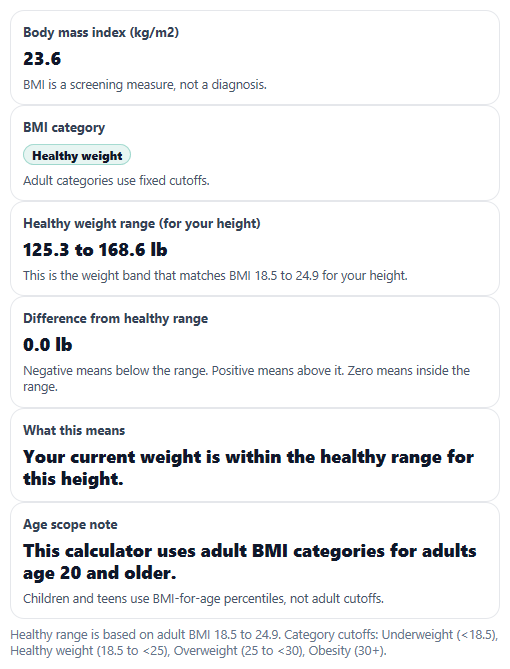
- Click Calculate to see your Body mass index, BMI category, healthy weight range, and Difference from healthy range.
- Sanity-check the result: if your entered height and weight look right, your Body mass index should usually fall near the category shown, and a Difference from healthy range of 0 means your current weight is inside the healthy band for your height.
- Read What this means and the Age scope note for context, especially if you are under age 20 because children and teens use BMI-for-age percentile instead.
Definitions
Body mass index: A number that compares weight with height. In this calculator, it is shown as Body mass index.
BMI category: The adult screening group that matches the BMI result: Underweight, Healthy weight, Overweight, or Obesity.
Healthy weight range lower bound: The lowest weight at your height that matches a BMI of 18.5.
Healthy weight range upper bound: The highest weight at your height that matches a BMI of 24.9.
Difference from healthy range: How far your current weight is from the nearest edge of the healthy range. Negative means below, positive means above, and zero means inside the range.
What this means: A short plain-language summary of whether your current weight falls within the healthy range for your height.
Age scope note: A reminder that this version is for adults age 20 and older; children and teens use a different BMI method.
Common mistakes and quick fixes
Mistake: Entering total inches in Height (inches) while also filling Height (feet) .
Fix: Put whole feet in Height (feet) and only the extra inches from 0 to 11.9 in Height (inches) .
Mistake: Filling both US and metric fields and expecting both to affect Body mass index .
Fix: The calculator uses only the fields that match Unit system , so make sure the selected unit matches the inputs you want used.
Mistake: Typing 0 or a negative number for Weight (lb) , Weight (kg) , Height (feet) , or Height (cm) .
Fix: Enter a real positive height and weight before you calculate.
Mistake: Reading Difference from healthy range as always bad because it has a minus sign.
Fix: A negative value means your current weight is below the healthy range, a positive value means above it, and 0 means inside the range.
Mistake: Treating BMI category as a diagnosis.
Fix: Use Body mass index and BMI category as screening results, then discuss personal health questions with a clinician.
Mistake: Using the Age scope note for a child or teen as if the same rule applies.
Fix: This calculator is for adults age 20 and older; children and teens need BMI-for-age percentile.
Limitations & Key Assumptions / Boundary Conditions
- This calculator is for adults age 20 and older. Children and teens need BMI-for-age percentile rather than adult BMI cutoffs.
- BMI is a screening tool, not a diagnosis. Two adults can have the same BMI but different health risks or body composition.
- The healthy weight range is based only on height and standard adult BMI cutoffs of 18.5 to 24.9. It does not account for muscle mass, pregnancy, body frame, or medical history.
- Results depend on accurate entry. Small height or weight errors can change the Body mass index, BMI category, and healthy weight range.
- For US entry, Height (inches) must be the extra inches beyond whole feet, not total inches.
- The calculator shows the healthy range in the same unit system you selected, but the underlying range comes from the same height-based BMI method in either system.
Methodology
How the calculator works
This calculator first reads the selected Unit system and uses only the matching visible fields. It then calculates Body mass index, assigns an adult BMI category, finds the healthy weight range for that height, and computes the signed Difference from healthy range.
Formulas used
BMI = weight_kg / (height_m^2)
BMI = 703 x weight_lb / (height_in^2)
healthy_weight_min_kg = 18.5 x (height_m^2)
healthy_weight_max_kg = 24.9 x (height_m^2)
if weight < min, diff = weight - min; else if weight > max, diff = weight - max; else diff = 0
For US units, total height in inches is found with 12 inches per foot, and the standard US BMI conversion factor is 703 [4]. For healthy-range outputs in US units, kilogram values are converted using 2.2046226218 pounds per kilogram.
Adult BMI categories used
The category cutoffs follow the common adult ranges: below 18.5 is Underweight, 18.5 to less than 25 is Healthy weight, 25 to less than 30 is Overweight, and 30 or higher is Obesity. Exact boundary values move into the higher category at 18.5, 25.0, and 30.0.
Worked mini-example
Example in US units: Height (feet) = 5, Height (inches) = 9, and Weight (lb) = 160.
total_height_in = 5 x 12 + 9 = 69
BMI = 703 x 160 / (69^2) = 23.6
healthy_weight_min_lb = 18.5 x (1.7526^2) x 2.2046226218 = 125.3
healthy_weight_max_lb = 24.9 x (1.7526^2) x 2.2046226218 = 168.6
diff = 0
That means the BMI falls in the Healthy weight category, and the current weight is inside the healthy range for that height.
Assumptions behind the result
BMI is a quick screening measure based on weight relative to height, not a full health assessment [1]. This calculator applies adult BMI logic only, so it is not the right method for children and teens [1][3]. Real-world health decisions may also consider other factors beyond BMI alone.