
Estimate lean body mass from height and weight or calculate it directly from body fat percentage, then compare the main formulas side by side.
Advanced options
How to use our Lean Body Mass Calculator
- Choose your Calculation method, then enter Sex, Unit system, and Body weight using the labels shown.
- If you use US customary units, fill in Height (feet) and Height (inches); if you use metric, fill in Height (cm).
- If you choose body fat mode, enter Body fat percentage (%) as a percent such as 20, not a decimal such as 0.20.
- Open Advanced options if you want Formula result view set to one formula only or if you want to hide Also show lean mass as percent of body weight.
- Click Calculate, then sanity-check the result by comparing Lean body mass with your Body weight; lean mass should not be higher than total body weight, and the Method note will explain if James needs extra caution.
Definitions
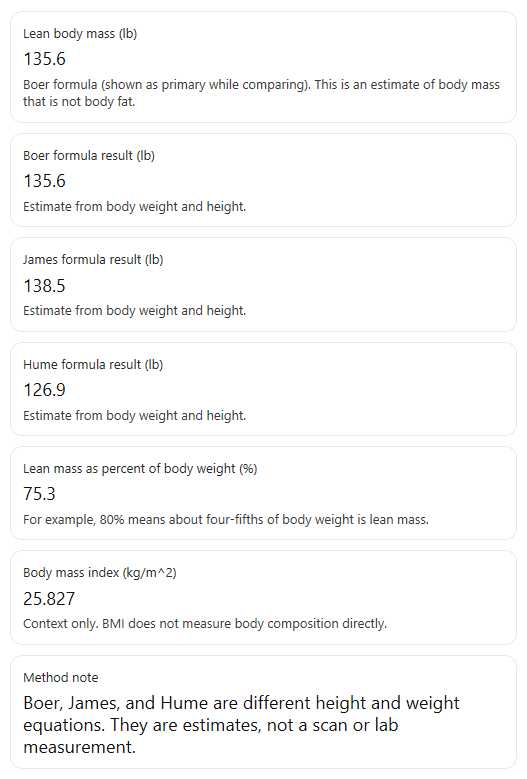
Lean body mass: Your body weight minus body fat. In everyday calculators, this is used very similarly to fat-free mass, though the technical definitions are not perfectly identical.
Calculation method: The way the calculator gets your result, either from height-and-weight formulas or directly from your entered body fat percentage.
Boer formula result: A lean body mass estimate based on body weight, height, and sex.
James formula result: Another standard estimate from body weight, height, and sex. It can become less suitable at higher BMI.
Hume formula result: A standard lean body mass prediction from body weight and height [1].
Direct result from body fat percentage: Lean body mass calculated from your body weight and your entered body fat percentage.
Lean mass as percent of body weight: The share of your total weight that is lean mass. For example, 80% means four-fifths of your weight is lean mass.
Body mass index: A height-and-weight ratio shown here only to add context for the James formula note. It does not directly measure body fat.
Method note: A short explanation that tells you whether you are looking at an estimate formula or a direct body-fat-based result, and whether any caution applies.
Common mistakes and quick fixes
Mistake: Entering Body fat percentage (%) as 0.20 instead of 20.
Fix: Type a percent value from 0 to 100. For 20%, enter 20.
Mistake: Filling in Height (cm) while Unit system is set to US customary, or filling in Height (feet) and Height (inches) while metric is selected.
Fix: Match the height entry to the selected Unit system . Hidden height fields are ignored.
Mistake: Forgetting that Body fat percentage (%) is required only when Calculation method is set to body fat percentage.
Fix: If you want formula estimates, choose the height and weight option. If you want the direct method, enter a valid body fat percent.
Mistake: Reading Boer formula result , James formula result , or Hume formula result as a measured scan result.
Fix: Treat each value as an estimate based on equations, and read Method note for context.
Mistake: Assuming James formula result is always the best choice for every body size.
Fix: Check Body mass index and the Method note . If a caution appears, compare James with Boer and Hume instead of relying on one number.
Mistake: Expecting Lean mass as percent of body weight to appear when the advanced setting is turned off.
Fix: In Advanced options , set Also show lean mass as percent of body weight to Yes.
Limitations & Key Assumptions / Boundary Conditions
- These results are estimates from equations or from the body fat percentage you enter. They are not direct measurements from a DEXA scan, Bod Pod, or similar test.
- When Calculation method uses formulas, the result depends on Sex, Body weight, and height only. Real body composition can differ.
- The direct method is only as accurate as your entered Body fat percentage (%). If that input is off, Lean body mass will be off by the same proportion.
- James formula result may be less reliable at higher Body mass index, so the calculator keeps it visible but adds a caution instead of hiding it.
- If impossible inputs produce a negative formula result, the calculator should show an error and ask you to check height and weight.
- Hidden fields do not count. For example, Height (cm) is ignored in US mode, and Height (feet) and Height (inches) are ignored in metric mode.
- A body fat value of 100% gives a valid but extreme result of zero lean mass, which is mathematical output only and not a realistic body-composition target.
Methodology
How the calculator works
There are two paths. In formula mode, it converts your measurements to kilograms and centimeters if needed, then calculates Boer, James, and Hume estimates. In body fat mode, it calculates lean body mass directly from your entered body fat percentage.
Unit conversions
W_kg = W_lb x 0.45359237
H_cm = (feet x 12 + inches) x 2.54
H_m = H_cm / 100
Direct body-fat method
LBM = W x (1 - BF/100)
This method uses your total body weight and subtracts the fat share. Example: if Body weight is 200 lb and Body fat percentage (%) is 18, then lean body mass is 200 x (1 - 0.18) = 164 lb.
Height and weight formulas
Boer male: LBM_kg = 0.407 x W_kg + 0.267 x H_cm - 19.2
Boer female: LBM_kg = 0.252 x W_kg + 0.473 x H_cm - 48.3
James male: LBM_kg = 1.1 x W_kg - 128 x (W_kg/H_cm)^2
James female: LBM_kg = 1.07 x W_kg - 148 x (W_kg/H_cm)^2
Hume male: LBM_kg = 0.32810 x W_kg + 0.33929 x H_cm - 29.5336
Hume female: LBM_kg = 0.29569 x W_kg + 0.41813 x H_cm - 43.2933
Example in formula mode: male, 180 lb, 5 feet 10 inches. First convert to 81.65 kg and 177.8 cm. Then Boer is about 62.81 kg, James is about 63.99 kg, and Hume is about 62.23 kg. In US mode those display as about 138.47 lb, 141.09 lb, and 137.20 lb.
Other outputs
Lean percent = (LBM / body weight) x 100
BMI = W_kg / (H_m^2)
Lean mass as percent of body weight helps you read the result more quickly. Body mass index is shown as context only so the calculator can add a caution when the James formula may plateau at higher BMI.
Assumptions behind the results
The equations predict lean body mass from a small set of inputs, so they cannot capture frame size, muscle distribution, hydration, or measurement error. Consumer tools also often use lean body mass and fat-free mass almost interchangeably, even though the technical definitions are not exactly the same. Hume is one of the classic height-and-weight prediction equations used for this purpose [1].