
Use this pregnancy calculator to estimate your due date, how far along you are today, and key dates from LMP, conception, IVF transfer, or an ultrasound due date.
Advanced options
How to use our Pregnancy Calculator
- Choose a Dating method based on the date you know best: First day of last menstrual period, Conception date, IVF transfer date, or Ultrasound estimated due date.
- Enter the matching date field for your method. If you use LMP, also enter Cycle length (days) if your usual cycle is not 28 days. If you use IVF, choose the correct Embryo age at transfer (days).
- Click Calculate to see your Estimated due date, Pregnancy age today, Estimated fetal age today, Estimated conception date, Current trimester, and milestone dates.
- Sanity-check the result: make sure the Estimated due date matches the dating method you entered and that Pregnancy age today looks reasonable for your known dates. If it seems off by days or weeks, recheck the date entered and the selected method.
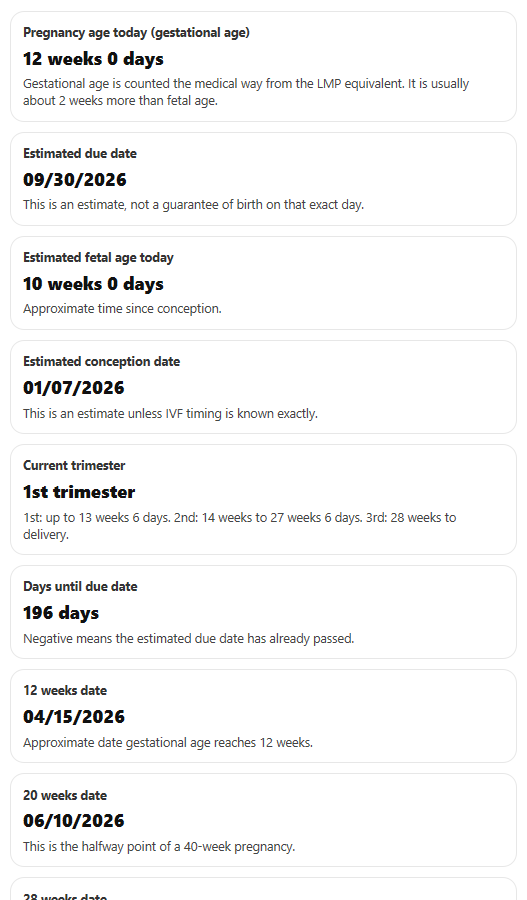
Definitions
Dating method: The starting point used to estimate pregnancy timing, such as LMP, conception, IVF transfer, or an ultrasound due date.
First day of last menstrual period: The first calendar day your last period started. Medical pregnancy dating often begins here.
Cycle length (days): Your usual number of days from the start of one period to the start of the next.
Estimated due date: The estimated day you reach 40 pregnancy weeks. It is a best estimate, not an exact prediction.
Pregnancy age today: Also called gestational age. This is how far along the pregnancy is today using the medical week count.
Estimated fetal age today: Approximate time since conception. It is usually about 2 weeks less than pregnancy age.
Estimated conception date: The approximate fertilization date implied by the dating method.
Current trimester: The current stage of pregnancy based on pregnancy age: first, second, or third trimester.
Common mistakes and quick fixes
Mistake: Entering the last day of bleeding instead of the First day of last menstrual period .
Fix: Use the first day bleeding began for First day of last menstrual period .
Mistake: Leaving Cycle length (days) blank or using a number outside your usual range when the Dating method is LMP.
Fix: Enter your usual cycle length in days. If you do not know, use 28 only if that is a realistic average for you.
Mistake: Picking Conception date when you only know ovulation roughly, then treating the result as exact.
Fix: Use the best-known date source in Dating method and remember Estimated due date is still an estimate.
Mistake: In IVF mode, entering IVF transfer date but choosing the wrong Embryo age at transfer (days) .
Fix: Match the embryo age to your transfer, usually day 3 or day 5, because it changes the dating offset.
Mistake: Mixing methods by entering an Ultrasound estimated due date but expecting hidden LMP or IVF fields to affect the result.
Fix: In each Dating method , only the visible fields for that method are used.
Mistake: Reading Estimated fetal age today as the same thing as Pregnancy age today .
Fix: Pregnancy age today is the medical week count, while Estimated fetal age today is about 2 weeks less in most non-IVF cases.
Limitations & Key Assumptions / Boundary Conditions
- All results are estimates and can differ from the date of actual birth.
- LMP dating assumes a typical relationship between period timing and ovulation; irregular cycles can make the estimate less reliable.
- Cycle length (days) only adjusts the LMP method. It does not change results in conception, IVF, or ultrasound due date modes.
- Pregnancy age today is counted the medical way, which starts before conception. That is why it can be about 2 weeks more than Estimated fetal age today.
- If your entered date is very recent, Estimated fetal age today may not be available yet because conception-equivalent timing has not been reached.
- If Days until due date is negative, the calculator shows that the estimated due date has already passed rather than forcing the value to zero.
- If the implied pregnancy age is over 44 weeks, the result may reflect an entered date problem and should be checked against your medical dating.
- This tool treats dates as calendar days, so real-world records based on scan timing, clinic rules, or updated medical dating can differ.
Methodology
How the calculator works
The calculator first converts your chosen dating method into one Estimated due date. Then it uses that due date to calculate today's pregnancy age, estimated conception date, trimester, and milestone dates.
Formulas used
EDD = LMP + 280 days + (cycle length - 28 days)
EDD = conception date + 266 days
EDD = IVF transfer date + (266 days - embryo age in days)
pregnancy age today in days = 280 - (EDD - today)
estimated conception date = EDD - 266 days
estimated fetal age today in days = pregnancy age today in days - 14
How outputs are interpreted
Pregnancy age today is shown in weeks and days because that is the standard medical format. Estimated fetal age today is based on conception timing, so it is usually about 2 weeks less than pregnancy age. If fetal age would be negative, the tool shows a plain-language message instead of a negative age.
Current trimester uses common cutoffs: first trimester through 13 weeks 6 days, second trimester through 27 weeks 6 days, and third trimester from 28 weeks onward. Milestone dates are calculated by counting forward from the same pregnancy timeline to 12, 20, and 28 weeks.
Mini example
If First day of last menstrual period is January 1, 2026 and Cycle length (days) is 28, the due date is October 8, 2026.
January 1, 2026 + 280 days = October 8, 2026
The estimated conception date is 266 days before that due date, which is January 15, 2026.
October 8, 2026 - 266 days = January 15, 2026
The 20 weeks date is 140 days before the due date, which is May 21, 2026.
October 8, 2026 - 140 days = May 21, 2026
Assumptions behind the math
The calculator follows standard obstetric dating rules that use a 280-day pregnancy from LMP and a 266-day pregnancy from conception, with ART or ultrasound due date entries treated as the starting medical date when those are used [1]. Real medical dating may be updated by a clinician if new information changes the best estimate [1].