
Enter cleaned coupon weights, exposed area, exposure time, and alloy density to calculate corrosion rate and, if needed, remaining wall life.
Coupon weights
Test conditions
Component condition
Table of contents
How to use our Corrosion Coupon Weight Loss and Remaining Life Calculator
- Choose "Rate from coupon weights" for a corrosion-rate result, or choose "Rate plus remaining life" if you also have component thickness records.
- Enter the Initial cleaned coupon weight and Final cleaned coupon weight from dry, cleaned laboratory weighings, then select the Coupon weight unit used for both values.
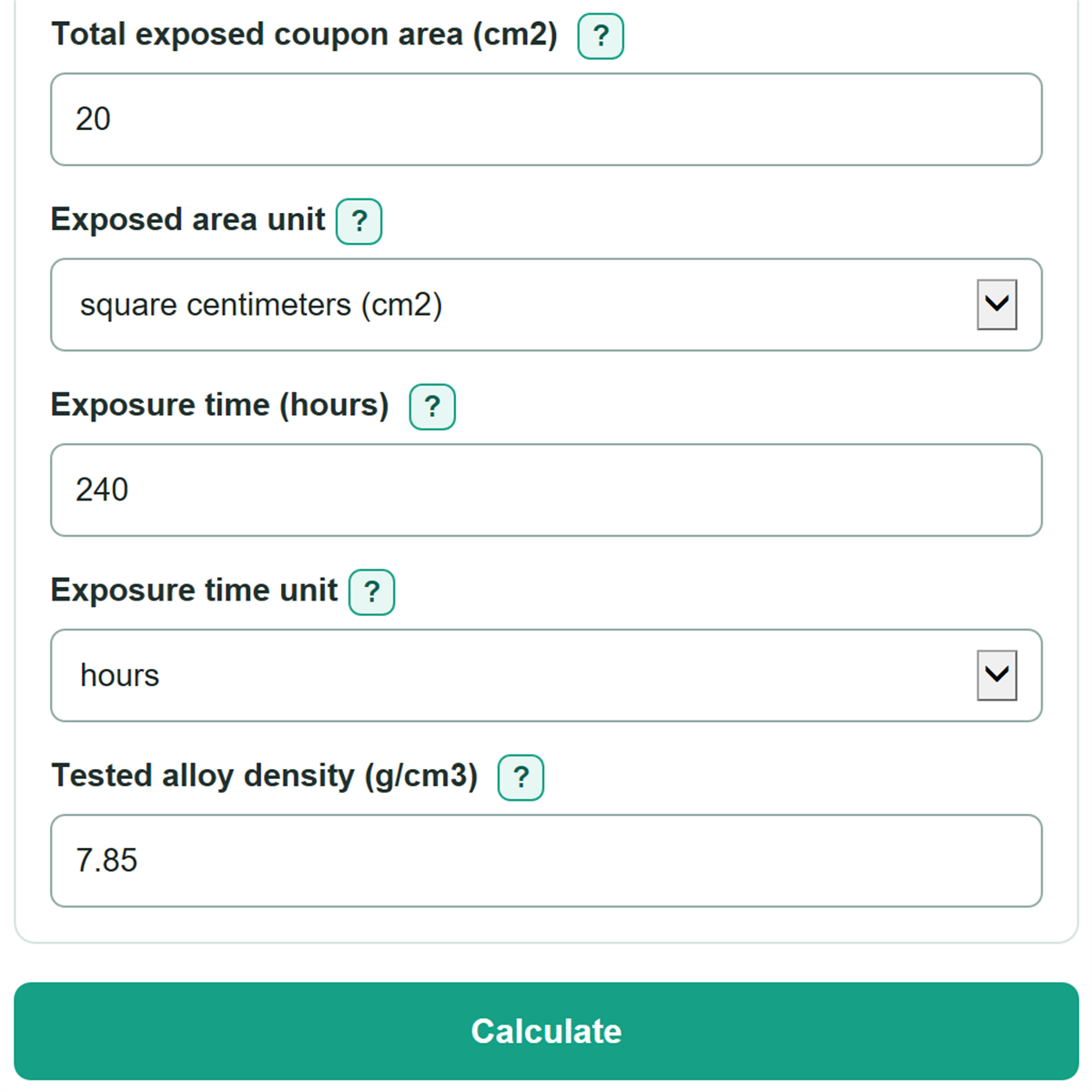
- Enter Total exposed coupon area, Exposure time, and Tested alloy density using the units shown on your test records or material certificate.
- For life mode, enter Current measured wall thickness and Minimum allowable wall thickness, then choose the Component thickness unit used by both records.
- Click Calculate. Check that Cleaned coupon weight loss is positive and that a longer Exposure time with the same loss would produce a lower Average corrosion rate (MPY).
Definitions
Corrosion coupon: A small test piece exposed to a process environment so its condition or mass change can be evaluated. [2]
Cleaned coupon weight loss: Initial cleaned coupon weight minus final cleaned coupon weight after exposure, cleaning, and drying.
Tested alloy density: The mass per volume of the exact coupon material, entered in g/cm3. It converts lost mass into lost metal volume.
MPY: Mils per year. One mil is one thousandth of an inch, so MPY is an average penetration rate in thousandths of an inch per year.
Minimum allowable wall thickness: The engineering thickness limit for the component. It is not automatically the original or nominal wall thickness.
Wall thickness available before minimum: Current measured wall thickness minus minimum allowable wall thickness, reported in mm.
Common mistakes and quick fixes
Mistake: Entering a Final cleaned coupon weight before cleaning and drying the coupon.
Fix: Use the post-exposure weight only after the coupon has been cleaned and dried according to the applicable procedure.
Mistake: Using one coupon face for Total exposed coupon area.
Fix: Enter the total wetted area, including both exposed faces and exposed edges, while excluding masked or holder-covered area.
Mistake: Choosing grams for Coupon weight unit when the laboratory record is in milligrams or ounces.
Fix: Select the unit printed on both weighing records before entering Initial cleaned coupon weight and Final cleaned coupon weight.
Mistake: Entering days while Exposure time unit is set to hours.
Fix: Match Exposure time unit to the number entered, or convert the record before entry.
Mistake: Using nominal new-wall size as Current measured wall thickness.
Fix: Use a current qualified inspection measurement and enter the engineering value for Minimum allowable wall thickness separately.
Mistake: Treating Estimated uniform-corrosion life remaining as proof that pitting is not present.
Fix: Use the life estimate only for unchanged uniform loss and assess localized corrosion with suitable inspection data.
Limitations & Key Assumptions / Boundary Conditions
- The rate is an average uniform-corrosion estimate from coupon mass loss. It can miss pitting, crevice corrosion, microbiologically influenced corrosion, and other localized attack.
- The remaining-life estimate assumes the coupon rate applies to the component material and environment and stays unchanged over time.
- Estimated uniform-corrosion life remaining is not an inspection interval, replacement date, or fitness-for-service decision.
- Use cleaned, dry coupon weights and the actual total exposed area. Cleaning errors, residue, missing exposed edges, and an incorrect density change the calculated rate.
- Current measured wall thickness must come from a qualified inspection record, and minimum allowable wall thickness must come from the applicable engineering calculation.
- The yearly rate uses a 365-day year. Leap-day effects are not included.
Methodology
Calculation steps
The calculator first converts the entered coupon weights to grams, exposed area to cm2, and exposure time to hours. It then finds metal volume loss from cleaned weight loss divided by tested alloy density.
cleaned weight loss (g) = (initial cleaned coupon weight - final cleaned coupon weight) x mass conversion factor
average penetration during test (mm) = (cleaned weight loss (g) / tested alloy density (g/cm3)) / exposed area (cm2) x 10
average corrosion rate (mm/year) = average penetration during test (mm) x 8760 / exposure time (hours)
average corrosion rate (MPY) = average corrosion rate (mm/year) / 25.4 x 1000
For life mode, both entered wall thickness values are converted to mm. The calculator subtracts the minimum allowable thickness from the current measured thickness, then divides that allowance by the calculated mm/year rate.
wall thickness available before minimum (mm) = (current measured wall thickness - minimum allowable wall thickness) x thickness conversion factor
estimated uniform-corrosion life remaining (years) = wall thickness available before minimum (mm) / average corrosion rate (mm/year)
Worked example
With a 50.0 g initial coupon, 49.9 g final coupon, 20.0 cm2 exposed area, 240 hours of exposure, and density of 7.85 g/cm3, cleaned weight loss is 0.1 g. The calculated rate is about 0.2325 mm/year, or 9.153 MPY. If current wall thickness is 0.500 in and minimum allowable wall thickness is 0.300 in, the available wall is 5.08 mm and estimated life is about 21.85 years.
Unit conversions
The calculator uses 1 oz = 28.349523125 g, 1 in2 = 6.4516 cm2, and 1 in = 25.4 mm. These are standard unit conversions. [1]