
Estimate delivered acid or caustic feed, product use, pump capacity, storage volume, and chemical cost from measured demand or a tested dose.
Dose information
Delivered product
Advanced options
Pump sizing
Operating schedule and storage
Cost
Calculation details
Table of contents
How to use our Acid and Caustic Neutralization Feed Calculator
- Choose how you know the active chemical dose. Use a lab titration result when demand is reported as CaCO3, or choose a documented jar-test or field dose.
- Enter Average flow (gpm), then enter the dose value required by your selected method.
- Copy Product strength by weight (percent) and Product density (lb/gal) from the delivered chemical specification.
- Open Advanced options to enter peak flow, pump headroom, operating time, annual operating days, price, and desired storage coverage if those planning results are needed.
- Check that the average feed rate and daily product use fit your operating records. If they do not, recheck the dose basis, product strength, density, and flow units before using the estimate.
Definitions
Titratable demand: The measured acid or base amount needed to reach a chosen endpoint. It is a chemical quantity, unlike pH alone.
mg/L as CaCO3: Milligrams per liter reported as calcium carbonate equivalent. The titration method converts this value using the active reagent equivalent weight and the CaCO3 equivalent weight of 50 g/eq.
Active reagent equivalent weight (g/eq): Grams of active chemical that supply one equivalent of neutralizing capacity. It is used only with measured titratable demand.
Product strength by weight (percent): The percent of the delivered solution that is active chemical by mass.
Product density (lb/gal): The weight of one gallon of delivered solution. It converts solution weight into liquid feed volume.
Headroom: Extra pump capacity added above calculated peak chemical demand for a planning target.
gph: Gallons of delivered product per hour.
Common mistakes and quick fixes
Mistake: Entering a pH value or pH change in Titratable demand to target (mg/L as CaCO3).
Fix: Enter a lab titration result to the intended endpoint, reported as mg/L as CaCO3. Use a documented dose if titration data are unavailable.
Mistake: Adding both Titratable demand to target (mg/L as CaCO3) and Tested active chemical dose (mg/L) as if they are combined.
Fix: Choose one dose method. The calculator uses only the dose input that matches How do you know the active chemical dose?.
Mistake: Using Product strength by weight (percent) where Product density (lb/gal) is needed.
Fix: Enter both supplier values separately. Strength converts active chemical to solution weight; density converts solution weight to gallons.
Mistake: Using Average flow (gpm) as Peak flow for pump sizing (gpm).
Fix: Use the highest expected operating flow for pump sizing, and keep it at least as large as average flow.
Mistake: Entering a pure-chemical price in Delivered product price ($/gal).
Fix: Enter the price of one gallon of the delivered solution. Leave it blank if no delivered-product quote is available.
Mistake: Treating Product volume for desired storage coverage as a final tank design.
Fix: Use it as the chemical volume for the selected days. Size the actual tank and containment under site, safety, delivery, and code requirements.
Limitations & Key Assumptions / Boundary Conditions
- The calculation needs measured titratable demand or a tested active dose. pH alone is not a valid chemical quantity basis for this tool.
- The titration method assumes the reported demand is at the target endpoint and that the entered active reagent equivalent weight is correct.
- Results use steady average flow for product use and cost. Rapid flow or water-quality changes can require a wider operating range, feed pacing, or control testing.
- Peak pump feed uses the entered peak flow and headroom only. It does not check pump turndown, pressure, suction conditions, calibration, injection point design, or chemical compatibility.
- Annual delivered chemical cost includes only delivered product volume times the entered price. It excludes equipment, installation, labor, controls, containment, mixing, and charges not included in the price.
- Storage quantity is chemical volume for the selected coverage days. It is not a final tank, freeboard, secondary-containment, delivery, or safety design.
Methodology
Calculation method
The calculator first finds the active chemical dose. With measured titratable demand, it converts CaCO3-equivalent demand using the entered active reagent equivalent weight. With tested active chemical dose, it uses the entered dose directly.
active dose (mg/L) = titratable demand (mg/L as CaCO3) * active reagent equivalent weight (g/eq) / 50
It then converts stream flow to delivered product feed. Product strength is changed from percent to a fraction, and density converts pounds of solution to gallons.
average feed (gph) = active dose * average flow * 3.785411784 * 60 / 453592.37 / (strength / 100) / density
Daily product use equals average feed times operating time. Annual product use multiplies daily use by operating days per year. Annual cost appears only when a delivered-product price is entered.
annual product use (gal/year) = product use (gal/day) * operating days per year
annual chemical cost ($/year) = annual product use * delivered product price ($/gal)
Peak pump feed uses peak flow instead of average flow and then adds the entered pump headroom.
peak pump feed (gph) = base feed at peak flow * (1 + headroom / 100)
Worked example
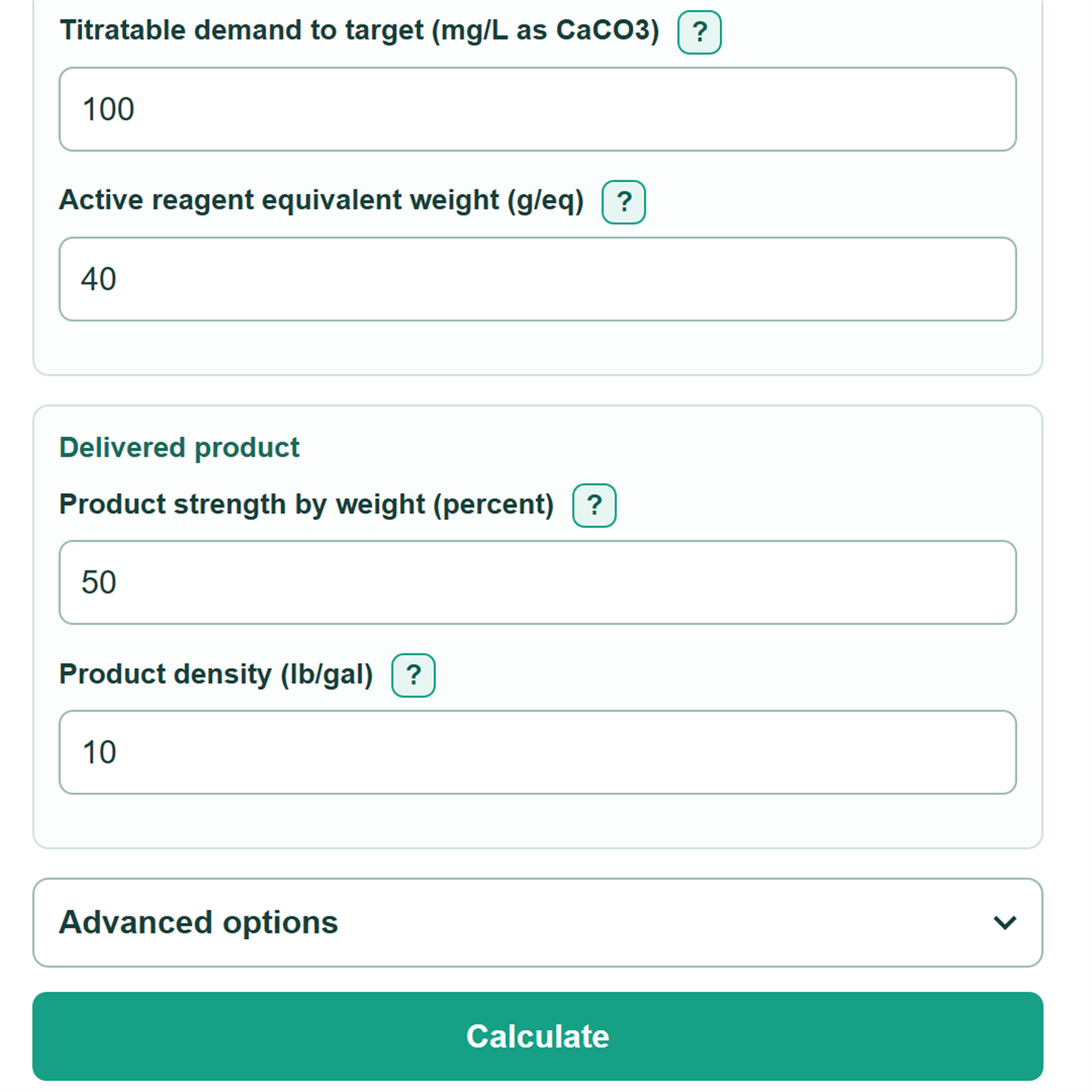
For 100 gpm, 100 mg/L as CaCO3 demand, an equivalent weight of 40 g/eq, 50% product strength, and 10 lb/gal density, the active dose is 80 mg/L. The estimated average delivered feed is about 0.0802 gph. At 150 gpm peak flow with 25% headroom, the estimated pump feed is about 0.1503 gph.
Calculation details
The calculation uses 3.785411784 L per US gallon, 60 minutes per hour, and 453592.37 mg per pound. Average flow drives chemical use, while peak flow and headroom drive the separate pump-capacity estimate. Final feed settings should be confirmed with site testing and commissioning.