
Calculate dry powdered activated carbon demand, slurry feed rate, and chemical-only PAC cost from your selected dose, flow, slurry strength, and price.
Table of contents
How to use our Powdered Activated Carbon Dose and Cost Calculator
- Enter the site-selected Powdered activated carbon dose in mg/L and the normal Average treated flow in MGD.
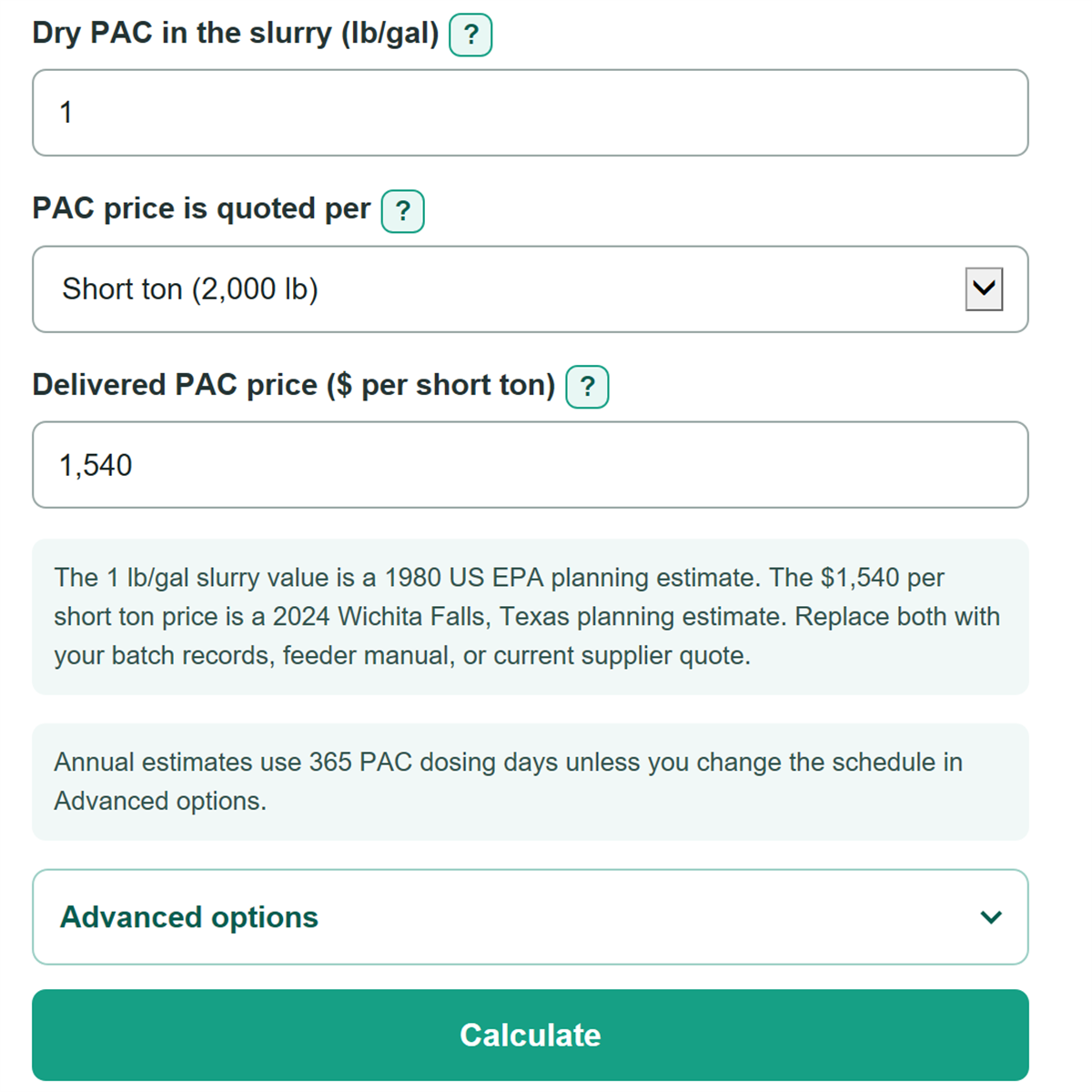
- Enter Dry PAC in the slurry from the batch recipe or feeder information; this is dry PAC pounds per final slurry gallon.
- Choose PAC price is quoted per, then enter the matching Delivered PAC price.
- Open Advanced options if needed to enter Peak treated flow (MGD) for a feeder-capacity check or change PAC dosing days per year for seasonal operation.
- Click Calculate, then check that the Required slurry feed rate is within feeder capacity and that the displayed PAC price used in the calculation matches the supplier quote.
Definitions
Powdered activated carbon (PAC): Fine activated carbon added to water or wastewater to adsorb, or hold onto, some dissolved substances.
mg/L: Milligrams per liter. It is the dry PAC dose applied to each liter of treated water.
MGD: Million US gallons per day. This calculator uses average MGD for routine PAC use and cost.
Dry PAC in the slurry (lb/gal): Pounds of dry PAC divided by the final gallons of prepared slurry. It is not bulk density or percent solids.
Short ton: A US mass unit equal to 2,000 lb.
$/MG: PAC material cost for treating one million gallons at the entered dose and price.
Common mistakes and quick fixes
Mistake: Entering a negative Powdered activated carbon dose or treating the example dose as a recommended dose.
Fix: Use zero or a positive site-selected dose from a jar test, treatment study, or operating setpoint.
Mistake: Using peak flow in Average treated flow when estimating routine PAC chemical cost per dosing day.
Fix: Enter normal dosing-period flow as Average treated flow and use Peak treated flow (MGD) only for the maximum feed-capacity check.
Mistake: Entering bulk density or percent solids as Dry PAC in the slurry.
Fix: Enter dry PAC pounds divided by final slurry gallons, in lb/gal.
Mistake: Choosing Pound when Delivered PAC price is actually quoted per short ton, or the reverse.
Fix: Match PAC price is quoted per to the unit printed on the supplier quote before entering Delivered PAC price.
Mistake: Reading PAC chemical cost per year as total treatment cost.
Fix: Treat PAC chemical cost per year as PAC material only; add equipment, labor, power, storage, and residuals costs separately.
Mistake: Leaving PAC dosing days per year at 365 for seasonal treatment.
Fix: Change PAC dosing days per year to the planned number of operating days before using annual or monthly budget results.
Limitations & Key Assumptions / Boundary Conditions
- The PAC dose is a site-selected input. This calculator does not predict removal, confirm treatment performance, or choose a dose.
- Results assume the entered dose is applied evenly over 24 hours at the entered average flow. Intermittent dosing needs a separate time-based feed check.
- Required slurry feed rate uses dry PAC pounds per final slurry gallon. A different batch recipe, dilution method, or actual slurry strength changes the feed volume.
- Peak feed is shown only when Peak treated flow (MGD) is entered, and it assumes the same PAC dose and slurry concentration at peak flow.
- Costs include PAC material only. They exclude freight not included in the entered price, equipment, storage, mixing, pumping, labor, power, sludge handling, disposal, and capital costs.
- Average monthly cost is annual PAC material cost divided by 12. It is a budgeting average and may not match a seasonal treatment month.
Methodology
Calculation method
The calculator first converts the supplier quote to dollars per pound. A short-ton quote is divided by 2,000; a per-pound quote is used directly.
Price ($/lb) = quoted price ($/short ton) / 2,000
Dry PAC demand comes from the selected dose and average treated flow. The conversion factor 8.345404 changes mg/L times MGD into lb/day.
Dry PAC (lb/day) = dose (mg/L) * average flow (MGD) * 8.345404
The daily dry mass is divided by the entered slurry strength, then divided by 24 for the average hourly feed target.
Slurry (gal/day) = dry PAC (lb/day) / dry PAC in slurry (lb/gal)
Slurry feed (gal/hr) = slurry (gal/day) / 24
Chemical cost is dry PAC mass times the normalized price. Annual cost uses the entered PAC dosing days per year, and the monthly figure is the annual amount divided by 12.
Daily PAC cost ($/day) = dry PAC (lb/day) * price ($/lb)
Annual PAC cost ($/year) = daily PAC cost ($/day) * dosing days per year
Worked example
At 10 mg/L and 2 MGD, dry PAC demand is 10 * 2 * 8.345404 = 166.90808 lb/day. With a 1 lb/gal slurry, this is 166.90808 gal/day or about 6.95 gal/hr. A $1,540 short-ton quote equals $0.77/lb, producing about $128.52 per dosing day.
Planning defaults
The displayed $1,540 per short ton PAC price is a 2024 Wichita Falls bid estimate [1]. Replace it with the delivered price from the current supplier quote or contract. The 1 lb/gal slurry value is a 1980 US EPA planning basis [2] and should be replaced with the site's actual batch recipe or feeder documentation.