
Enter one water sample's pH, temperature, TDS, calcium, and alkalinity to calculate its calcium carbonate saturation tendency.
Sample conditions
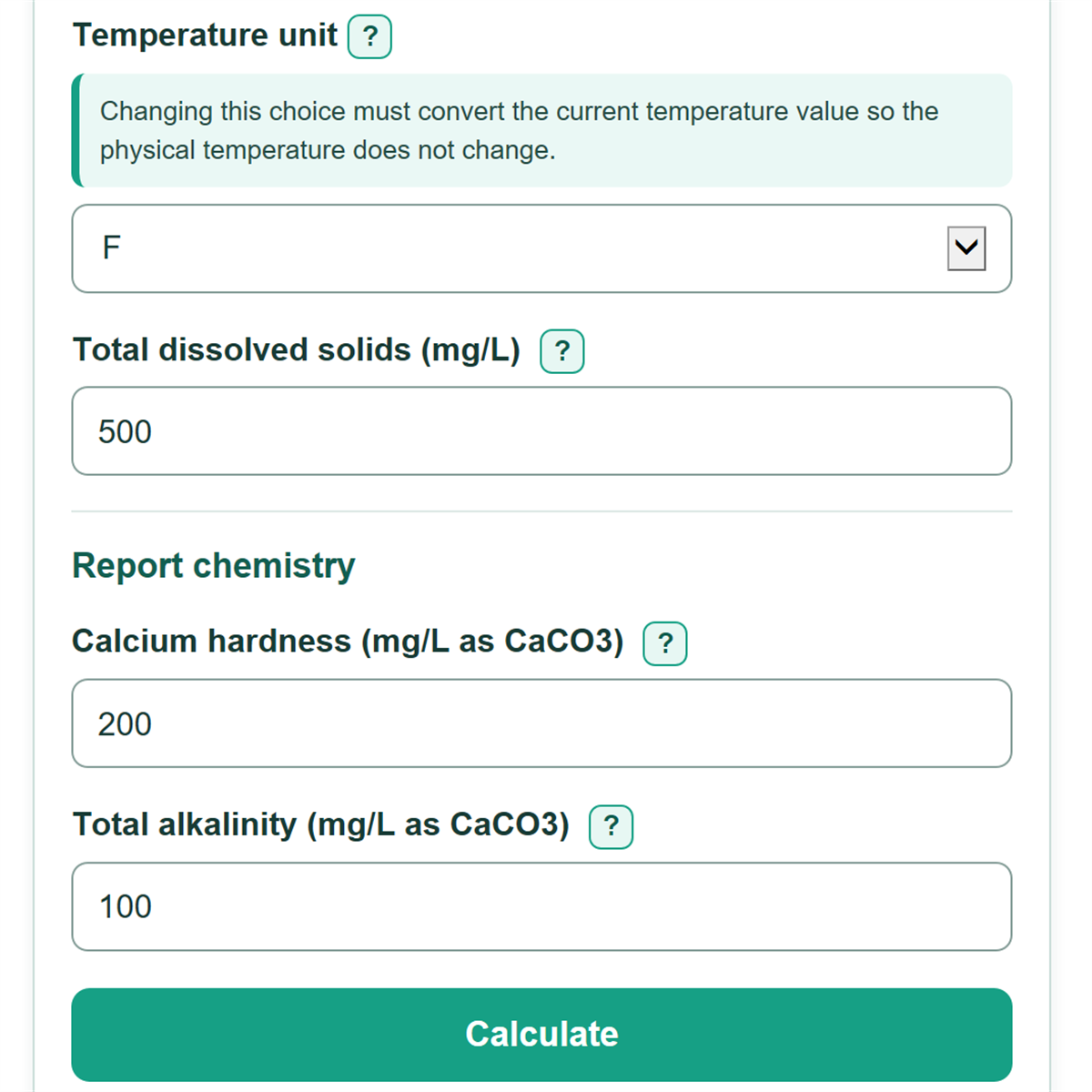
Report chemistry
Table of contents
How to use our Langelier Saturation Index Calculator
- Choose how calcium and alkalinity are listed on the same water test or laboratory report.
- Enter Measured pH, Water temperature, Temperature unit, and Total dissolved solids from that sample.
- Enter either Calcium hardness and Total alkalinity as CaCO3, or Calcium and Bicarbonate as raw ions, matching your selected report basis.
- Select Calculate, then compare Measured pH with Calculated saturation pH: their difference is the Langelier Saturation Index.
- Sanity-check the normalized calcium and alkalinity cards. They should match your CaCO3 report values or show sensible conversions from your raw-ion results.
Definitions
Langelier Saturation Index (LSI): Measured pH minus calculated saturation pH. A positive LSI means the water has an increasing calcium carbonate scale-forming tendency; a negative LSI means it is undersaturated with respect to calcium carbonate. [1]
Saturation pH: The estimated pH at which calcium carbonate is in equilibrium for the entered temperature and water chemistry.
Calcium hardness as CaCO3: A calcium result expressed as an equivalent amount of calcium carbonate. It is not the same number as raw calcium in mg/L as Ca2+.
Total alkalinity as CaCO3: A measure of acid-neutralizing capacity reported on a calcium carbonate basis. It is not the same number as bicarbonate in mg/L as HCO3-.
Total dissolved solids (TDS): The concentration of dissolved material in water, entered here in mg/L. This calculation uses TDS directly, not electrical conductivity.
Common mistakes and quick fixes
Mistake: Entering Total hardness where the report asks for Calcium hardness.
Fix: Use the result specifically labeled Calcium hardness. Total hardness can include magnesium and is not the same input.
Mistake: Choosing the CaCO3 report basis and typing a raw Calcium result.
Fix: Choose the raw-ion report basis when the report lists Calcium in mg/L as Ca2+.
Mistake: Typing conductivity into Total dissolved solids.
Fix: Enter a TDS result in mg/L. Do not treat conductivity as TDS because its conversion factor can vary by water.
Mistake: Mixing Measured pH from one test with Water temperature or chemistry values from another sample.
Fix: Use results from the same sample and relevant operating temperature.
Mistake: Treating a positive Langelier Saturation Index as a prediction of a certain amount of scale.
Fix: Read Calcium carbonate tendency as a saturation screening result, not as scale thickness or a corrosion-rate measurement.
Limitations & Key Assumptions / Boundary Conditions
- The calculation is an empirical screening estimate of calcium carbonate saturation, not a direct prediction of scale thickness, deposit location, corrosion rate, or damage to a specific material.
- All entries should describe the same water sample and relevant operating temperature. Mixing readings from different times, temperatures, or locations can distort the result.
- The equation requires Total dissolved solids, calcium contribution, and alkalinity contribution above zero because it uses logarithms of those values.
- This general-water method does not adjust for pool-specific cyanuric acid, treatment chemicals, flow, pressure, contact time, dissolved gases, or full chemical speciation.
- At unusually low or high TDS, or where water chemistry is complex, confirm decisions with a more complete water analysis and site-specific treatment review.
Methodology
Calculation method
The calculator first puts calcium and alkalinity on a common mg/L as CaCO3 basis. A CaCO3-basis report is used directly. A raw-ion report is converted using 2.497 for calcium and 0.820 for bicarbonate. The saturation-pH relation combines dissolved solids, temperature, calcium hardness, and alkalinity factors. [1]
TDS factor = (log10(TDS) - 1) / 10
Temperature factor = -13.12 * log10(temperature in C + 273) + 34.55
Calcium factor = log10(calcium hardness as CaCO3) - 0.4
Alkalinity factor = log10(alkalinity as CaCO3)
Saturation pH = 9.3 + TDS factor + temperature factor - calcium factor - alkalinity factor
LSI = Measured pH - Saturation pH
Worked example
With pH 7.5, water temperature 77 F, TDS 500 mg/L, calcium hardness 200 mg/L as CaCO3, and total alkalinity 100 mg/L as CaCO3, the calculated saturation pH is about 7.6571. LSI is 7.5 minus 7.6571, or about -0.1571, which falls in the displayed near-equilibrium screening band from -0.3 through 0.3.
Calculation choices
Results above 0.3 are labeled scale-forming tendency, results below -0.3 are labeled undersaturated tendency, and values in between are labeled near equilibrium. The signed LSI is kept because its direction is part of the interpretation.
Assumptions and limits
The temperature factor uses degrees C internally; changing between F and C converts the entered temperature instead of changing the physical water temperature. The method uses routine water-test values and does not model every dissolved chemical species or operating condition.