
Estimate lime, soda ash, dry sludge, and planning costs from plant flow, hardness, alkalinity, and your own chemical prices.
Advanced options
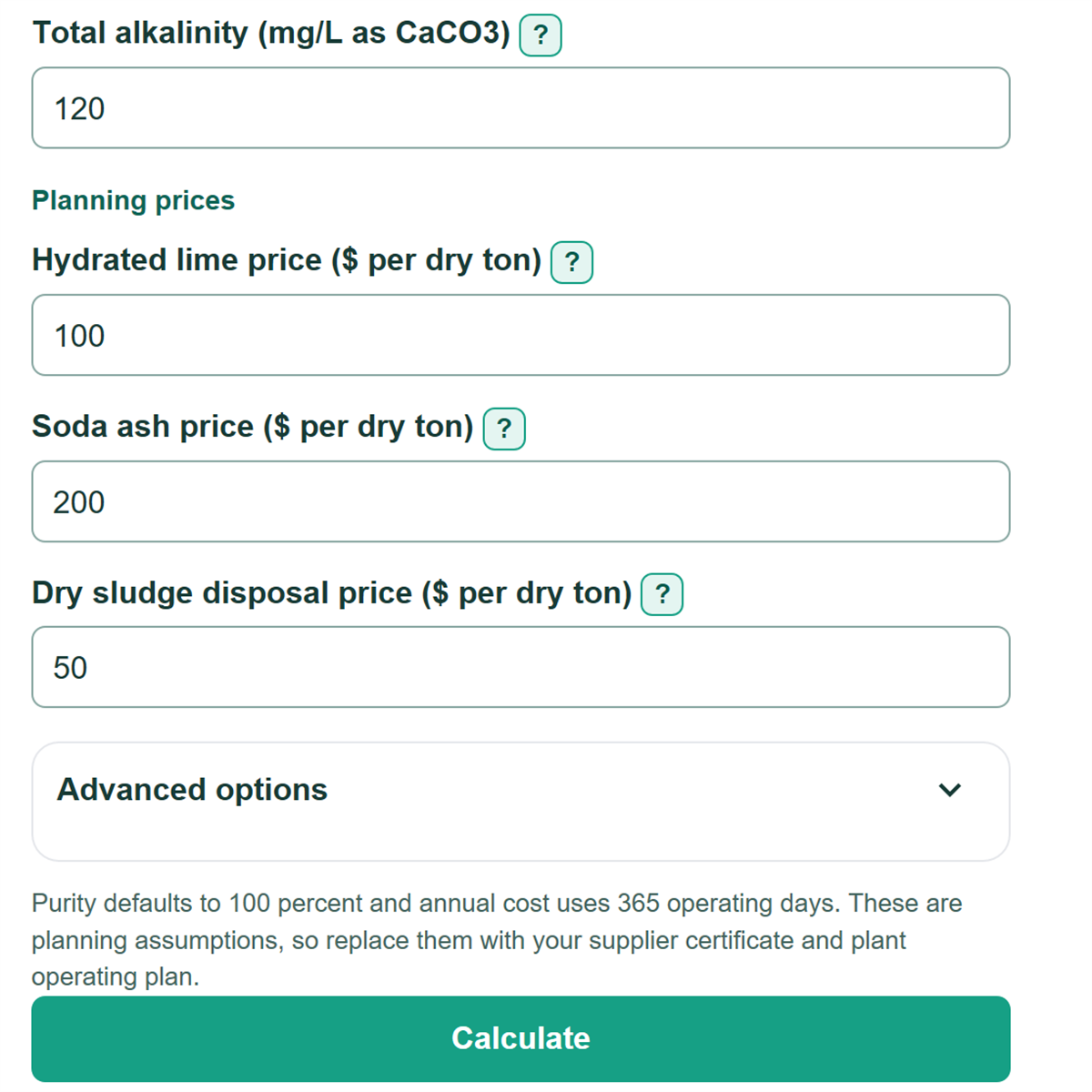
Purity defaults to 100 percent and annual cost uses 365 operating days. These are planning assumptions, so replace them with your supplier certificate and plant operating plan.
Table of contents
How to use our Lime-Soda Ash Softening Cost Calculator
- Enter Plant flow (MGD) from average daily production records for a daily planning estimate.
- Copy Total hardness (mg/L as CaCO3), Calcium hardness (mg/L as CaCO3), and Total alkalinity (mg/L as CaCO3) directly from a lab report.
- Enter delivered quotes for hydrated lime, soda ash, and dry sludge disposal. Replace the example prices before using the cost results.
- Open Advanced options if you have a CO2 result, a site-specific extra-lime allowance, product purity data, or fewer than 365 operating days.
- Check that calcium hardness is no higher than total hardness, then compare the daily mass results with expected plant chemical use before using the estimate for planning.
Definitions
mg/L as CaCO3: A common reporting basis that expresses hardness or alkalinity as an equivalent amount of calcium carbonate. It lets related water-test results be compared on one basis.
Total hardness: The combined calcium and magnesium hardness in the raw water.
Calcium hardness: The part of total hardness caused by calcium. Magnesium hardness is total hardness minus calcium hardness. [1]
Carbonate hardness: The smaller of total hardness and total alkalinity in this screening method.
Non-carbonate hardness: Total hardness left after carbonate hardness is removed.
Hydrated lime: Calcium hydroxide, written Ca(OH)2. The calculator reports its active dose separately from delivered product mass.
Soda ash: Sodium carbonate, written Na2CO3, used to remove non-carbonate hardness in the calculation.
Dry sludge: The estimated mass of precipitated solids with water removed. It is not the mass of wet filter cake or hauled sludge.
Product purity: The active percentage of a delivered chemical product. Lower purity increases the product mass needed for the same active dose.
Common mistakes and quick fixes
Mistake: Entering a calcium concentration instead of Calcium hardness (mg/L as CaCO3).
Fix: Use the lab result specifically reported as calcium hardness in mg/L as CaCO3, or have the concentration converted first.
Mistake: Setting Calcium hardness (mg/L as CaCO3) higher than Total hardness (mg/L as CaCO3).
Fix: Recheck the report units and sample. Calcium hardness is part of total hardness.
Mistake: Treating Estimated dry sludge produced each day as wet dewatered cake.
Fix: Use dry tons only for the calculator result. Convert to wet cake separately using actual cake solids data.
Mistake: Leaving example values in Hydrated lime price ($ per dry ton) or Soda ash price ($ per dry ton).
Fix: Replace them with delivered supplier quotes for the actual products and contract terms.
Mistake: Using Hydrated lime dose as the delivered product feed amount when purity is below 100 percent.
Fix: Enter Hydrated lime purity (percent) and use Hydrated lime product needed each day for purchasing or feed planning.
Mistake: Using Daily chemical plus dry-sludge cost as the complete treatment cost.
Fix: Add separate estimates for energy, labor, recarbonation, testing, hauling minimums, equipment, taxes, and capital costs.
Limitations & Key Assumptions / Boundary Conditions
- This is a preliminary stoichiometric estimate based on total hardness, calcium hardness, alkalinity, optional CO2, and an optional extra-lime allowance.
- It assumes magnesium hardness is removed and uses a simplified theoretical dry-solids estimate. Actual sludge depends on raw-water chemistry, reaction conditions, coagulants, solids capture, and dewatering.
- Dry sludge produced each day is not wet-cake mass. A wet-cake hauling estimate needs actual cake solids percentage and site handling data.
- The cost total includes only hydrated lime, soda ash, and dry-sludge disposal at the entered prices. It excludes labor, energy, recarbonation, equipment, capital, lab testing, taxes, and hauling minimum charges.
- Use average flow for a planning estimate. Review maximum-day flow separately for feed-system sizing.
- Use certified lab data, a full ion balance, process review, and jar testing before changing feed rates or making design decisions.
Methodology
Hardness split
The calculator keeps all hardness and alkalinity terms on the mg/L as CaCO3 basis. Carbonate hardness is the lower of total hardness and total alkalinity; calcium hardness must not exceed total hardness. [1]
CH = min(TH, Alk); NCH = TH - CH; MgH = TH - CaH
MgCH = min(MgH, CH); MgNCH = MgH - MgCH
Chemical dose
CH is carbonate hardness, NCH is non-carbonate hardness, MgH is magnesium hardness, MgCH is magnesium carbonate hardness, and MgNCH is magnesium non-carbonate hardness. CO2 is entered as mg/L as CO2; the calculation changes it to a CaCO3-equivalent lime demand using 2.27273.
CaO = 0.56 x ((CH - MgCH) + 2 x MgCH + MgNCH + 2.27273 x CO2 + extra lime)
Ca(OH)2 = CaO x 1.32127; Na2CO3 = 1.06 x NCH
These factors convert the CaCO3-equivalent treatment demand into calcium oxide, hydrated lime, and soda ash equivalents used by the screening calculation. [1]
Soda ash covers all non-carbonate hardness, including the calcium formed while removing magnesium non-carbonate hardness. Dose and feed-unit conversions follow the Florida DEP operator formula sheet.
Mass, sludge, and cost
Active chemical dose is scaled by flow and then divided by product purity to estimate delivered product mass. The theoretical dry-solids estimate balances calcium carbonate from the original calcium and reacted lime, plus magnesium hydroxide (0.5827 times magnesium hardness). It assumes complete hardness removal. It excludes unreacted excess lime, chemical impurities, coagulants, suspended solids and any later recarbonation solids.
product lb/day = dose mg/L x flow MGD x 8.345404452 / purity fraction
dry sludge ton/day = (TH + CH + 2.27273 x CO2 + 0.5827 x MgH) x flow MGD x 8.345404452 / 2000
daily cost = lime dry tons x lime price + soda ash dry tons x soda ash price + dry sludge tons x disposal price
annual cost = daily cost x operating days per year
Worked screening example
With total hardness of 200, calcium hardness of 140, and alkalinity of 120 mg/L as CaCO3, the calculation gives CH = 120, NCH = 80, MgH = 60, MgCH = 60, and MgNCH = 0. With zero CO2 and zero extra lime, CaO is 100.8 mg/L, hydrated lime is about 133.18 mg/L as Ca(OH)2, and soda ash is 84.8 mg/L as Na2CO3. At 1 MGD and 100 percent purity, this is about 1,111.47 lb/day of hydrated lime, 707.69 lb/day of soda ash and 1.481 dry US tons/day of theoretical sludge. Flow, purity, and entered prices determine the daily mass and cost.
Calculation boundaries
Blank Carbon dioxide and Extra lime for magnesium removal values are treated as zero. Purity must be greater than 0 through 100 percent, operating days must be 1 through 366, and zero flow produces zero daily mass, sludge, and usage-based cost while leaving concentration doses unchanged.