
Estimate daily GC gas use, cylinder life, and gas cost from your method flow, run schedule, cylinder volume, and price.
Table of contents
How to use our GC Carrier Gas Consumption, Cylinder Life and Run Cost Calculator
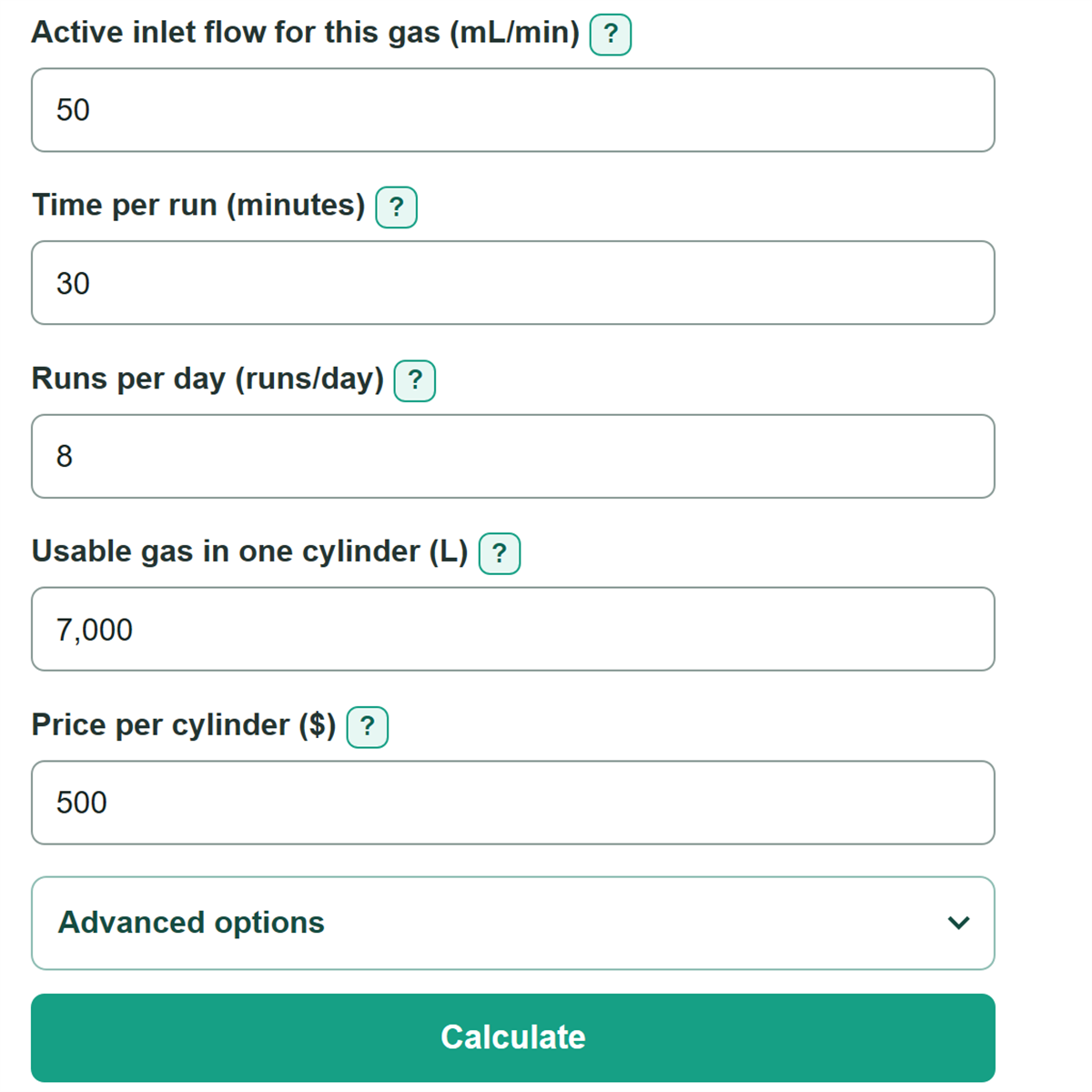
- Enter the combined Active inlet flow for this gas shown by your GC during a run, including inlet streams already included in its total-flow reading.
- Enter Time per run and Runs per day from the method and normal daily sequence schedule.
- Copy the supplier-stated Usable gas in one cylinder and your current Price per cylinder. Use gas volume, not the cylinder water capacity.
- Open Advanced options only if the same cylinder supplies standby flow, a detector, headspace equipment, or another accessory. Enter idle flow and idle time together.
- Click Calculate, then compare Total gas used per day with supplier records or measured use when available. A large difference can point to a missed load, a double-counted flow, or a leak.
Definitions
Active inlet flow: Total flow of the selected gas while a GC run is active. It can include carrier, split, purge, and septum-purge flow when the instrument reports them together.
Idle flow: Flow of the selected gas while the GC is in standby, sleep, or another non-running state.
Usable gas in one cylinder: Supplier-stated amount of gas available from one cylinder, measured in liters (L). This is different from the cylinder's water capacity.
Combined flow during active runs: Active inlet flow plus any entered detector, headspace, and other equipment flow supplied by the same cylinder.
Gas cost per run: Cylinder purchase cost assigned to one run, including entered idle gas spread across the entered daily run count.
Common mistakes and quick fixes
Mistake: Entering only column flow in Active inlet flow for this gas while split, purge, or septum-purge flow also comes from the same cylinder.
Fix: Enter the combined active inlet total shown by the GC, or add the applicable inlet streams before entering it.
Mistake: Using cylinder water capacity for Usable gas in one cylinder.
Fix: Use the supplier-stated gas quantity in L at its stated reference condition.
Mistake: Filling in Total idle flow for this gas but leaving Idle time per day blank.
Fix: Check Active inlet flow for this gas and then recalculate. Enter both idle values, or clear both fields if no idle schedule is included.
Mistake: Letting Time per run multiplied by Runs per day overlap with Idle time per day.
Fix: Count only non-running time as idle time; active and idle time together cannot exceed 24 hours.
Mistake: Adding Detector flow using this gas when that flow is already included in Active inlet flow for this gas.
Fix: Count each same-gas stream once. Check Combined flow during active runs before relying on the cost estimate.
Mistake: Treating Price per cylinder as the full delivered cost.
Fix: Enter only the gas purchase price. Delivery, rental, demurrage, regulators, and manifold charges are not included in Estimated annual gas cost.
Limitations & Key Assumptions / Boundary Conditions
- The estimate uses the flow, run time, schedule, cylinder gas volume, and cylinder price you enter. It does not measure actual gas use.
- Leaks, supply-line losses, unlisted inlet streams, and omitted equipment loads can make actual consumption higher.
- Idle gas is zero unless both idle inputs are entered. Do not include idle hours that overlap active run time.
- Annual cost applies the entered daily schedule to 365 days. Change runs per day and idle time to reflect your average operating day.
- Cost includes only the usage-dependent cylinder purchase price. It excludes delivery, rental, demurrage, regulator, manifold, taxes, and other fixed or stepwise charges.
- Flows entered for detector, headspace, and other equipment must use the same gas and the same cylinder being planned. Do not count a flow twice.
Methodology
Calculation method
The calculator changes flow in mL/min into gas volume in L/day, then compares that daily use with the entered usable cylinder volume. Blank optional detector, headspace, and other equipment flows count as 0. Both idle fields must be blank or both must have values.
active_minutes_per_day = run_minutes * runs_per_day
active_flow_total = active_inlet_flow + detector_flow + headspace_flow + other_aux_flow
active_gas_per_day = active_flow_total * active_minutes_per_day / 1000
idle_gas_per_day = idle_total_flow * idle_hours_per_day * 60 / 1000
total_gas_per_day = active_gas_per_day + idle_gas_per_day
cylinder_life_days = cylinder_gas_volume / total_gas_per_day
annual_gas_cost = total_gas_per_day * 365 * cylinder_price / cylinder_gas_volume
gas_cost_per_run = total_gas_per_day * cylinder_price / cylinder_gas_volume / runs_per_day
Worked example
With 50 mL/min active inlet flow, 30 minutes per run, and 8 runs per day, active time is 240 minutes per day. Active gas use is 50 * 240 / 1000 = 12 L/day. A 7,000 L cylinder therefore lasts about 583.3 days before any idle or auxiliary loads are added. At $500 per cylinder, the estimated gas cost is about $0.11 per run and $312.86 per year when this schedule is used every day.
Checks before calculation
Core values must be greater than 0. Optional flows must be 0 or more. Active run time plus entered idle time cannot exceed 24 hours per day, because overlapping time would count gas use twice.