
Calculate the solid reagent mass for a target stock solution using final volume, hydrate water, formula weight, and purity.
Table of contents
How to use our Laboratory Stock Solution Purity and Hydration Calculator
- Enter the Target concentration and choose the same Concentration unit used in your protocol.
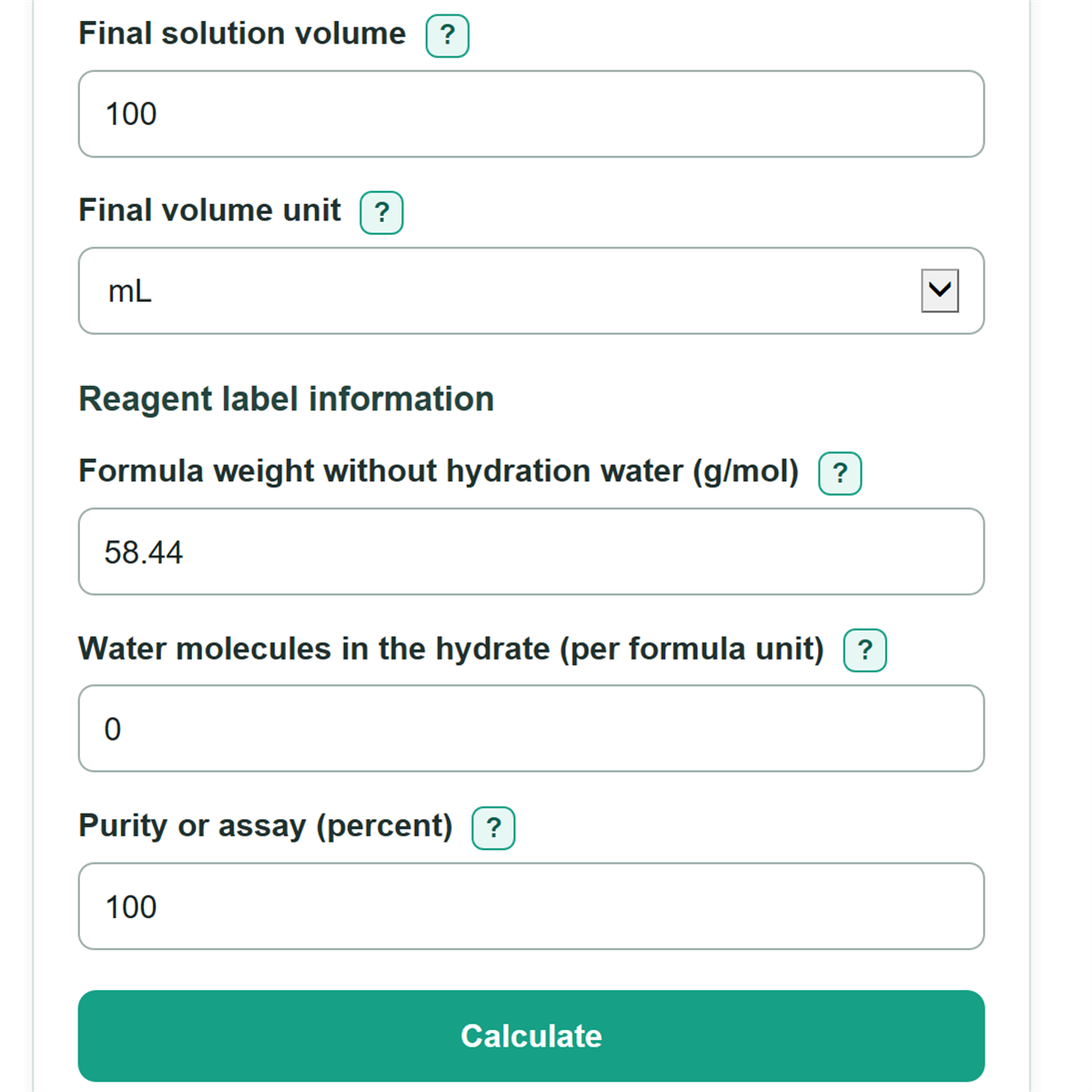
- Enter the planned Final solution volume, then choose its Final volume unit. This is the completed solution volume, not the solvent added first.
- Copy the Formula weight without hydration water, Water molecules in the hydrate, and Purity or assay from the exact reagent label or current lot certificate of analysis.
- Click Calculate. Weigh the displayed Purity-corrected mass to weigh, dissolve it in less than the final volume, then add solvent until the full solution reaches the displayed final volume.
- Sanity-check that the Molar mass used after hydration correction matches the material in hand and that the gram and milligram mass values agree with your balance range.
Definitions
Target concentration: The planned amount of dissolved substance per final volume of solution.
Molarity (M): Concentration in moles per liter of final solution. A millimolar (mM) is 0.001 M; a micromolar (uM) is 0.000001 M. [1]
Final solution volume: The total volume after the solid dissolves and solvent is added to the final mark.
Formula weight without hydration water: The molar mass of the non-water part of the exact material being weighed, in g/mol.
Water molecules in the hydrate: The number of bound water molecules per formula unit, such as 5 for a pentahydrate.
Purity or assay: The percentage of the weighed reagent that is the target compound used for the mass correction.
Moles: A chemistry amount unit. The calculator finds the needed moles from concentration and final volume before converting them to mass.
Common mistakes and quick fixes
Mistake: Entering the amount of solvent added first as the Final solution volume.
Fix: Enter the volume after dissolving and bringing the whole solution to its final mark.
Mistake: Copying a formula weight that already includes water into Formula weight without hydration water, then also entering a hydrate count.
Fix: Use the non-water formula weight and enter the exact Water molecules in the hydrate only once.
Mistake: Using the formula weight for a different salt, acid, base, or anhydrous form.
Fix: Match Formula weight without hydration water and Water molecules in the hydrate to the exact bottle label.
Mistake: Leaving Purity or assay at 100 when the current lot has a lower assay.
Fix: Enter the applicable percentage from the current lot certificate of analysis or label.
Mistake: Reading a 100 mM protocol as 100 M by choosing the wrong Concentration unit.
Fix: Check the unit beside the concentration number before calculating.
Mistake: Treating a very small Purity-corrected mass in milligrams as automatically weighable.
Fix: Check that an appropriate balance can reliably weigh that amount under your laboratory procedure.
Limitations & Key Assumptions / Boundary Conditions
- The calculation assumes the entered formula weight, hydrate count, and purity or assay all describe the exact reagent lot being weighed.
- It calculates a planned mass only. It does not test solubility, chemical stability, compatibility, storage conditions, reaction hazards, or safe handling.
- The entered Final solution volume is the completed solution volume. Dissolving a solid can change volume, so do not add the full final volume of solvent before making up the solution.
- A displayed small mass may be below the reliable range of a balance. Use a suitable balance and laboratory procedure, or prepare an appropriate intermediate stock when allowed by the protocol.
- The hydration correction uses 18.01528 g/mol for each water molecule. The calculator does not read chemical formulas or verify hydrate, salt, acid, or base identity.
- Purity correction assumes the assay percentage is the active mass fraction for the target compound. Follow the product documentation when the certificate reports assay on a different basis.
Methodology
Calculation steps
The calculator converts the selected concentration to mol/L and the selected final volume to L. Molarity is moles of solute divided by liters of solution. [1]
concentration_mol_per_l = target_concentration x unit_factor
final_volume_l = final_solution_volume x unit_factor
It adds the mass of bound water to the non-water formula weight.
hydrated_molar_mass = base_molar_mass + water_molecules_in_hydrate x 18.01528 g/mol
It then finds the moles needed, calculates the mass for a pure reagent, and divides by the assay fraction.
moles_needed = concentration_mol_per_l x final_volume_l
theoretical_mass_g = moles_needed x hydrated_molar_mass
mass_to_weigh_g = theoretical_mass_g / (purity_or_assay_percent / 100)
mass_to_weigh_mg = mass_to_weigh_g x 1000
Worked example
For 500 mL of 100 mM solution made from an anhydrous reagent with formula weight 58.44 g/mol and 100 percent purity, the calculator converts to 0.5 L and 0.1 mol/L. Needed moles are 0.05 mol, so the mass to weigh is 2.922 g, or 2,922 mg.
Preparation use
Weigh the purity-corrected mass, dissolve it in less than the requested final volume, and then add solvent until the complete solution reaches that final volume. This keeps the concentration based on the final volume rather than the starting solvent amount.
Calculation boundaries
The method requires positive concentration, volume, and formula weight; a hydration count of zero or more; and purity above 0 percent through 100 percent. It does not round intermediate values before the mass calculation, but displayed values may be rounded for readability.